The Guild of Merchant Explorers
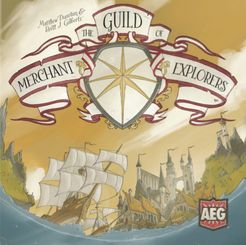
The Guild of Merchant Explorers is a simultaneous map-exploration strategy game. Players follow exploration cards to place explorers across grassland, desert, mountain, and sea, founding villages, connecting cities, and visiting ruins and discovery sites. Explorers reset each era while lasting settlements remain, letting each player extend a trade network across four eras.
The Guild of Merchant Explorers supports 1–4 players; community best: 2 players; playing time: 45 minutes. A WANGO browser trial has not been confirmed.
Background & introduction
The old maps of Tigomé no longer connect its cities and trading routes, so the Queen calls on the Guild of Merchant Explorers to survey the kingdom. In The Guild of Merchant Explorers, each player plans routes on a personal map while responding to the same exploration card revealed for the whole table. A card may ask players to explore particular terrain, move in a straight line, or place a chain of adjacent explorers. Everyone faces the same action, but each map has its own terrain, cities, and existing villages, so the opportunity differs from player to player.
Explorers cannot be scattered freely across the map: they must extend outward from the capital, a village, or an existing explorer network. Completing every space in a connected land region can let a player found a village, which becomes a new starting point in later eras. Connecting cities, searching ruins for treasure, visiting discovery sites, and building towers can produce coins or other rewards. The exploration deck grows as the game moves through four eras; explorers return to their supply between eras, while villages, trading posts, treasure markers, and towers stay on the map.
The maps include grassland, desert, mountain, and sea, along with spaces such as coins, cities, ruins, and discoveries. Players read each card’s terrain and placement requirements and check adjacency one explorer at a time. A new village changes future routes, a connected city route can turn exploration into income, and a ruin may offer an immediate effect or endgame value. The map layouts and goal cards vary, so an exploration action is not equally valuable in every location.
The game is a puzzle of personal route planning and a race for shared opportunities rather than direct movement or blocking on another player’s map. Exploration cards provide a common constraint each turn, while lasting settlements create continuity across eras: fill in a region to earn a village or reward now, then use that fixed point to reach more distant cities and discoveries later. After four eras, players compare their coins. AEG lists the base game for one to four players and includes components for solo play; expansions add more maps, goals, or player options.
Core rules & scoring
Objective and flow: Explore a personal map over four eras, founding villages, completing city connections, visiting ruins and discovery spaces, and collecting coins. The exploration deck determines the turns in an era. Each time a card is revealed, every player simultaneously places explorers according to the same action. After the fourth era, the player with the most coins wins. Map layouts and era cards create different route opportunities, so players balance expansion, rewards, and future space.
Setup: Each player chooses a map and takes matching village markers and explorers. Place the Exploration Board, era cards, exploration cards, Investigate cards, Treasure cards, discovery towers, trading posts, coins, and other markers within reach. Prepare goal cards for the selected map and build the Era I exploration deck as instructed. AEG recommends Avenia for a first game; other maps use different terrain and spatial layouts.
Exploration cards and simultaneous turns: One player reveals an exploration card and places it on the matching space of the Exploration Board. All players inspect the same card and resolve its exploration action on their own map at the same time. A card may require explorers of a specified terrain, adjacent spaces, or a straight line of sea spaces. Place explorers one by one and resolve map rewards as soon as they are triggered, without waiting for the entire action to finish.
Golden rules of exploration: Each new explorer must be adjacent to one of your villages, your capital, or explorers; the capital remains a starting point in every era. Explorers must go on legal open spaces and cannot cover villages or discovery towers. Place as many explorers as the action allows while following all terrain and arrangement requirements. You may choose to place fewer, but unused placements cannot be saved for a later turn.
Terrain and routes: Maps show grassland, desert, mountain, and sea. Basic explore cards restrict which terrain or arrangement is allowed; for example, a sea action may require a straight line, while an any-adjacent-space action may cross terrain types. The capital and each village can serve as a starting point. Once you discover a village, you can explore from it later even if it is not connected to your current explorers. Permanent villages remain usable as starting points in every later era.
Villages and cities: When you explore every space in a connected land region during one era, including its city spaces, you must replace one explorer with a village marker. The village must go on a blank space, and a region can contain only one village. Earn the number of coins shown for that village in the map’s score area for the current era. A network of explorers, villages, and the capital that connects two cities between two cities without trading posts must score their values multiplied together, then place a trading post on one city; a city with a trading post cannot score another route. Villages remain for the rest of the game and extend future routes.
Coins, ruins, and discovery towers: Coin spaces award the number shown. Exploring a ruin draws a Treasure card, which may have an immediate effect or provide an endgame reward; a marked ruin normally does not yield another new treasure when explored again. When you explore a discovery space, return the explorer to your supply, place a discovery tower, and earn coins according to the map. A built tower remains and cannot be explored again. Trading posts, villages, and other spaces resolve using the rules for that map or card.
Era cards and Investigate cards: The exploration deck expands over the eras. The first time an era card appears, each player draws two Investigate cards, chooses one, and resolves its special explore action. Place the chosen card in the matching era position and use it again when the corresponding era card appears later. In Era IV, a wild era card lets you reuse one of the Investigate actions already chosen. These cards add route options but never override the Golden Rules of exploration.
End of an era: When the exploration deck is empty, the era ends. Return all explorers from your map to your personal supply. Villages, trading posts, treasure markers, and discovery towers stay in place. Build the next era’s exploration deck using the corresponding era cards and the basic explore cards. Permanent nodes let you start the next era from a new village, so each era can establish another network instead of treating explorers as permanent roads.
Endgame and solo scope: After the final exploration deck is exhausted in Era IV, compare the coins collected; the player with the most wins; ties go to more discovery towers, then more villages, then a shared victory. The official AEG page lists 1–4 players and notes solo-mode era markers. This entry summarizes the shared exploration procedure rather than the solo challenge’s separate scoring. AEG’s Queen’s Special Orders and Party Pack are separate expansions; their maps and player-count rules are not part of the base game.
Rules & gameplay questions
How do you play The Guild of Merchant Explorers?
A card is revealed each turn, and everyone simultaneously places explorers on their own map according to its action. Start from your capital, villages, or connected explorers to expand, found new villages, connect cities, and visit ruins or discovery sites. Explorers return to supply after each era, but lasting settlements remain. The player with the most coins after four eras wins.
What happens in the four eras?
The game has four eras, and the exploration deck grows as new era cards are added. The cards change the actions players must carry out and also introduce Investigate cards that provide special explore actions. At the end of an era, explorers return to supply, but villages, trading posts, treasure markers, and discovery towers stay on the map. These lasting points let players continue from new locations in the next era.
Can I place an explorer on any empty space?
No. Each new explorer must be adjacent to one of your villages, your capital, or your explorers; the capital is available as a starting point in every era. The card may also restrict terrain or require a particular formation. Place explorers one at a time, and do not cover villages or discovery towers. You may place fewer than the action allows, but you cannot save unused placements for another turn.
How do I found a village?
If you explore every space in a connected land region during the same era, including city spaces in that region, you must replace one of your explorers with a village marker. The village can only go on a blank space, and each region can have only one. Take the coins shown for the current era on your map. The village remains and gives you a new place to start future explore actions.
What do city, coin, and ruin spaces do?
A coin space gives the amount shown, while connecting two cities through your explorers, villages, and capital when both cities have no trading post scores their values multiplied together; place a trading post on one city, which cannot score another route. Exploring a ruin lets you draw a Treasure card, which may resolve immediately or score at the end. Maps also include discovery spaces: when explored, they return an explorer to supply, place a tower, and give coins according to the map; a tower cannot be explored again.
Which pieces remain after an era?
At the end of each era, return all explorers from the map to your supply so you can place them again in the next era. Villages, trading posts, treasure markers, and discovery towers remain through the end of the game. These lasting pieces provide rewards and change where you can begin exploring. A new village can open distant parts of the map without requiring explorers to stay connected across eras.
What do Investigate cards do?
When an era card appears for the first time, draw two Investigate cards and choose one to resolve as a special exploration action. Place it in the matching era area; when that era card appears later, use the chosen action again. In Era IV, a wild era card lets you reuse one of the Investigate cards you already chose. The actions add options but still follow terrain and adjacency rules.
Can I play solo?
The base game is listed for one to four players, and AEG’s product page includes solo-mode era markers. Multiplayer games use the same revealed exploration card while each player works on a personal map. Solo play has its own challenge pacing and scoring procedure, so use the official solo rules for those details; this overview focuses on the shared base-game exploration loop.
How is the winner determined?
After the exploration deck for Era IV is exhausted, players reveal and compare the coins they have collected. The player with the most coins wins. Ties go to more discovery towers, then more villages, then a shared victory. Coins can come from connected cities, villages, discovery spaces, treasure cards, and map objectives. Explorers themselves are not a separate final score, so players need to create legal routes and trigger valuable map features as the game advances.
Are The Queen's Special Orders or Party Pack in the base box?
No. The Queen's Special Orders adds extra maps, islands, or objectives, while Party Pack is a separate expansion that supports a larger group. AEG lists them in the expansions area of its product page. This entry describes the four-era procedure of base SKU AEG 7102; use the rules included with an expansion for its maps, goals, and player-count changes.
Rules & introduction sources
- Edition
- This entry covers AEG base game SKU AEG 7102. AEG’s current product page lists 1–4 players, ages 14+, and about 45 minutes; the four-era coin race and simultaneous exploration procedure follow the publisher’s base rules. Solo support is confirmed by the official product information, but this entry does not detail its separate solo procedure. The Queen's Special Orders, Party Pack, and other expansions are outside scope.
- Rule references
- Introduction source
- BoardGameGeek
WANGO editorial
| Parameter | Recorded value |
|---|---|
| BGG overall rank (snapshot) | #364 |
| Complexity Weight | 2.05 / 5 |
| Best player count (community) | 2 |
| Player range | 1–4 |
| Playing time (minutes) | 45 |
| Core mechanisms | Bingo · Chaining · Hexagon Grid · Hidden Victory Points · Line Drawing · Network and Route Building · Pattern Movement · Solo / Solitaire Game |
| Chinese publication | Unconfirmed |
| WANGO browser play | No confirmed WANGO trial |
| Year published | 2022 |
| Suggested age | 14+ |
BGG statistics are stored snapshots, not live rankings. Source checked:2026-09-27
Player questions
What is the best player count for The Guild of Merchant Explorers, and can I play online?
The Guild of Merchant Explorers supports 1–4 players; community best: 2 players; playing time: 45 minutes. A WANGO browser trial has not been confirmed. Recorded mechanism tags: Solo / Solitaire Game.
How complex is The Guild of Merchant Explorers, and which mechanisms does it use?
Weight: 2.05 / 5. Mechanisms: Bingo · Chaining · Hexagon Grid · Hidden Victory Points · Line Drawing · Network and Route Building · Pattern Movement · Solo / Solitaire Game. Chinese publication: Unconfirmed.
Where can I learn The Guild of Merchant Explorers?
No rule guide, strategy article or WANGO trial has been confirmed for this record.