Wayfarers of the South Tigris
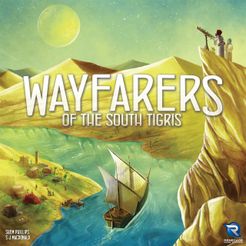
Wayfarers of the South Tigris combines dice placement, worker placement, and tableau building. Explore Land, Water, and Space, upgrade your Caravan, and compete for Guild prestige.
Wayfarers of the South Tigris supports 1–4 players; community best: 2 players; playing time: 60–90 minutes. A WANGO browser trial has not been confirmed.
Background & introduction
Wayfarers of the South Tigris follows a caravan exploring and mapping routes across Land, Water, and Space. Players record discoveries through map cards and travel markers while improving their Caravan, building Influence, and completing Inspiration goals. Each region offers a different path: expand the map, gain resources and abilities, or pursue celestial discoveries and Guild rewards. Scoring comes from several overlapping systems rather than a single measure of route length.
On each turn, a player chooses one of three main options: place a die, place a worker, or Rest. Dice can be assigned to Caravan spaces or acquired cards, where their face and the player’s assets determine available actions. Workers go to eligible spaces on the personal board or face-up cards, and their color determines which icons can be used. Influence competes for cards and Guild positions, while Silver, Provisions, two worker colors, and five dice all require careful planning. Players can also advance their Journal marker to meet requirements and claim rewards.
The game end is triggered when someone reaches one of the five final spaces at the far right of the Journal Track. After the trigger player completes the turn, everyone takes one final turn. Players score Land and Water tags, Space cards, completed Inspiration goals, Comet majorities, Caravan upgrades, and Guild control. The rulebook also includes a full solo competitive simulation: the AI uses Scheme Cards to select prioritized actions, so the base game supports solo play without an expansion.
Core rules & scoring
Objective and victory: Explore and map Land, Water, and Space, upgrade the Caravan, complete Inspiration goals, and compete for majorities in three Guilds. Score from map markers, Space cards, goals, Comets, Caravan tiles, and Guild control. The end is triggered when a player reaches one of the five final spaces at the far-right end of the Journal Track; after that player finishes the turn, everyone gets one final turn.
Setup: Set out the Main Board and five card displays, revealing four cards in each display. Each player takes a player board, Caravan, Journal marker, Influence, yellow and blue workers, and five dice; roll three dice and keep two in reserve. Starting Silver, Provisions, and other resources vary by turn order. The base game supports 1–4 players and includes a solo AI setup. Turns proceed clockwise.
Main turn choice: On a turn, choose exactly one main option: place one die, place one worker, or Rest. A die or worker may permit several printed actions, which can be resolved in an allowed order; optional actions may be skipped. Do not treat the main choice as limiting the turn to one small effect, since a single placement can enable multiple rewards or actions.
Dice placement: Place a die in an unoccupied Caravan space or on an eligible acquired card. The die face and assets already on the Caravan determine which spaces and effects are available; some require a Camel, Telescope, or Ship. Resolve action costs and linked effects in any order allowed by the rules. Each turn, one Yellow Influence may adjust a die by up to two without wrapping from 6 back to 1.
Worker placement: Place a worker on an eligible face-up card around the Main Board, never on your own player board or acquired panorama cards. Space cards cannot receive workers. The card’s row and the worker’s color determine the legal action; Green workers can use Townsfolk, Land, Water or Inspiration spaces, Yellow can use Land or Inspiration, and Blue can use Water or Inspiration, subject to each card’s available colored spaces. Resolve at least part of the printed action. A worker placed this turn cannot be retrieved during that same turn.
Influence and the Journal: Spend Influence to claim cards, Guild positions, or meet Journal Track requirements. If an opponent uses a card bearing another player’s Influence, they must pay that player one Silver or one Provision. Journal advances require the printed tags or Influence and grant the listed rewards. Each of the five final Journal spaces can be occupied by only one player, and reaching one triggers the endgame sequence.
Resting and dice recovery: Rest is the third main option. Rest abilities activate only if you have zero or one die remaining in your supply; with two or more dice they do not activate. Return dice from the Panorama to your supply and roll those returned dice; you may also reroll dice still in supply, then resolve available Rest abilities. Rest is a main turn choice rather than an extra action, so consider both the dice refresh and the lost placement opportunity.
Regional development: Use dice and workers to acquire, place, and use cards in the Land, Water, and Space systems. Caravan upgrades add assets or spaces that unlock later dice actions. Influence contests cards and Guild positions, while Silver and Provisions pay action costs or card interactions. Cards can provide tags, actions, or scoring effects; before placement, check the required resource, icon, and available space.
Guild and other scoring: At game end, score Land and Water tags, Space cards, completed Inspiration goals, Comet cards and Comet-marker majorities, and Caravan upgrade tiles. Each Guild majority is worth 3 VP; a tied Guild majority earns no Guild points. Ties in total VP are broken in order by Black, Yellow, and Blue Influence. If those are still tied, the players share the win.
End timing and solo: When a player reaches one of the five far-right Journal spaces, finish that turn, then give every player—including the trigger player—one final turn before scoring. For solo, use the AI side of the player board and the six Scheme Cards. The AI follows card priorities to move markers, gain resources, and take actions; it is a competitive opponent simulation included in the base rulebook. Tides of Trade is a separate expansion.
Rules & gameplay questions
What is the objective of Wayfarers of the South Tigris?
Explore Land, Water, and Space, improve your Caravan, complete Inspiration goals, and compete for majorities in three Guilds. Final points combine map tags, Space cards, Comet markers, Caravan upgrades, and Guild control. Reaching one of the five far-right Journal Track spaces triggers the end, but the trigger player must finish the current turn and everyone then takes one final turn before scoring.
Does the base game have an official solo mode?
Yes. The base rulebook contains a complete solo AI procedure. Set up as a two-player game and use the AI side of the player board, AI markers, and six Scheme Cards. The AI does not use player dice, Silver, or Provisions; it follows priorities on the Scheme Cards to move markers, gain resources, and take actions. This is a competitive opponent simulation and does not require Tides of Trade.
What main options can I choose on my turn?
Choose exactly one main option: place a die, place a worker, or Rest. A die or worker can then activate more than one printed action, and some optional actions may be skipped; those effects do not change the main option you selected. Before placing, check the space requirements, die face, worker color, and resources, then resolve the action and its rewards according to the rules.
Where can dice go, and what does the die face do?
A die goes on an unoccupied Caravan space or on an eligible acquired card. Its face and the assets on your Caravan determine which spaces can be used; some spaces require a Camel, Telescope, or Ship. Costs and linked actions may be resolved in any permitted order. Once per turn, you may spend one Yellow Influence to adjust one die by up to two, without wrapping across the 6-to-1 boundary.
How is worker placement different from dice placement?
Workers go on eligible face-up cards around the Main Board, while dice go on your own legal dice spaces. You cannot place a worker on Space cards or your own player board. Green, Yellow and Blue workers have different allowed rows and each card has limited colored spaces. You must resolve at least one part of the printed action. Once placed, a worker becomes a shared resource, but the worker just placed cannot be retrieved by any means during that same turn.
What do Influence and the Journal Track do?
Influence helps claim cards, Guild positions, and satisfy requirements on the Journal Track. If an opponent uses a card carrying another player’s Influence, the opponent must pay its owner one Silver or one Provision. Journal advances require the printed tags or Influence and grant rewards along the track. Each of the five final spaces is exclusive, and occupying one of them starts the endgame sequence.
When do Rest abilities work?
Rest is one of the three main turn options. Its Rest abilities activate only when you have zero or one die left in your supply; they do not activate if you have two or more. During Rest, return dice from the Panorama to your supply and roll them, optionally reroll the dice that were already in supply, and then resolve available Rest abilities. Rest refreshes your dice but uses your main option for the turn.
How do Guild majorities and other endgame points work?
Final scoring includes Land and Water tags, Space cards, completed Inspiration goals, Comet cards and marker majorities, and Caravan upgrade tiles. A Guild majority is worth 3 VP; if players tie for that majority, no one scores the Guild points. If total VP is tied, compare Black Influence first, then Yellow, then Blue. A tie after all three Influence colors is a shared victory.
Does the game end immediately when someone reaches the Journal’s final spaces?
No. Reaching any of the five far-right Journal spaces triggers the end, but the player must complete the current turn. Then every player, including the one who triggered the end, takes one final turn in order. Only after those turns are finished does the game proceed to final scoring. Because each final space can hold only one player, Journal progress also affects the timing of the ending.
How many players and how long does it take? Are expansions required?
Garphill lists 1–4 players and 60–90 minutes. Renegade lists 1–4 players, age 12+, and 60 minutes, while BGG lists age 13+, so the published duration and age metadata differ. Solo AI is in the base rulebook. Tides of Trade and promo cards are separately listed products; their additional content should not be treated as required parts of the base game.
Rules & introduction sources
- Edition
- This entry covers the 2022 base game listed as BGG 350316, using Garphill Games / Renegade rulebook and product materials. Garphill lists 1–4 players and 60–90 minutes; Renegade lists 1–4 players, age 12+, and 60 minutes; BGG lists age 13+, so duration and age metadata differ. The base rulebook includes a solo AI mode with six Scheme Cards; no expansion is needed for solo. Tides of Trade and promo cards are separate products and are not included here. The official rulebook endpoint linked by Renegade was too large to parse directly; page references were checked against a readable copy bearing the same copyright, as documented in the source note.
- Rule references
- Garphill Games — Wayfarers of the South Tigris official base-game page
- Renegade Game Studios — Wayfarers of the South Tigris retailer product page and official rulebook link
- Garphill Games / Renegade — Wayfarers of the South Tigris rulebook, 24-page English copy, pp. 2–24
- BoardGameGeek — Wayfarers of the South Tigris, game ID 350316
- Garphill Games — Tides of Trade expansion page, for scope separation
- Introduction source
- BoardGameGeek
WANGO editorial
| Parameter | Recorded value |
|---|---|
| BGG overall rank (snapshot) | #347 |
| Complexity Weight | 3.81 / 5 |
| Best player count (community) | 2 |
| Player range | 1–4 |
| Playing time (minutes) | 60–90 |
| Core mechanisms | Area Majority / Influence · End Game Bonuses · Modular Board · Open Drafting · Race · Set Collection · Solo / Solitaire Game · Tags · Tile Placement · Track Movement · Worker Placement with Dice Workers · Worker Placement, Different Worker Types |
| Chinese publication | Unconfirmed |
| WANGO browser play | No confirmed WANGO trial |
| Year published | 2022 |
| Suggested age | 13+ |
BGG statistics are stored snapshots, not live rankings. Source checked:2026-09-27
Player questions
What is the best player count for Wayfarers of the South Tigris, and can I play online?
Wayfarers of the South Tigris supports 1–4 players; community best: 2 players; playing time: 60–90 minutes. A WANGO browser trial has not been confirmed. Recorded mechanism tags: Solo / Solitaire Game.
How complex is Wayfarers of the South Tigris, and which mechanisms does it use?
Weight: 3.81 / 5. Mechanisms: Area Majority / Influence · End Game Bonuses · Modular Board · Open Drafting · Race · Set Collection · Solo / Solitaire Game · Tags · Tile Placement · Track Movement · Worker Placement with Dice Workers · Worker Placement, Different Worker Types. Chinese publication: Unconfirmed.
Where can I learn Wayfarers of the South Tigris?
No rule guide, strategy article or WANGO trial has been confirmed for this record.