Stone Age
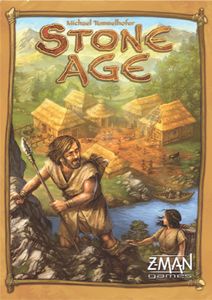
Guide a prehistoric tribe through competing demands for labor, food and development. Dice determine each harvest, while civilization cards turn the shape of your village into final points.
Stone Age supports 2–4 players; community best: 4 players; playing time: 60–90 minutes. A WANGO browser trial has not been confirmed.
Background & introduction
Stone Age combines worker placement with dice-based gathering. Players first allocate their people in alternating turns, then resolve their own locations in a chosen order. A larger group rolls more dice, but leaves fewer people available elsewhere. Limited village spaces make immediate supplies compete with permanent improvements.
Wood, clay, stone and gold use progressively larger divisors to convert a dice total into resources. Tools can bridge the gap to another unit, so resolution order matters: acquiring a tool before gathering may improve a roll later in that same round.
Growing the tribe expands future placement options and also increases its food bill. Buildings award immediate points; civilization cards reward cultural diversity or multiply particular aspects of development. Reading the remaining stacks helps players judge how much time an investment has to pay off.
Core rules & scoring
The original base game supports 2–4 players. Each starts with five people, twelve food, zero agriculture and zero points. Prepare one seven-tile building stack per player.
Each round proceeds through placement, action resolution and feeding. In clockwise placement turns, commit the required people to one location. You cannot add people to a location where you already have people that round.
The tool maker and field each hold one person; the hut requires two of one color placed together. Each resource site holds seven people, hunting has no capacity limit, and each displayed civilization card or building holds one.
After placement, the first player resolves all their locations before the next player does so. Resolve your locations in any order and return the people after their actions.
Roll one die per person gathering. Add any tools used, then divide by two for food, three for wood, four for clay, five for stone or six for gold, rounding down. Each tool tile can be used in full only once per round.
The field raises agriculture by one. The hut adds a person for placement in future rounds. Buy civilization cards with the resources required by their position; food cannot pay for cards or buildings. Buildings award points immediately after their required payment.
For feeding, collect food equal to agriculture, then pay one food per person. Spend all available food first; resources may cover the shortfall one for one. An unpaid shortfall costs ten points, regardless of how many people remain unfed.
Pass first player clockwise. Before the next round, slide remaining civilization cards right, refill to four and reset tools. If cards cannot refill, end before that new round. If a building stack empties, finish the current round, including feeding, before ending.
Add civilization scoring: each set of different green cultural symbols scores its size squared, with duplicates forming further sets. Sand-background figures multiply agriculture, total tool value, buildings or people as appropriate. Each leftover non-food resource scores one; highest total wins.
With two or three players, use only two of the tool maker, hut and field each round. Resource sites may hold at most two players in a three-player game and one in a two-player game. Break a score tie by the combined agriculture level, total tool value and number of people.
Rules & gameplay questions
Can I add more people to the forest later?
No. Choose the size of the group when placing it. Even with empty spaces, you cannot add to your own group at that location during the same round.
Can I split a tool between two rolls?
No. Use its full value on one gathering roll, then it is unavailable for the rest of the round. Several unused tools may improve the same roll.
Does a food shortage remove people?
No. Pay all food you have, then decide whether to cover the shortfall with resources. Leaving it unpaid costs ten points for the round, rather than a penalty per person.
Can a newborn person be placed immediately?
No. Birth occurs during action resolution, after placement has finished. The additional person can be placed in future rounds, but is already included in feeding this round.
Does an empty building stack stop play immediately?
No. Finish that round and its feeding. Failing to refill four civilization cards at the start of a new round instead ends play before that round begins.
Rules & introduction sources
- Edition
- Original 2008 Stone Age base game, using the publisher’s currently linked English base manual (copyright 2008–2014; 2013 F2Z English edition). Includes two- and three-player adjustments; excludes the Anniversary edition, expansions and the separately published solo variant.
- Introduction source
- BoardGameGeek
WANGO editorial
| Parameter | Recorded value |
|---|---|
| BGG overall rank (snapshot) | #189 |
| Complexity Weight | 2.46 / 5 |
| Best player count (community) | 4 |
| Player range | 2–4 |
| Playing time (minutes) | 60–90 |
| Core mechanisms | Action Retrieval · Contracts · Dice Rolling · End Game Bonuses · Increase Value of Unchosen Resources · Set Collection · Turn Order: Progressive · Worker Placement |
| Chinese publication | Unconfirmed |
| WANGO browser play | No confirmed WANGO trial |
| Year published | 2008 |
| Suggested age | 10+ |
BGG statistics are stored snapshots, not live rankings. Source checked:2026-09-27
Player questions
What is the best player count for Stone Age, and can I play online?
Stone Age supports 2–4 players; community best: 4 players; playing time: 60–90 minutes. A WANGO browser trial has not been confirmed.
How complex is Stone Age, and which mechanisms does it use?
Weight: 2.46 / 5. Mechanisms: Action Retrieval · Contracts · Dice Rolling · End Game Bonuses · Increase Value of Unchosen Resources · Set Collection · Turn Order: Progressive · Worker Placement. Chinese publication: Unconfirmed.
Where can I learn Stone Age?
No rule guide, strategy article or WANGO trial has been confirmed for this record.