Cat in the Box: Deluxe Edition
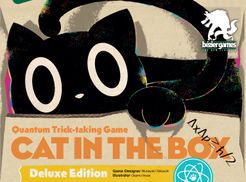
Cat in the Box: Deluxe Edition is a quantum trick-taking game in which cards have numbers but no fixed suits. Predict your tricks, claim color-number spaces on a shared research board, connect your tokens, and avoid a paradox.
Cat in the Box: Deluxe Edition supports 2–5 players; community best: 4 players; playing time: 20–40 minutes. A WANGO browser trial has not been confirmed.
Background & introduction
Cat in the Box: Deluxe Edition turns a trick-taking game into an experiment in observation and declaration. Every cat card has a number but no fixed suit. When a player actually plays a card, they declare that it is red, blue, yellow, or green. That choice is constrained by the shared research board: each number-and-color space may be used only once during a round. A single card therefore changes the legal possibilities for every player still holding cards.
At the beginning of a round, players inspect their hands and predict how many tricks they will win. They record that prediction on their player board, then play cards in turn and place their tokens on the corresponding spaces of the Research Board. The first color declared in a trick becomes its led color. Later players may follow it or, when legal, declare another color; changing color removes their ability to use the led color again for the rest of the round. Red is trump, but a player leading a trick usually cannot lead red until the red row has been opened.
The Research Board is both a record of combinations already observed and a scoring map. The winner of each trick collects its cards and leads the next one. If a player’s prediction is exactly right, they also score for their largest group of orthogonally connected tokens on the board. This gives players two linked goals: win the expected number of tricks while arranging claims that can still connect at scoring time.
A paradox occurs if a player discovers that none of the cards in their hand can be legally assigned a color. They reveal their hand and the trick phase stops immediately. Nobody wins the unfinished trick, and tokens already placed remain on the Research Board. The player who caused the paradox scores negatively for tricks won and loses the prediction bonus. The design makes every declaration a commitment: a flexible choice now can preserve options later, while a careless sequence may leave the hand with no legal play.
Core rules & scoring
Objective and scope: Players try to score the most points over a number of rounds equal to the player count. Bezier Games lists Deluxe Edition for 2–5 players; each trick is worth a point, and a correct prediction can score a connected-token bonus from the Research Board. This summary covers the 2022 base rules and excludes later Colossal expansion modules.
Round setup: The number of rounds equals the number of players, and the Round Start Player rotates. Use cards by player count: two players use 1–5, three use 1–6, four use 1–8, and five use 1–9. Deal ten cards to each player except in a five-player game, which deals nine. Everyone secretly sets aside one card that is not used this round, then predicts their trick total in clockwise order. Two-player games skip prediction and use their special bonus rule.
Play and claim a space: The Round Start Player leads a card and declares its color; all other players play one card clockwise and declare a color. Place your played card by that color on your player board and put one of your tokens on the matching number-and-color space on the shared Research Board. That space must be empty, and your player board must still show a token on that color’s X, meaning you have not given up that color this round.
Leading color: The first color declared in a trick is its led color. A player leading a trick normally may declare blue, yellow, or green, but not red trump. They may lead red if any token is already in the red row of the Research Board, or if none of the cards in their hand could be legally declared as another color. Following players may declare any color that satisfies the empty-space and remaining-color rules.
Following or changing color: A player who declares a color different from the led color removes the token from that led-color X on their player board. They may no longer declare that color for the rest of the round. Cards have no printed suits, so players are not simply following a suit printed on a card; instead, every declaration both determines the current trick and restricts that player’s later hand.
Winning a trick: If everyone declares the led color, the highest number wins. If multiple colors appear, red trump is strongest, the led color is next, and all other colors are weaker; compare numbers only among the cards in the strongest color. The winner collects all cards in the trick and becomes the lead player for the next trick. The Round Start Player card stays where it is.
Trick phase and paradox: Normally, continue until each player has one card remaining. If a player cannot legally declare a color for any card in their hand, a paradox occurs: they reveal the hand, the current unfinished trick has no winner, and the round proceeds to scoring. Research Board tokens already placed remain in place. A player cannot intentionally create a paradox if a legal card can be played.
Round scoring and two players: Each won trick is worth one point. If a player’s prediction was correct, score one point for each token in their largest orthogonally connected group on the Research Board; diagonal connections do not count. A player who caused a paradox instead loses one point per trick won and forfeits the prediction bonus. In a two-player game there is no prediction: each player who wins four or fewer tricks earns the connected-group bonus.
End of game: After every player has been the Round Start Player once, add the round scores. The highest total wins. If tied, compare the tied players’ scores in the final round; if they remain tied, they share victory. At each round’s end, retrieve tokens from the boards, reset the color markers, and pass the Round Start Player card to the player on the left.
Rules & gameplay questions
Which version of Cat in the Box does this entry cover?
This summary covers Bezier Games’ 2022 Cat in the Box: Deluxe Edition and its official base rulebook. It supports two to five players with personal color boards and a shared Research Board. The later Colossal edition has separately sold String Theory and Doppler Effect modules and changed the five-player board and card range; those rules are not included here.
When is a cat card’s color decided?
A card has a number but no fixed color. The player declares its color when playing it. The declaration must use a number-and-color space that is still empty on the Research Board, and the player must still have that color token on their own board. A combination can be declared only once in the round, so each play affects the legal options available to everyone.
What is the reward for a correct prediction?
At the start of the round, players predict how many tricks they will win. If their final number matches the prediction exactly, they score one bonus point for each token in their largest group of orthogonally connected tokens on the Research Board. Diagonal spaces are not connected. The bonus rewards players for planning their board layout as well as their trick total.
Can the first player lead with red?
Normally, the first player may lead blue, yellow, or green but cannot lead red trump. There are two exceptions: a token is already present in the red row of the Research Board, or none of the cards in the player’s hand can be legally declared as another color. Later players may declare any color that meets the empty-space and remaining-color rules.
What happens if I declare a color different from the lead?
A following player may declare another legal color, but must remove the token from the led-color X on their player board. That color is unavailable to them for the rest of the round. Changing color can affect the current trick’s winner, but it also reduces the number of colors that player can use for later cards, so the decision can create future risks.
How do you determine the trick winner?
If all cards use the led color, compare their numbers and the highest wins. If more than one color appears, red trump ranks first, the led color ranks second, and other colors are weaker; compare numbers only within the strongest color present. The trick winner takes all its cards and leads the next trick, but does not take over the Round Start Player marker.
What causes a paradox?
A paradox happens when a player has no card that can be legally assigned a color under the current Research Board spaces and the color tokens remaining on their player board. They reveal their hand, the trick phase ends immediately, and nobody wins the unfinished trick. Tokens already on the Research Board stay there. The paradox player loses one point per trick won and cannot score the prediction bonus.
How does the two-player scoring differ?
Two-player games do not use trick predictions. Instead, each player who wins four or fewer tricks in a round earns a bonus based on the largest orthogonally connected group of their tokens on the Research Board. Other trick scoring still applies. The full multiplayer game lasts as many rounds as players, with the Round Start Player role rotating to the left each round.
Rules & introduction sources
- Edition
- This entry follows Bezier Games’ 2022 Deluxe Edition product page and official rulebook for 2–5 players. It covers the base game’s prediction, color declarations, Research Board, paradox, and two-player scoring. String Theory, Doppler Effect, and the additional 10 card for five players in the later Colossal edition are excluded.
- Rule references
- Introduction source
- BoardGameGeek
WANGO editorial
| Parameter | Recorded value |
|---|---|
| BGG overall rank (snapshot) | #383 |
| Complexity Weight | 2.05 / 5 |
| Best player count (community) | 4 |
| Player range | 2–5 |
| Playing time (minutes) | 20–40 |
| Core mechanisms | Enclosure · Hand Management · Predictive Bid · Trick-taking |
| Chinese publication | Unconfirmed |
| WANGO browser play | No confirmed WANGO trial |
| Year published | 2022 |
| Suggested age | 13+ |
BGG statistics are stored snapshots, not live rankings. Source checked:2026-09-27
Player questions
What is the best player count for Cat in the Box: Deluxe Edition, and can I play online?
Cat in the Box: Deluxe Edition supports 2–5 players; community best: 4 players; playing time: 20–40 minutes. A WANGO browser trial has not been confirmed.
How complex is Cat in the Box: Deluxe Edition, and which mechanisms does it use?
Weight: 2.05 / 5. Mechanisms: Enclosure · Hand Management · Predictive Bid · Trick-taking. Chinese publication: Unconfirmed.
Where can I learn Cat in the Box: Deluxe Edition?
No rule guide, strategy article or WANGO trial has been confirmed for this record.