Ark Nova
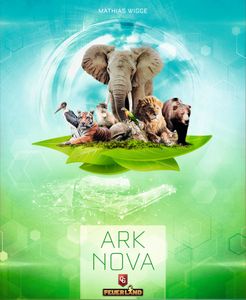
Plan a modern zoo, house animals, build facilities and support wildlife conservation.
Ark Nova supports 1–4 players; community best: 2 players; playing time: 90–150 minutes. A WANGO browser trial is available.
Background & introduction
Build a modern zoo by arranging enclosures on your zoo map, introducing animals and supporting conservation projects. Your cards provide many of your opportunities, including specialist support, unique buildings and animal conservation projects.
Five action cards organize your choices each turn: acquire cards, construct buildings, introduce animals, carry out association work or obtain sponsors. An action’s strength depends on its position in your action row, so when you use a card matters alongside which animals and projects you choose.
Animal abilities, enclosure requirements, sponsors and research are linked through the cards. An efficient zoo makes these elements work together while increasing appeal and advancing conservation. The game combines spatial planning in your own zoo, card combinations and opportunities contested by all players.
Core rules & scoring
Choose 1 action card. Its position from 1–5 plus X-tokens paid beforehand determines its strength, with each X adding 1. You may hold at most 5 X-tokens; tokens gained during an action cannot strengthen that action. After resolving it, move the card to position 1 and shift cards previously to its left one space right; cards to its right stay put. Alternatively, gain 1 X instead of performing the action, still moving the chosen card.
The Cards action first advances the Break token 2 spaces. Side I draws from the deck, with possible discards, according to its strength table, or Snaps any 1 display card at strength 5 or more. Side II uses an improved table to take cards from the deck and/or within reputation range in the display, or Snaps any 1 card at strength 3 or more. Snap ignores reputation range. Refill the display only after the entire turn. Reaching reputation 10 or higher requires upgrading Cards.
Build I constructs 1 building whose size is no greater than the action strength, paying 2 money per space. If your zoo has no buildings, its first building must touch the map edge; otherwise, build adjacent to an existing building. Map A’s preprinted kiosk counts as an existing building, so you may continue building next to it. Buildings cannot overlap, leave the map or cover water or rocks, and marked spaces require upgraded Build. Build II permits several different buildings with total size no greater than strength, and unlocks the Large Bird Aviary and Reptile House. Pay for and place each building separately.
Animals plays the number of animals permitted by the strength table, one at a time. Meet each card’s conditions, pay its cost first and provide an empty enclosure satisfying its size and water or rock adjacency requirements. A standard enclosure becomes occupied after housing one animal card. Petting Zoo animals need the Petting Zoo; suitable animals may instead use capacity in a special enclosure. Animals II also permits cards within reputation range in the display for an additional folder cost; at strength 5 or more, first gain 1 reputation.
Association I performs 1 task: strength at least 2 gains 2 reputation, 3 takes a partner zoo, 4 takes a university and 5 supports a conservation project. Assign available workers. A task already containing 1 of your workers requires 2 additional workers to repeat; with 3 there, you cannot repeat it before a break. Each player may support each project only once and must meet an unoccupied requirement. Association II permits several different tasks with total task values no greater than strength. After completing at least one task, you may also donate once: pay the cheapest unoccupied donation space to gain 1 conservation point, without a worker.
Sponsors I plays 1 Sponsor card from your hand with a level no greater than strength, meeting its conditions; alternatively, advance the Break token by strength and gain that much money. Sponsors II can play several cards in sequence with total levels no greater than strength plus 1, including display cards within reputation range for their additional folder costs. Its break option still advances by strength, but gains twice that much money.
When the Break token reaches the end, finish the current turn before all players take a break. Discard to 3 hand cards, or 5 with the relevant university; remove Multiplier, Venom and Constriction tokens from action cards; retrieve workers and replenish association supplies; discard display folders 1 and 2, slide and refill; collect income from appeal, kiosks and unlocked sources; then reset the Break token. The player triggering the break gains 1 X-token.
Your appeal and conservation counters reaching the same scoring area or crossing triggers the end at the end of your own turn or during a break. A turn-end trigger gives every other player 1 final turn; a break trigger gives everyone 1 final turn. The first time a player reaches or exceeds 10 conservation points, everyone discards one Final Scoring card; if nobody does, discard one before final scoring. Resolve the retained card and end-game icons, then, using rules Version 2.0, add your appeal to the white base-scoring number shown in the area containing your conservation counter. Highest score wins; ties favor more supported conservation projects, then a shared victory.
Rules & gameplay questions
How do action strength and card movement work?
Choose an action card. Its position from 1–5 plus X-tokens paid beforehand sets the strength, with each X adding 1. Afterwards, put the used card in position 1 and shift cards formerly to its left one space right; cards to its right stay put. You may hold at most 5 X-tokens, and tokens gained during the action cannot increase that action’s strength.
How do drawing, Snap and reputation differ?
Cards first advances the Break token 2 spaces. Side I draws from the deck and may require discards according to its strength table, or Snaps any 1 display card at strength 5 or more, ignoring reputation. Side II can take from the deck and display within reputation range using its improved table, or Snap any 1 card at strength 3 or more. Refill the display at turn end. Reputation 10 and beyond requires upgraded Cards.
Can I place enclosures anywhere, and does sufficient size guarantee an animal can enter?
Build I constructs 1 building no larger than strength, for 2 money per space. If your zoo has no buildings, its first building must touch the map edge; otherwise, build adjacent to an existing building. Map A’s preprinted kiosk counts as an existing building, so you may continue building next to it. Do not overlap, leave the map or cover water or rocks; marked spaces require upgraded Build. An animal must also meet its card conditions, cost, size and water or rock requirements. A standard enclosure flips to occupied after housing one animal card and cannot take a second; the Petting Zoo and suitable special enclosures follow their own rules.
Can one association worker perform any task?
Side I performs 1 task with sufficient strength: reputation 2, partner zoo 3, university 4 or conservation project 5. You need available workers. If you already have 1 worker on that task, repeating it requires 2 more; with 3 there, you cannot repeat it before a break. Other players’ workers do not increase your cost. Side II permits several different tasks with total values no greater than strength, plus at most 1 donation after completing at least 1 task in that action. Donations need no worker.
When can I upgrade action cards?
Base-game opportunities come from the conservation track, reputation track, second partner zoo and second university. At 2 conservation points, choose between an action upgrade and activating an association worker; the rewards at 5 and 8 are not fixed upgrades. You can upgrade at most four action cards. A flipped card counts as upgraded immediately, but its improved action effects apply from the next use of that action.
Rules & introduction sources
- Edition
- Ark Nova base multiplayer game for 2–4 players, official English rules Version 2.0 and FAQ V2. Uses the Version 2.0 final-score presentation: appeal plus the white base-scoring number in the conservation area. Earlier rule versions express the score as a track difference. Excludes solo, Marine Worlds and other expansions, promotional cards, and optional preset introductory hands.
- Rule references
- Introduction source
- BoardGameGeek
WANGO editorial
| Parameter | Recorded value |
|---|---|
| BGG overall rank (snapshot) | #2 |
| Complexity Weight | 3.80 / 5 |
| Best player count (community) | 2 |
| Player range | 1–4 |
| Playing time (minutes) | 90–150 |
| Core mechanisms | Contracts · End Game Bonuses · Events · Expiring Actions · Grid Coverage · Hand Management · Hexagon Grid · Income · Increase Value of Unchosen Resources · Open Drafting · Race · Set Collection · Solo / Solitaire Game · Tags · Tile Placement · Track Movement · Variable Player Powers · Variable Set-up |
| Chinese publication | Unconfirmed |
| WANGO browser play | Available · browser trial |
| Year published | 2021 |
| Suggested age | 14+ |
BGG statistics are stored snapshots, not live rankings. Source checked:2026-09-26
Player questions
What is the best player count for Ark Nova, and can I play online?
Ark Nova supports 1–4 players; community best: 2 players; playing time: 90–150 minutes. A WANGO browser trial is available. Recorded mechanism tags: Solo / Solitaire Game.
How complex is Ark Nova, and which mechanisms does it use?
Weight: 3.80 / 5. Mechanisms: Contracts · End Game Bonuses · Events · Expiring Actions · Grid Coverage · Hand Management · Hexagon Grid · Income · Increase Value of Unchosen Resources · Open Drafting · Race · Set Collection · Solo / Solitaire Game · Tags · Tile Placement · Track Movement · Variable Player Powers · Variable Set-up. Chinese publication: Unconfirmed.
Where can I learn Ark Nova?
Available resources: Rule guide https://wangogame.com/wiki/games/ark-nova?tab=howto;Strategy https://wangogame.com/wiki/analysis/ark-nova;Play online https://play.wangogame.com/ark-nova/