Marrakesh
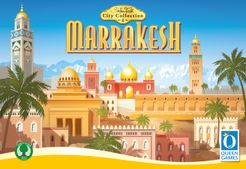
Marrakesh is a city-building strategy game. Across three seasons of four rounds, players assign assistants and colored Keshis to regional actions, develop resources and influence, and compete for the highest final score.
Marrakesh supports 2–4 players; community best: 3 players; playing time: 120 minutes. A WANGO browser trial has not been confirmed.
Background & introduction
Marrakesh places players in a city of markets, mosques, palaces, and oases. Each player develops a personal city board by assigning assistants to regions and using colored Keshis to trigger actions. The game centers on area planning and resource management rather than moving characters along a map.
The game lasts three seasons of four rounds each. Every round, players place assistants in several regions, then send matching colored Keshis into towers. When pieces fall from the towers, players select available Keshis in turn to strengthen or activate the regions where their assistants were placed. Building materials, dirhams, water, dates, goods, and oases each serve different purposes. Players also watch river rankings and season-end offerings; failing to pay an offering can cost resources and points.
Regions provide different immediate effects: players can advance mosque or palace influence, trade in the market, develop schools and squares, manage date palms or the Medina, or use the river and Sahara. No single track determines the winner. Final scoring combines completed regions, oases, and leftover resources. Queen’s Essential, Classic Special, and Deluxe boxes differ in components, but their official manuals share the same core three-season structure and final scoring.
Core rules & scoring
Objective and players: Players develop city districts over three seasons and compete for the highest final score. Queen Games supports two to four players and currently lists 60–90 minutes; BGG still lists 120 minutes, while the rules do not give a fixed duration. Each season has four rounds. The base game is competitive and its main rules do not provide a solo or cooperative objective.
Edition and setup: Marrakesh is Stefan Feld City Collection 4, released by Queen Games in 2022. Queen provides main rules for Classic Special/Deluxe and a separate Essential Edition manual. Materials, Keshi counts, and component icons vary, but the verified core round sequence and end scoring are the same. Prepare the player boards, assistants, colored Keshis, towers, resources, offering cards, river, and districts using the manual for the box you own; separately sold expansions are not automatically included.
Seasons and rounds: The game has three seasons with four rounds each, for twelve rounds total. In each round, players assign assistants and use matching colored Keshis to drive regional actions. At the end of each round, take any river reward indicated by position. At the end of each season, resolve river ranking and offerings, then prepare market and river cards and Keshi supplies for the next season. Plan short-term actions together with season-end payment.
Assistant placement and regions: Players place assistants in three regions on their city boards. Regions include the Mosque, Palace, Market/Shops, School, Square, Date Palms, Medina, Sahara, and River. The chosen region determines the action. Since assistant placements are limited, choose the districts to develop before considering whether the available Keshis can provide the resources or markers needed. Each region has its own action and scoring path.
Tower and Keshi selection: Secretly choose three different-colored wooden Keshis from those remaining behind your screen, reveal them, and place assistants in the matching sectors. Drop the chosen Keshis into the shared tower. In turn order, each player takes up to two available Keshis of one color they can still accept, continuing until no selectable pieces remain. Exchange them for cardboard pieces or advance the matching color markers as the edition instructs. Place red water vendors only in sectors without one; colors are not freely interchangeable resources.
Resolving regional actions: After assistants and Keshis are prepared, resolve actions for the regions. These can involve religious influence in the Mosque, Palace steps, market trading, development in the School or Square, resources and building in the Date Palms or Medina, and rewards in the River or Sahara. Costs and effects depend on each region. Place building markers, resources, or oases only in legal spaces and do not transfer them freely between districts.
River, offerings, and season end: At the end of each round, take the reward indicated by the River position. At the end of each season, score the river ranking and pay the revealed offering requirements. If a player lacks enough resources, they pay all resources they have and lose the points printed on all activated provision tiles. Then update Market and River cards and reset the Keshi supply for the next season. Resource reserves can directly affect final score.
Completed districts and oases: After the final round of the third season, score completed districts. A qualifying district is worth ten points; it generally must reach eight spaces in the relevant Keshi or marker track and contain the specified red cardboard Keshi. Players also score their three highest-value oases. District and oasis rewards encourage balanced development, but concentrating on one district does not guarantee the lead.
Leftover resources and ties: Add remaining Dirhams, Water, Dates, and Goods Keshis; every two are worth one point, rounded down. Add these to district, oasis, and other season scores. The highest total wins. In a tie, compare Palace steps first, then Mosque steps; if still tied, players share the victory. Follow the component icons in the edition you own rather than assuming every box has identical physical pieces.
Expansion and mode boundary: The main Marrakesh manuals contain optional module chapters, and Queen Games publishes separate rules for expansions such as Camels & Nomads and Gems & Experts. For the base game, use the basic setup and do not treat a separately sold module as a default rule. Classic Special/Deluxe and Essential are box editions, not three different core season systems.
Rules & gameplay questions
How many players does Marrakesh support, and how long is it?
Queen Games supports two to four players. Its current product page lists 60–90 minutes, while BGG lists 120 minutes; the rulebook does not give a fixed duration, so present these as differing catalog estimates rather than a precise guarantee. A full game lasts three seasons of four rounds each, then the highest total from districts, oases, and remaining resources wins.
Are the Classic Special, Deluxe, and Essential rules the same?
Queen Games publishes a main manual for Classic Special/Deluxe and a separate Essential Edition manual. Materials, Keshi counts, and component icons differ, but the official manuals checked share the three-season structure, four rounds per season, regional actions, and final scoring. Use the component diagram for your own box rather than applying the main manual’s wooden-piece counts to Essential’s mixed cardboard and wooden components.
How many rounds are there, and what does a player do?
The full game has three seasons with four rounds each. In each round, players place assistants in three regions, then put matching colored Keshis into towers; pieces that fall are selected in turn and used for regional actions. Each round ends with a river-position reward, and each season ends with river ranking and offering payment. The number of rounds is fixed, but available colors and actions depend on tower results and placement.
Are the Keshis in the tower dice?
No. Keshis are colored components placed into the towers to produce a set of available colors when the pieces fall. Players select them in turn and use them with their assistants to resolve regional actions. The result varies the colors and resources, but it is not a die roll and does not turn every color into a universal resource; follow the region and player-board icons.
Which regions can players activate?
Core regions include the Mosque, Palace, Market or Shops, School, Square, Date Palms, Medina, Sahara, and River. Assistant placement determines which regions a player develops, while Keshi colors work with those actions to provide resources or markers. The districts have different costs and rewards; they are not interchangeable worker spaces. Check optional modules separately if they are part of your setup.
What happens if I cannot pay an offering at season end?
At the end of a season, first resolve river ranking rewards and then pay the revealed offering requirement. If you lack the required resources, you do not simply skip payment and keep everything: the rules make you pay all resources you have and lose the points on that offering card. Then the game updates Market and River cards and prepares the Keshi supply for the next season. Save resources for this check.
How do completed districts and oases score?
After season three, each qualifying completed district scores ten points; typically its relevant track must reach eight spaces and contain the specified red cardboard Keshi. Players also score their three highest-value oases, plus other endgame and leftover-resource points. The manuals use edition-specific component diagrams, so check the one for your box before judging whether a district is complete.
Can leftover resources score, and how are ties broken?
Remaining Dirhams, Water, Dates, and Goods Keshis are added together, with every two worth one point and any remainder rounded down. The highest final total wins. If tied, compare Palace steps, then Mosque steps; if still equal, the players share the victory. Not every leftover component is a resource point, so score only the items listed in the rules.
Does Marrakesh have an official solo or cooperative mode?
Queen Games’ main and Essential manuals describe a two-to-four-player competitive game and do not include an official solo or cooperative mode. A player manages many districts and resources, but that is not a solo game against an automated opponent. Separately sold expansions have their own rule files; identify them as expansions rather than default base-box play.
Rules & introduction sources
- Edition
- This entry covers Marrakesh (BGG 342810), Stefan Feld City Collection 4 by Queen Games, released in 2022. It uses Queen’s official Essential Edition English manual and cross-checks the Classic Special/Deluxe main rules. Box editions differ in components and Keshi counts, but the core season flow and final scoring were verified as consistent. Queen lists 2–4 players and 60–90 minutes; BGG lists 120 minutes, while the rules do not promise a fixed duration. The base rules are competitive and do not list solo or cooperative play; separately sold expansions are outside scope.
- Rule references
- Introduction source
- BoardGameGeek
WANGO editorial
| Parameter | Recorded value |
|---|---|
| BGG overall rank (snapshot) | #342 |
| Complexity Weight | 3.45 / 5 |
| Best player count (community) | 3 |
| Player range | 2–4 |
| Playing time (minutes) | 120 |
| Core mechanisms | Cube Tower · End Game Bonuses · Open Drafting · Simultaneous Action Selection |
| Chinese publication | Unconfirmed |
| WANGO browser play | No confirmed WANGO trial |
| Year published | 2022 |
| Suggested age | 14+ |
BGG statistics are stored snapshots, not live rankings. Source checked:2026-09-27
Player questions
What is the best player count for Marrakesh, and can I play online?
Marrakesh supports 2–4 players; community best: 3 players; playing time: 120 minutes. A WANGO browser trial has not been confirmed.
How complex is Marrakesh, and which mechanisms does it use?
Weight: 3.45 / 5. Mechanisms: Cube Tower · End Game Bonuses · Open Drafting · Simultaneous Action Selection. Chinese publication: Unconfirmed.
Where can I learn Marrakesh?
No rule guide, strategy article or WANGO trial has been confirmed for this record.