Great Western Trail: Second Edition
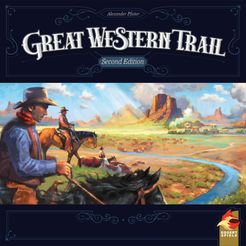
Repeatedly herd cattle to Kansas City, improve your cattle deck, hire workers and develop the railway to build a varied ranching enterprise.
Great Western Trail: Second Edition supports 1–4 players; community best: 3 players; playing time: 75–150 minutes. A WANGO browser trial has not been confirmed.
Background & introduction
Great Western Trail Second Edition follows nineteenth-century American ranchers delivering cattle to Kansas City and shipping them east. Cowboys help buy better cattle, builders construct private buildings, and engineers advance your engine.
Private buildings, hazards and outlaws change the route. Where you stop determines the actions you can use: local actions belong to neutral buildings and your own buildings, while other locations offer auxiliary actions. Hand symbols charge fees along the way.
Cattle cards provide delivery income and pay for some trail actions. Kansas City rewards the variety in your current hand rather than the value of your whole deck. Removing discs for deliveries unlocks abilities, while buildings, rail development, cattle and objectives contribute to final scoring.
Core rules & scoring
Setup and turns: Each player starts with the same 14 cattle cards and one starting objective. On the first turn, discard down to four cards and start at any neutral building. Thereafter move, use the destination, then refill to the hand limit. Shuffle the discard pile only when a card must be drawn from an empty draw pile. Newly acquired cattle and objectives go to the discard pile.
Movement and actions: Follow arrows for at least one location up to your movement limit; empty spaces do not count and Kansas City forces a stop. At neutral or your own buildings, perform each local action once in any order, or forgo all of them for one single auxiliary action. Opponents’ buildings, hazards and outlaws allow only one single auxiliary action. Pay hand-symbol fees when passing or stopping; pay what you can if short, continue, and owe nothing later.
Workers and buildings: Hire only workers above the job-market token’s row, paying the row price with the action’s modifier. Place each in its type’s leftmost empty slot and optionally use its immediate action. Cowboys improve buying options and engineers determine the corresponding train action’s distance. Construction requires enough builders and payment; upgrading your own building uses the difference in builder requirements and removes the old tile.
Kansas City: Add one tile from each of the three foresight pairs, then reveal your hand and count each different cattle breed’s breeding value once. You may spend temporary certificates and add permanent certificates. Take that much income and discard your entire hand. This total sets your delivery destination limit; your engine’s position does not.
Delivery and rail: Move an eligible disc from your board to a city, observing corner restrictions and unlocking its ability. Except Kansas City and New York, you cannot deliver again to a city you already marked. If your engine is behind the destination, pay one dollar per intervening railroad cross. Stop at a station turnout to pay for an upgrade; taking its station-master tile requires exchanging a rightmost hired worker at that moment.
Objectives and exchange: Play objectives before phase A or before or after actions in phase B for their immediate effects, never during an action or after starting the refill. Played objectives must score at the end; unplayed ones may be scored or removed. Meet each objective’s requirements separately rather than reusing the same achievement. Spend an exchange token at any time to draw up to two cards, then discard the same number.
Ending: Placing a worker in the final job-market space during Kansas City moves the token out and triggers the end. Finish that turn; everyone else gets one final turn, and no further worker foresight tiles may be selected. Score all 11 categories, including buildings, cities, stations, cattle, hazards, objectives and station masters; every five dollars scores one point and the job-market token scores two. Highest score wins; ties share victory.
Rules & gameplay questions
Do duplicate cattle breeds add their value twice?
No. Each different breed in your hand counts once for a delivery; certificates can increase the total separately.
Does paying a fee let me use an opponent’s building actions?
No. The fee does not buy access to its local actions. Stopping there permits only one available single auxiliary action.
Must an incomplete objective always lose points?
Played objectives in your personal area must score, potentially losing points. Unplayed objectives still in your deck may be removed instead of scored. Starting objectives have no negative score.
Can I deliver beyond my engine?
Yes. Eligibility depends on this delivery’s total breeding value and city repetition restrictions. An engine behind the destination creates transport costs of one dollar per intervening railroad cross; reaching the city with your engine is not a prerequisite.
Rules & introduction sources
- Edition
- Great Western Trail Second Edition (2021), the standard 2–4-player game. Simmental is an optional variant. The separate Sam solo booklet, Rails to the North expansion, and Argentina, New Zealand and El Paso are outside this rules summary.
- Introduction source
- BoardGameGeek
WANGO editorial
| Parameter | Recorded value |
|---|---|
| BGG overall rank (snapshot) | #31 |
| Complexity Weight | 3.70 / 5 |
| Best player count (community) | 3 |
| Player range | 1–4 |
| Playing time (minutes) | 75–150 |
| Core mechanisms | Deck, Bag, and Pool Building · Hand Management · Ownership · Rondel · Set Collection · Solo / Solitaire Game · Tags · Track Movement · Variable Set-up |
| Chinese publication | Unconfirmed |
| WANGO browser play | No confirmed WANGO trial |
| Year published | 2021 |
| Suggested age | 12+ |
BGG statistics are stored snapshots, not live rankings. Source checked:2026-09-27
Player questions
What is the best player count for Great Western Trail: Second Edition, and can I play online?
Great Western Trail: Second Edition supports 1–4 players; community best: 3 players; playing time: 75–150 minutes. A WANGO browser trial has not been confirmed. Recorded mechanism tags: Solo / Solitaire Game.
How complex is Great Western Trail: Second Edition, and which mechanisms does it use?
Weight: 3.70 / 5. Mechanisms: Deck, Bag, and Pool Building · Hand Management · Ownership · Rondel · Set Collection · Solo / Solitaire Game · Tags · Track Movement · Variable Set-up. Chinese publication: Unconfirmed.
Where can I learn Great Western Trail: Second Edition?
No rule guide, strategy article or WANGO trial has been confirmed for this record.