Summoner Wars (Second Edition)
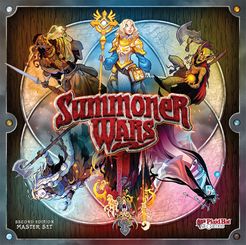
Summoner Wars Second Edition is a tactical two-player card battle. Each side deploys units, moves and attacks across a battlefield, and manages Magic while trying to destroy the opposing Summoner.
Summoner Wars (Second Edition) supports 2 players; community best: 2 players; playing time: 40–60 minutes. A WANGO browser trial has not been confirmed.
Background & introduction
Summoner Wars Second Edition is a tactical card battle in which two Summoners lead their factions across a gridded battlefield. Each player chooses a prebuilt deck, places a Summoner, starting units, and a Gate, then summons new units from hand, builds structures, claims routes, and attacks the opponent. Unit cards occupy spaces on the field. Position and range determine which targets are reachable, while Magic pays for summons and construction.
A turn follows five phases: Summon, Move, Build, Attack, and Magic. Players deploy units from their hands, move up to three different units, place structures, choose units to attack enemy cards, and may discard cards for Magic. Attacks roll dice based on a unit’s strength; damage reduces a card’s life, and a card at zero life is destroyed. Destroying an enemy card can also generate Magic. The current rules no longer have a separate draw phase; players refill to five cards at the end of the turn.
The victory condition is clear: destroy the opposing Summoner. Battlefield positions, Gates, and structures affect where units can be summoned and what actions remain available. Overly cautious play has a cost: if the Attack phase ends without any enemy card being chosen as a target, your own Summoner takes damage from Cost of Inaction. The Master Set includes six prebuilt factions and also supports deck construction under its rules. The physical game is a two-player duel with no official solo or cooperative procedure; online AI and solo campaigns are separate digital modes.
Core rules & scoring
Objective and box scope: Each player leads a faction of cards on a battlefield. Destroying the opposing Summoner wins the game. This entry covers Master Set PH3600-5, officially listed for 2 players, ages 9+, and 45–60 minutes, with six prebuilt factions. Second Edition cards and rules are incompatible with First Edition and should not be mixed.
Set up the battlefield: Each player chooses a faction deck, using one of the Master Set prebuilt decks or a legal custom deck. Place the Summoner, starting units, and one 10-life Gate according to the diagram on the Summoner card. Shuffle and draw five cards. The first player starts with 2 Magic and the second player with 3. Gates and the Summoner’s position affect where units can be summoned and where buildings may be placed, so follow the current faction setup diagram.
Current turn phases: The current v1.2 turn has five phases: Summon, Move, Build, Attack, and Magic. An earlier official rulebook listed Draw as a separate phase; the 2024 official FAQ v1.2 removed it and changed the rules to refill the hand to five cards at the end of the turn. Do not use the old six-phase list as the current sequence. Refill occurs before other end-of-turn effects, with card text and the FAQ handling special timing.
Summon and Move: During Summon, pay Magic costs to play any permitted number of units from hand onto empty spaces adjacent to a Gate you control. During Move, move up to three different friendly units, usually one or two spaces each; units cannot pass through cards or enter an occupied space. Unit abilities, terrain rules, or card text may change these general limits, so resolve specific exceptions from the current card.
Build and Attack: During Build, pay for permitted structures from hand and place them according to location rules, including spaces adjacent to your Summoner or within your back three rows. During Attack, choose up to three different friendly units to attack. Melee units attack adjacent cards; ranged units use their attack type and unobstructed line of sight to find a target within range. Declare attackers and targets, then roll dice based on the relevant unit’s strength.
Damage and Magic: The number of dice is generally based on the attacking unit’s strength; dice matching its attack type cause damage. Damage lowers a card’s life, and a card at zero life is destroyed. When a card you control destroys an enemy card, gain 1 Magic. During the Magic phase, discard any number of cards from hand to gain one Magic per card. Summons, buildings, and some events spend Magic; events can only be played in phases allowed by their text.
Cost of Inaction: At the end of your Attack phase, your Summoner takes 1 damage if none of your attacks targeted an enemy card during the entire turn. An attack need not deal damage to satisfy the targeting condition. Some card effects allow attacks outside the normal Attack phase, so check all attacks made during the turn when applying this rule.
End of turn and hand refill: After the Magic phase, the current rules refill the hand to five cards at the end of the turn, before other end-of-turn effects. Magic may come from discarding cards this turn or destroying enemy cards. Keeping or discarding cards affects which units and buildings can be played on a later turn. If a card changes drawing, discarding, or end-of-turn timing, follow its text and the current FAQ.
Winning: A player wins when only one player’s Summoner remains on the battlefield. Destroying ordinary units, buildings, or Gates does not itself end the game; the goal is to use battlefield control, summons, and attacks to reach the enemy Summoner. There is no personal score, turn limit, or team victory condition. The Master Set duel ends when one Summoner is destroyed.
Decks, modes, and updates: Prebuilt decks can be played as supplied; custom decks can be constructed using the Summoner’s faction markers and deck-building limits. Additional faction decks are sold separately. The physical rules are for a two-player contest and have no solo campaign or cooperative mode; AI matches and solo story campaigns belong to Summoner Wars Online. The current FAQ v1.2 removed the Draw Phase, and the official card-adjustment page continues to update some card text; older printings may differ.
Rules & gameplay questions
What is the win condition in Summoner Wars Second Edition?
Each player leads a faction deck on the battlefield, summoning and moving units to attack the opposing Summoner. A player wins once only one player’s Summoner remains. Destroying ordinary units or buildings can change the battle but does not by itself end the game; there is no personal score or turn-count end condition.
How many players can use the Master Set, and can it be played solo?
Plaid Hat Games’ Second Edition Master Set is a two-player duel, listed for ages 9+ and 45–60 minutes. The physical rules do not include a cooperative mode or solo campaign. AI opponents and single-player story campaigns are features of Summoner Wars Online, a separate digital product, not solo rules in the Master Set card box.
Which factions are in the Master Set?
The current PH3600-5 Master Set includes six prebuilt decks: Vanguards, Savanna Elves, Polar Dwarves, Cave Goblins, Breakers, and Fallen Kingdom. Each player chooses one faction and sets up its starting units and Gate as shown on its Summoner card. Other Second Edition factions are generally sold as separate decks or expansions.
What are the current phases of a turn?
Current v1.2 rules use five phases: Summon, Move, Build, Attack, and Magic. Early v1.0 rules had a separate Draw phase, but the official FAQ v1.2 removed it and moved the refill to the end of the turn, up to five cards. When reading an older rulebook, apply this official update to the turn sequence.
How do players gain and spend Magic?
Players can discard cards during the Magic phase to gain one Magic per discarded card. They can also gain one Magic when a card they control destroys an enemy card. Magic pays for unit summons, buildings, and some events. The second player starts with one more Magic than the first, while faction abilities can change specific costs or rewards.
What are the movement and building restrictions?
The Move phase lets you move up to three different friendly units, usually one or two spaces each, without passing through cards or entering occupied spaces. New summons usually enter an empty space adjacent to a Gate you control. Buildings have placement limits, including spaces near your Summoner or in your back rows. Card abilities can override these general rules.
How does an attack work, and why can’t I skip the Attack phase?
During Attack, up to three different units can attack. Dice usually depend on the attacker’s strength; matching symbols deal damage, and zero life destroys a card. At the end of the Attack phase, your Summoner takes 1 Cost of Inaction damage if no attack targeted an enemy card during the turn. An attack can count even if it deals no damage, including an attack allowed by a card effect outside the normal phase.
When do players draw back up?
Current official v1.2 rules no longer have a separate Draw phase. At the end of the turn, refill your hand to five cards before resolving other end-of-turn effects. This is a major update from the earlier rulebook. Discarding cards for Magic, event effects, and end-of-turn abilities may affect your hand, so check the current FAQ and card text for specific timing.
Can First Edition cards be mixed with Second Edition?
No. Plaid Hat Games’ official FAQ says First and Second Edition are incompatible. Their cards, rules, dice, and faction-deck systems should not be combined in one game. This overview follows the Second Edition Master Set and current rules updates; players with early Second Edition cards should also check the publisher’s later card adjustments.
Can official card updates affect an older Master Set printing?
Some card wording or values have changed, and older physical cards may retain earlier text. Plaid Hat’s adjustments page distinguishes changes already in print from items still marked Printing Soon. Check the physical card printing and the current adjustment list for the copy in play. Card updates do not automatically mean the core turn sequence has changed.
Rules & introduction sources
- Edition
- This draft covers BoardGameGeek ID 332800, Summoner Wars (Second Edition), using the Plaid Hat Games Second Edition Master Set, current SKU PH3600-5. The official specifications are 2 players, ages 9+, and 45–60 minutes, with six prebuilt factions. Current v1.2 rules use five phases—Summon, Move, Build, Attack, and Magic—with the hand replenished to five cards at the end of the turn; the official FAQ removed the older v1.0 Draw Phase. Second Edition is incompatible with First Edition. The physical box has no solo or cooperative mode; AI and solo campaigns belong to Summoner Wars Online.
- Rule references
- Plaid Hat Games — Summoner Wars Second Edition Master Set
- Plaid Hat Games — Summoner Wars Second Edition game page and rules resources
- Plaid Hat Games — Second Edition Rulebook v1.2
- Plaid Hat Games — FAQ & Expanded Rules v1.2 (2024-04-03)
- Plaid Hat Games — Summoner Wars card adjustments
- Plaid Hat Games — Official Second Edition FAQ (compatibility)
- BoardGameGeek — Summoner Wars (Second Edition), ID 332800
- Introduction source
- BoardGameGeek
WANGO editorial
| Parameter | Recorded value |
|---|---|
| BGG overall rank (snapshot) | #360 |
| Complexity Weight | 2.57 / 5 |
| Best player count (community) | 2 |
| Player range | 2 |
| Playing time (minutes) | 40–60 |
| Core mechanisms | Action Points · Card Play Conflict Resolution · Deck Construction · Dice Rolling · Die Icon Resolution · Grid Movement · Hand Management · Multi-Use Cards · Take That · Variable Player Powers |
| Chinese publication | Unconfirmed |
| WANGO browser play | No confirmed WANGO trial |
| Year published | 2021 |
| Suggested age | 9+ |
BGG statistics are stored snapshots, not live rankings. Source checked:2026-09-27
Player questions
What is the best player count for Summoner Wars (Second Edition), and can I play online?
Summoner Wars (Second Edition) supports 2 players; community best: 2 players; playing time: 40–60 minutes. A WANGO browser trial has not been confirmed.
How complex is Summoner Wars (Second Edition), and which mechanisms does it use?
Weight: 2.57 / 5. Mechanisms: Action Points · Card Play Conflict Resolution · Deck Construction · Dice Rolling · Die Icon Resolution · Grid Movement · Hand Management · Multi-Use Cards · Take That · Variable Player Powers. Chinese publication: Unconfirmed.
Where can I learn Summoner Wars (Second Edition)?
No rule guide, strategy article or WANGO trial has been confirmed for this record.