John Company: Second Edition
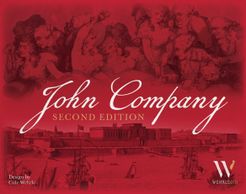
Negotiate appointments, assets, and political support to build family prestige through the fortunes of a jointly operated East India Company.
John Company: Second Edition supports 1–6 players; community best: 4–5 players; playing time: 90–240 minutes. A WANGO browser trial has not been confirmed.
Background & introduction
John Company: Second Edition gives each player a family pursuing its own reputation within the British East India Company. The organization needs money, ships, personnel, and cooperation to function, while the families controlling those resources each seek personal advantage.
Each game turn follows a fixed institutional sequence. London society and family investment lead into appointments and office operations, followed by revenue, events in India, Parliament, and upkeep. Negotiation connects these stages, subject to explicit limits on transfers and promises.
Cash buys opportunities rather than victory directly. Retiring family members can purchase prizes that score points but require upkeep. Shares, enterprises, and political power also change value with the Company’s ultimate survival or failure, making collective cooperation and private contingency planning inseparable.
Core rules & scoring
The second edition supports 1–6. Three to six use the selected scenario; solo and two-player games add the Crown opponent. Scenarios set the starting position, final turn, and possible Deregulation. Use the 1710 scenario to learn rather than importing first-edition procedures.
Each turn runs London Season, Family, Hiring, Company Operation, Bonuses, Revenue, Events in India, Parliament Meets, then Upkeep and Refresh. Skip London Season on turn one. Scenario instructions and passed laws can modify particular procedures.
Keep family cash, Company Balance, and each office treasury separate. Family cash funds investments, retirements, and negotiation; office cash can only be spent by that office. The Chairman can take debt and allocate Company Balance to other office treasuries, rather than treating it as personal money.
Family actions enlist writers or officers, purchase luxuries/shipyards/workshops, or seek a share. Repeating the action already bearing your opportunity marker normally allows two uses. Seek Share enters the Stock Exchange first; Company debt subsequently converts rightmost waiting members into Court shares while reducing debt.
Hire vacant offices in ascending numbered order, using each specified supervisor and candidate pool. Hiring your own family normally requires verbal consent from every other player in that pool; Chairman election is exempt. Election needs support from a strict majority of shares, with the former Chairman resolving a failed majority process.
Operate offices along the red ribbon and skip vacant offices. For a check, spend office resources, subtract penalty dice, and use the lowest rolled die: 1–2 succeeds, 3–4 fails with possible retries, and 5–6 is catastrophic, normally removing the officeholder and ending that office’s actions. Actions need an effect or chance of success.
Each President orders their own, Commander, and Governors’ operations; one position finishes before the next starts. Trade follows connected open orders from the home port, using ships to fill orders and raise Company Balance. The President and owners of writers actually placed gain separate personal income. Each President may trade successfully at most once per turn.
Revenue pays Company expenses, checks expectations, then allows the Chairman to pay dividends. Emergency loans and missed expectations may lower Standing. Storms and Indian events then alter the situation, Parliament votes on a law/policy, and families pay prize upkeep at turn end or remove unpaid prizes and lose their points.
London Season starts with attrition: roll for each office and add fatigue, with an extra one for the Chairman. A result of at least five creates a pensioner. Spend family cash to retire pensioners to scoring prizes; total retirement spending sets prestige-card order. Pensioners cannot be kept indefinitely after that Season.
Finish after the scenario’s final turn or when Standing reaches its leftmost space; legislated failure finishes resolving that vote first. Stop negotiations, calling promises, and ordinary blackmail. Score power, then shares/workshops: surviving shares score positively; failed shares lose points and workshops score one each. Survival adds final attrition/retirement without prestige cards; failure resolves a random failure card. Break final ties by windows, then Prime Minister order.
Rules & gameplay questions
Does Company profit mean everyone wins together?
No. Families compete for individual victory points, and Company money is separate. Shares score positively on survival and negatively on failure; retirement prizes and other scoring still determine the winner.
Can I sell an office or make every future bargain binding?
Officeholders, writers, officers, and pieces on prizes cannot be transferred. Family cash, enterprises, shares, facedown blackmail, and promise cards can. Immediate transfers are binding; other future bargains are not. Promise cards can compel their printed obligation, but cannot be called during Final Scoring.
Can I retire a family member whenever I want?
Normally no. Attrition first creates pensioners through office dice and fatigue. You then pay family cash for prizes, and remaining pensioners return to supply at the end of London Season. Company survival grants a separate final attrition and retirement.
Does every failed check remove the officeholder?
No. An ordinary failure, lowest die 3 or 4, does not automatically remove them and may permit a retry with sufficient resources. A catastrophic failure, lowest die 5 or 6, removes the officeholder and ends that office’s operations under the general rule.
In solo, do I control all the families?
No. Official solo and two-player play add the Crown, using AI cards, climate, and the Crown Handbook. Humans spend or gain limited promise cubes through favors. This entry summarizes the main rulebook’s setup and interaction rather than reproducing every office instruction.
Rules & introduction sources
- Edition
- John Company: Second Edition using the current publisher-linked English 48-page Second Printing, 2023 rules. Covers the shared Company’s core sequence, negotiation, retirement, final scoring, and official Crown solo/two-player overview. Deregulation and private firms are identified as scenario boundaries without detailed procedures; follow scenario cards, laws, Crown office instructions, and applicable errata. Excludes the 2017 first edition, fan solo, megagame, and roleplaying adaptations.
- Rule references
- Introduction source
- BoardGameGeek
WANGO editorial
| Parameter | Recorded value |
|---|---|
| BGG overall rank (snapshot) | #218 |
| Complexity Weight | 4.45 / 5 |
| Best player count (community) | 4–5 |
| Player range | 1–6 |
| Playing time (minutes) | 90–240 |
| Core mechanisms | Bribery · Dice Rolling · Negotiation · Push Your Luck · Simulation · Solo / Solitaire Game · Voting |
| Chinese publication | Unconfirmed |
| WANGO browser play | No confirmed WANGO trial |
| Year published | 2022 |
| Suggested age | 13+ |
BGG statistics are stored snapshots, not live rankings. Source checked:2026-09-27
Player questions
What is the best player count for John Company: Second Edition, and can I play online?
John Company: Second Edition supports 1–6 players; community best: 4–5 players; playing time: 90–240 minutes. A WANGO browser trial has not been confirmed. Recorded mechanism tags: Solo / Solitaire Game.
How complex is John Company: Second Edition, and which mechanisms does it use?
Weight: 4.45 / 5. Mechanisms: Bribery · Dice Rolling · Negotiation · Push Your Luck · Simulation · Solo / Solitaire Game · Voting. Chinese publication: Unconfirmed.
Where can I learn John Company: Second Edition?
No rule guide, strategy article or WANGO trial has been confirmed for this record.