So Clover!
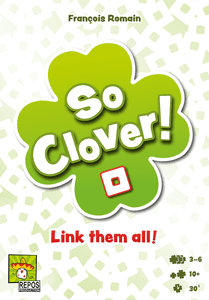
So Clover! is cooperative word association: write clues for four outside-edge pairs, add a decoy card, then reconstruct four cards and their orientations for a shared score.
So Clover! supports 3–6 players; community best: 3–4 players; playing time: 30 minutes. A WANGO browser trial has not been confirmed.
Background & introduction
So Clover! is a cooperative word-association game by François Romain for three to six players. Each player secretly places Keyword cards on a Clover board and writes one clue for each of four pairs. The group later has to connect the clue to the exact words, while following restrictions: a clue cannot simply repeat a Keyword, translate it, use a related form from the same word family, or invent a word.
After clues are written, the four original cards are removed and a fifth Keyword is added as a decoy. During the resolution phase, one player becomes the Spectator and the rest form the team. The team discusses how to place four of the five cards into the spaces matching the clues. The Spectator cannot help or signal; after an attempt, they silently remove incorrectly placed cards. The team must understand both the word links and which plausible card is the extra one.
A team that restores all four pairs correctly on the first attempt earns the card points plus a perfect-first-try bonus. If there is any error, the team gets one final attempt but cannot earn that bonus. Each player serves as Spectator once; then the group adds the round scores and records a team total. There is no individual winner. Adding extra Keyword cards is an optional challenge for a group that already knows the standard four-clue, one-decoy game.
Core rules & scoring
Setup: Give each player a Clover board and erasable marker, then shuffle the Keyword deck. Secretly draw four cards and randomly place them in the four recessed spaces. Each card bears several words, but clue writing uses only the eight outside-edge Keywords. Each side has a pair beneath its Clue Zone, formed by the neighboring cards; a card space is not a separate one-clue slot. Keep the arrangement hidden until that player’s resolution.
Writing clues: All players work simultaneously and privately. Look at the eight outside Keywords across the four pairs and write one clue word for each pair in its matching Clue Zone. A clue must be one word, although compound words are allowed. The rules allow common nouns, proper nouns, acronyms, numbers, and onomatopoeia. A clue may not be a Keyword itself, its translation, a word from the same word family, or an invented word. It should connect the pair rather than simply copy one answer.
Adding the decoy: After all four clues are written, remove the original four Keyword cards from the Clover board. Draw one new card without looking at it, then shuffle it with the original four to make a five-card face-down pile. The fifth word is a decoy. Do not tell the team which four cards were originally on the board; inferring the extra card is part of the puzzle.
Team resolution: Choose one player as the Spectator for the current round; everyone else is the team. The Spectator lays out their board and five Keyword cards face up, then cannot communicate in any way. Teammates use the four clues to discuss and restore four cards to the correct spaces and orientations. They may test arrangements on the board and explain their reasoning. If the team cannot agree, the player seated to the Spectator’s left makes the final placement decision.
Checking and scoring: After the team commits to its first arrangement, the Spectator checks the cards. Four correctly restored cards score four points plus a two-point first-try bonus, six total. If there is an error, silently remove the incorrect cards to the table center and leave correct cards in place. The team gets one second and final attempt. Remove cards still wrong and score one point per correctly restored card, zero to four. Do not score individual words or restore the lost first-try bonus. Record the round score on the board back and discard the five used cards.
Rotation and game end: The player to the current Spectator’s left becomes the next Spectator. The game ends once every player has served as Spectator once. Add the individual round scores and record the team total in the Record of Legends. The score is a shared high-score record, not a ranking of individual players. The rulebook also offers an optional difficulty challenge: after learning the standard game, agree to add the same number of extra Keyword cards for every player before resolution.
Rules & gameplay questions
Can a clue be two words or a complete sentence?
No. Each standard clue must be one word, though a compound word is permitted as a single clue. The rulebook allows common nouns, proper nouns, acronyms, numbers, and onomatopoeia. The clue should connect the pair of Keywords without directly repeating either answer. Write all four clues before removing the original cards, and check that every clue also follows the translation and word-family restrictions.
Can I use a translation or related form of a Keyword as my clue?
No. A Keyword itself and its translation into another language are prohibited, as is a word from the same word family. Invented words are also invalid. The clue should be a valid word that gives the team a useful association between both Keywords, not a translation, suffix change, or spelling trick that reveals one of the answers while bypassing the rule.
Why is a fifth Keyword added after the clues are written?
The fifth Keyword is a hidden decoy. After writing clues, the player removes the original four cards, draws one new card without looking at it, and shuffles all five together. Teammates then have to place four cards into the correct spaces and orientations and infer which word does not belong. The clue writer must not identify the original cards or the decoy, because that would give the team extra information.
Can the Spectator hint while the team is restoring the cards?
No. Once the Spectator reveals their board and five cards, they cannot communicate in any way. The other players may discuss, explain their logic, and test card placements. If they disagree, the player seated to the Spectator’s left decides the final arrangement. The Spectator only checks the committed attempt, silently removes incorrect cards, and records the score; gestures and facial signals are not allowed.
Can the team still score six points after a wrong first attempt?
No. Six points require all four pairs to be correct on the first attempt: four card points and a two-point perfect-first-try bonus. If the first arrangement has any error, the Spectator removes the wrong cards and the team gets one final attempt. The final score is then the number of correctly placed cards, from zero to four, and the bonus cannot be earned back on the second try.
Who becomes Spectator next, and when does the game end?
After each round, the player to the current Spectator’s left becomes the next Spectator. The game ends after every player has been Spectator once. Add each round’s result and write down the team total. So Clover! is cooperative, so the score is a shared record for the group rather than a personal ranking or an individual winner for each round.
May the team add extra Keyword cards during resolution?
Yes, but only as an optional challenge after the group has learned the standard rules. The team may agree to add the same number of extra Keyword cards for every player before resolution, making the decoy harder to identify. The standard game still uses four clue zones and one decoy card. Extra cards change the difficulty; they do not replace the normal rotation or cooperative scoring rules.
Rules & introduction sources
- Edition
- Repos Production’s standard cooperative So Clover! for 3–6 players, based on the official product page and linked 2020 English rulebook. Excludes unverified two-player variants; the extra-Keyword challenge is optional, not the default setup.
- Rule references
- Introduction source
- BoardGameGeek
WANGO editorial
| Parameter | Recorded value |
|---|---|
| BGG overall rank (snapshot) | #264 |
| Complexity Weight | 1.12 / 5 |
| Best player count (community) | 3–4 |
| Player range | 3–6 |
| Playing time (minutes) | 30 |
| Core mechanisms | Communication Limits · Cooperative Game |
| Chinese publication | Unconfirmed |
| WANGO browser play | No confirmed WANGO trial |
| Year published | 2021 |
| Suggested age | 10+ |
BGG statistics are stored snapshots, not live rankings. Source checked:2026-09-27
Player questions
What is the best player count for So Clover!, and can I play online?
So Clover! supports 3–6 players; community best: 3–4 players; playing time: 30 minutes. A WANGO browser trial has not been confirmed.
How complex is So Clover!, and which mechanisms does it use?
Weight: 1.12 / 5. Mechanisms: Communication Limits · Cooperative Game. Chinese publication: Unconfirmed.
Where can I learn So Clover!?
No rule guide, strategy article or WANGO trial has been confirmed for this record.