Unconscious Mind
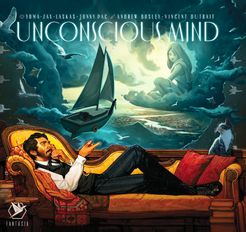
Unconscious Mind is a strategy game about Freud's early psychoanalytic circle. Players place Ideas, move an Inkpot, research and publish theories, and treat Clients' dreams; the official solo mode adds an automated opponent called the Id.
Unconscious Mind supports 1–4 players; community best: 2–3 players; playing time: 60–120 minutes. A WANGO browser trial has not been confirmed.
Background & introduction
Unconscious Mind places players in early twentieth-century Vienna, within the Wednesday Psychological Society where Freud and his contemporaries discussed psychology and dream symbolism. Players take the role of researchers in that circle, aiming to develop therapeutic techniques, build a clientele, and become Freud's most distinguished contemporary. The rulebook uses the history of psychoanalysis as a thematic frame; the game portrays a board-game version of research and treatment, not a guide to real mental-health care.
Players place Ideas on the central Meeting Table, pointing them toward different action spaces. Their Inkpot moves around a personal track and can trigger Notebook, Insight, and Reputation effects. Players also collect Research, cite one another's work, and publish Treatises. The theories are part of the game engine: Idea placement affects the Meeting Table actions available, while Notebook rows and columns connect early choices to later effects.
A second major path is treating Clients' dreams. Each Client has a Grief Layer and one or more Dreams; players use the Insights shown on a Dream to gain Therapy points and advance its treatment track. Reaching certain spaces triggers Catharsis, removes grief, and eventually cures the Client for points. Coffee and Heart-Shaped Boxes can add Therapy at the end of a turn, so players must schedule research and care within a limited number of main actions.
In the standard game, a turn offers one main choice: State Ideas, Recall Ideas, or Treat Clients. The first two move actions and resources between the shared Meeting Table and a personal map; treating Clients spends Insights to resolve Dreams. Freud's Reputation marker also serves as a shared timer. When it reaches the end of its track, players finish the current round and then play one final round before scoring.
The game includes an official solo mode. A solo player faces the Id, an automated opponent that uses a special deck to place Ideas on the Meeting Table without triggering those action spaces. Instead, the Id advances its Inkpot and triggers Notebook effects. It converts some effects that would normally create Insights into Coffee, then turns Coffee into Heart-Shaped Boxes and uses them to treat its Clients. The player wins by scoring more than the Id; solo play is not simply multiplayer with an empty seat.
Core rules & scoring
Edition and setup: The core game supports 1–4 players; standard multiplayer turns proceed clockwise from the starting player. Place the City Map and Meeting Table in the center and prepare the Client, Dream, Research, Treatise, Notebook, and Bright Idea displays. Each player takes a Player Board, Office, Professor, Inkpot, Ideas, Insights, Coffee, and markers. The number of available Meeting Table spaces and Notebook tiles changes with player count. This entry uses Fantasia's 2024-11 v2 core and official solo rulebooks; Nightmares is outside scope. (Core Rulebook PDF pp. 4–8; Solo Rulebook PDF pp. 1–3)
Main turn choices: On each turn, choose one main option: State Ideas, Recall Ideas, or Treat Clients. The next player takes a turn after the selected option is complete. Each choice connects different resources: State Ideas places Ideas and activates a Meeting Table space while moving the Inkpot; Recall collects Ideas and gains Coffee plus a map bonus; Treat Clients uses Dreams and Insights to create Therapy points. An Idea, an action space, and a whole turn are not interchangeable units. (Core Rulebook PDF p. 9)
State Ideas: Take one or two Ideas from your supply and place them on a vacant Meeting Table space, with their tails pointing toward an adjacent action space. You may not point two of your Ideas in the same turn to an action space you already pointed to. Ideas may be stacked on one Idea space to trigger that action space more than once. A Bright Idea can substitute for a regular Idea and follows the same placement and trigger rules, but all Bright Ideas are removed at the end of the turn. Resolve the action text and respect the remaining space, arrow, and card conditions. (Core Rulebook PDF pp. 13–15)
Inkpot and Notebook: The Inkpot moves around the player's circular track. Its destination may let the player resolve a Notebook row or column, or advance Freud's and the player's Reputation. The first, second, and third time the Inkpot passes the designated icon, it unlocks Ideas from the player board and adds them to the supply for later turns. Check the exact space reached and which columns are already unlocked; merely passing through an area does not allow an effect to be repeated. (Core Rulebook PDF pp. 11, 14–15)
Recall Ideas: Count the different Idea spaces you occupy on the Meeting Table and gain that many Coffee, then return all of your Ideas from the table. You may then claim a map bonus from the Location of your Professor or Freud, such as a District token, Reputation, or a location effect; the available options depend on the spaces, location, and icon conditions. The BGG file-page change log and designer clarification for the 2025.1 Second Print permit Recall without placing a new Idea only when both conditions hold: you have no own Ideas on the Meeting Table, and no legal Idea space remains where you could place one. Choosing not to place an Idea while a legal space remains does not qualify for this exception. The downloadable Fantasia v2 PDF retains the older sentence, so use that printed rule when playing from that edition. (Core Rulebook PDF p. 19; BGG 2025.1 Second Print file changelog and designer clarification)
Treat Clients: On a Treat Clients turn, you may treat one or both Clients in your Office, but each Client can be treated only once that turn. Use the fully exposed top Dream, spend the Insights it shows, and resolve its effects and Therapy points. Move the Client's Therapy marker toward the cured end; score immediately when it passes Victory Point spaces. When it reaches Catharsis, resolve that effect and discard the relevant Grief Layer. When the marker reaches the far-left space, the Client is cured, scores the points on its card, and leaves the Office. If Dreams are layered, do not use the one underneath the exposed Dream. (Core Rulebook PDF pp. 20–21)
End of turn and new Clients: At the end of a turn, you may use Heart-Shaped Boxes to give Therapy points to Clients. Normally you must then draft a new Client and Dream set for every empty Office Room. During the final round, however, do not draft a new Client for an empty room at the end of your turn. A Heart-Shaped Box supplies Therapy points; it is not an Insight. Insights trigger Dream effects, while a Heart-Shaped Box directly advances the treatment track. Discard unused Dreams from a cured Client's room and refill from the display as the rules specify. (Core Rulebook PDF pp. 21–22)
Reputation, end, and final scoring: When Freud reaches the tenth space, finish the current round and play one final round; do not draft new Clients into empty Office Rooms at the end of turns in that round. Final Scoring includes the Victory Points shown by your own Reputation marker. The player ranked highest in Reputation scores 2 points for each Published Treatise and Cured Client; the second-ranked player scores 1 for each. Then score player-color Insights in distinct Districts, completed Notebook rows, different Location tags, and eligible Case-Study Clients that have reached Catharsis without a Grief Layer. Each unused Heart-Shaped Box is worth 2 points, and every 3 Coffee converts into a Bright Idea worth 1 point. The player with the most Victory Points wins; Reputation breaks a final score tie. (Core Rulebook PDF pp. 9, 11, 22–23)
Solo Id: Set up the game as a two-player game with the Id's Player Board, Office, Meeting Table deck, and other solo components; choose a difficulty level. The player and Id take turns. The Id chooses State Ideas or Recall Ideas according to its available Ideas. Its deck determines placement; those Ideas do not trigger ordinary Meeting Table actions. Instead, its Inkpot advances and resolves its own Notebook effects. The Id converts certain Insight and other effects into Coffee, turns Coffee into Heart-Shaped Boxes when it reaches the rule threshold, and uses the boxes to treat its Clients. The player wins by scoring more Victory Points than the Id; if their scores tie, higher Reputation wins. (Solo Rulebook PDF pp. 1–8)
Rules & gameplay questions
Can I choose State Ideas and Treat Clients in the same turn?
No. The standard rules give you one main choice per turn: State Ideas, Recall Ideas, or Treat Clients. State Ideas places Ideas on the Meeting Table and activates its spaces; Recall collects your Ideas and gains Coffee plus a map bonus; Treat Clients uses Dreams to treat your Clients. You may use Heart-Shaped Boxes at the end of your turn, but that is an end-of-turn step rather than a second main option.
What happens if I stack two Ideas on the same space?
The Idea tails must point to an adjacent Meeting Table action space. Stacking two Ideas on one Idea space can trigger the pointed-to action space repeatedly. You cannot point multiple Ideas placed by you during the same turn to an action space you already pointed to. A Bright Idea may replace a regular Idea and follows the same placement and trigger rules, but it is removed at the end of the turn. Check the vacant space and arrow before resolving effects.
Can I Recall when I did not place an Idea?
The BGG 2025.1 Second Print changelog and designer clarification allow Recall without a newly placed Idea only when both conditions are true: you have no own Idea on the Meeting Table, and no legal Idea space remains for a placement. If a legal space remains and you simply choose not to place an Idea, this exception does not apply. Fantasia’s downloadable 2024-11 v2 PDF still requires at least one of your Ideas on the table. The 2025.1 file is labeled official and was uploaded by Fantasia team member Zinia Redo, but BGG blocked its download during this review; this correction is based on the visible changelog and designer clarification.
Can I use the lower Dream while another Dream is on top?
No. On a Treat Clients turn, use the fully exposed top Dream and spend the Insights it shows to resolve its effects. If a Manifest Dream is layered over a Latent Dream, treat the Manifest Dream first; the lower Dream is not available until the layer above it is removed. The Therapy marker advances for Therapy points, scoring spaces trigger points immediately, and Catharsis or curing has its own separate effect.
Is Catharsis the same as curing a Client?
No. Catharsis is an intermediate space on the treatment track. When the Therapy marker reaches its icon, resolve the Client's Catharsis effect and remove the Grief Layer; more Therapy may still be needed to move the marker to the far-left end. Only then is the Client cured, scores the points printed on its card, and leaves the Office. Any Victory Point spaces passed on the way score immediately.
Can a Heart-Shaped Box be spent as an Insight?
No. Insights pay for or trigger Dream, Notebook, Treatise, and other effects; a Heart-Shaped Box directly gives Therapy points at the end of a turn and moves a Client's treatment marker. Coffee is a third resource, used for permitted effects and, in solo mode, converted by the Id into Heart-Shaped Boxes. Although all three can support treatment indirectly, the rules do not make them interchangeable. Follow the icon and cost printed for the effect you are resolving.
Does the game stop immediately when Freud reaches the end of the Reputation track?
Freud's marker signals the end when it reaches the tenth space, but play does not stop in the middle of the current round. Finish the current round so every player completes their turn, then play one final round before Final Scoring. During that final round, do not draft a new Client into an empty Office at the end of a turn. Advancing Reputation shortens the time available for long plans, but it does not deny players their remaining turns in the current round. Freud's track is a shared game timer, not only a personal score track.
Does the official solo opponent use the same three choices as a human?
No. The Solo Rulebook defines the Id as an automated opponent. It mainly alternates between State Ideas and Recall Ideas, using its special deck to place Ideas without activating ordinary Meeting Table spaces. Its Inkpot triggers its own Notebook effects, and it converts certain Insight effects into Coffee. Coffee is then exchanged for Heart-Shaped Boxes that advance the Id's own Client treatment. The human player wins with more Victory Points; if the scores tie, the player must have higher Reputation than the Id.
Rules & introduction sources
- Edition
- This entry follows Fantasia Games' Unconscious Mind core rules and official Solo Rulebook, covering the 2–4 player game and the Id-driven solo mode; the Nightmares expansion is excluded. The directly downloadable, inspected rulebooks are Fantasia's 2024-11 v2 core and solo PDFs. A BGG file page also lists an Official English Rulebook, Version 2025.1 (Second Print), uploaded by Zinia Redo, whom Fantasia lists as a team member. Its changelog records a change to Recall when no legal Idea spaces remain, but BGG blocked the PDF download, so the full file could not be inspected or hashed. This entry adopts only that explicit change; other core rules follow the publisher-hosted v2 snapshot. FAQs are editorial explanations, not a publisher FAQ.
- Rule references
- Fantasia Games — Unconscious Mind product page
- Fantasia Games — Unconscious Mind Core Rulebook, 2024-11 v2
- Fantasia Games — Unconscious Mind Solo Rulebook, 2024-11 v2
- BGG — Official English Rulebook, Version 2025.1 (Second Print), uploaded by Zinia Redo
- Fantasia Games — About Us (Zinia Redo team role)
- BGG — Designer clarification on the 2025.1 Recall change
- Introduction source
- BoardGameGeek
WANGO editorial
| Parameter | Recorded value |
|---|---|
| BGG overall rank (snapshot) | #295 |
| Complexity Weight | 4.02 / 5 |
| Best player count (community) | 2–3 |
| Player range | 1–4 |
| Playing time (minutes) | 60–120 |
| Core mechanisms | Contracts · End Game Bonuses · Layering · Melding and Splaying · Open Drafting · Programmed Movement · Rondel · Set Collection · Solo / Solitaire Game · Tags · Variable Set-up · Worker Placement |
| Chinese publication | Unconfirmed |
| WANGO browser play | No confirmed WANGO trial |
| Year published | 2024 |
| Suggested age | 12+ |
BGG statistics are stored snapshots, not live rankings. Source checked:2026-09-27
Player questions
What is the best player count for Unconscious Mind, and can I play online?
Unconscious Mind supports 1–4 players; community best: 2–3 players; playing time: 60–120 minutes. A WANGO browser trial has not been confirmed. Recorded mechanism tags: Solo / Solitaire Game.
How complex is Unconscious Mind, and which mechanisms does it use?
Weight: 4.02 / 5. Mechanisms: Contracts · End Game Bonuses · Layering · Melding and Splaying · Open Drafting · Programmed Movement · Rondel · Set Collection · Solo / Solitaire Game · Tags · Variable Set-up · Worker Placement. Chinese publication: Unconfirmed.
Where can I learn Unconscious Mind?
No rule guide, strategy article or WANGO trial has been confirmed for this record.