Terraforming Mars: Ares Expedition
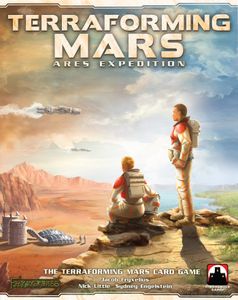
Develop a Martian corporation through simultaneous phase selection, balancing production, project cards, and your contribution to terraforming.
Terraforming Mars: Ares Expedition supports 1–4 players; community best: 3 players; playing time: 45–60 minutes. A WANGO browser trial has not been confirmed.
Background & introduction
Terraforming Mars: Ares Expedition concentrates corporate growth into cards and phase selection. Players share progress on temperature, oxygen, and oceans while accumulating their own terraforming rating and project benefits. This standalone game does not need the original Terraforming Mars tile-placement system.
Not every phase happens each round. Everyone secretly selects a phase, all players participate in the selected phases, and selectors receive bonuses. You cannot select the same phase on consecutive rounds, making opponents’ likely need for production or construction relevant to your own plans.
Green projects support production, blue projects offer actions or ongoing effects, and red events provide immediate effects. Steel and titanium repeatedly discount suitable projects, while spare cards can fund purchases. The base solo mode gives you twenty-five rounds to finish terraforming, with a phase deck supplying both extra phases and a timer.
Core rules & scoring
The base game supports 1–4 players. Normally choose one of two corporations, receive eight project cards and your corporation’s starting benefits, and start at five terraforming rating. Start temperature and oxygen at their minimums with nine unflipped oceans. The manual provides first-game card presets.
Each round has Planning, Resolve Phases, and End steps. Secretly select a phase card simultaneously, reveal it, and retrieve your previous choice. You cannot select the same phase in consecutive rounds.
Resolve only phases selected by at least one player, in Development, Construction, Action, Production, Research order. Everyone participates simultaneously, each phase occurs once regardless of how many selected it, and each selector receives its bonus.
Development allows one paid green project; its selector reduces that card’s cost by three MC. Each steel capability discounts building-tag projects by two MC; each titanium capability discounts space-tag projects by three. These apply across card colors, are not spent, and cannot reduce a cost below zero.
Construction allows one blue or red project. Its selector may play another, or draw one card before or after playing. Ocean, oxygen, and temperature requirements use the state at the start of the phase. A project card in hand can be discarded for three MC at any time.
Action normally permits each in-play card’s Action ability once; its selector may use one again. Standard actions can repeat: eight plants or twenty MC for a forest; eight heat or fourteen MC for temperature; fifteen MC for an ocean. At phase end, spend usable plants or heat on standard terraforming while the corresponding parameter remains below its maximum.
Production supplies MC production plus current terraforming rating, and plant, heat, and card production; its selector gains four extra MC. Research normally draws two and keeps one; its selector draws five and keeps two instead, discarding the remainder. Rebuild an empty project deck by shuffling its discards.
Each parameter step normally adds one terraforming rating. Throughout the phase when a parameter reaches its maximum, players may still gain the prescribed benefits for raising it; extra ocean effects use the last flipped ocean’s reward. Later phases give no further benefits for raising that parameter, though building forests still awards forest points.
At round end, reduce your hand to ten and gain three MC per card discarded this way. Once temperature reaches +8°C, oxygen reaches 14%, and all nine oceans are flipped, finish only the current phase, then score terraforming rating, forests, and projects. Break ties by total heat, MC, and plants; convert unwanted hand cards to MC before comparing.
Base solo uses twenty-five rounds. Shuffle five extra phase cards as a dummy hand; reveal one each round to activate that phase without a selector bonus. Reshuffle after each five-round group, choosing the dummy order for the final five rounds. On the first four reshuffles, Novice/Advanced assists raise oxygen or temperature two/one steps without rating or forest points; Expert gives no assistance. Finish all terraforming before time expires to win.
Rules & gameplay questions
Are steel and titanium resources I spend?
No. They are persistent discounts for matching project tags: two MC per steel capability and three per titanium. The resulting cost cannot be negative.
Can a temperature rise this phase qualify my project immediately?
No. Temperature, oxygen, and ocean requirements check the state at the phase’s start, before changes made during that phase.
Do slower players miss rewards when a parameter fills?
No. Throughout the phase in which it fills, raising it still supplies the prescribed rewards, including terraforming rating. Oceans repeat the last flipped tile’s reward. The restriction begins in later phases.
May I save eight usable heat for a later round?
At the end of an Action phase, you must use sufficient heat or plants for their standard terraforming actions while the associated parameter remains incomplete. A completed parameter removes that obligation.
If the solo dummy matches my phase, does it happen twice?
No. Resolve it once. Your own selection gives its bonus; the dummy adds no bonus. Your next choice must differ from your previous personal selection, not from the dummy’s previous card.
Rules & introduction sources
- Edition
- 2021 Ares Expedition base game for 1–4, using FryxGames’ currently linked 20-page English base manual and its twenty-five-round solo mode. The current product is labeled Collector’s edition; layered boards do not alter this overview’s base procedures. Does not detail the printed two-player cooperative mode. Excludes Discovery, Crisis, Foundations, promotional cards, extended-round community variants, and rules from the original Terraforming Mars.
- Rule references
- Introduction source
- BoardGameGeek
WANGO editorial
| Parameter | Recorded value |
|---|---|
| BGG overall rank (snapshot) | #195 |
| Complexity Weight | 2.93 / 5 |
| Best player count (community) | 3 |
| Player range | 1–4 |
| Playing time (minutes) | 45–60 |
| Core mechanisms | End Game Bonuses · Follow · Hand Management · Income · Market · Multi-Use Cards · Set Collection · Simultaneous Action Selection · Solo / Solitaire Game · Tags · Tech Trees / Tech Tracks · Track Movement · Variable Phase Order · Variable Player Powers · Variable Set-up |
| Chinese publication | Unconfirmed |
| WANGO browser play | No confirmed WANGO trial |
| Year published | 2021 |
| Suggested age | 14+ |
BGG statistics are stored snapshots, not live rankings. Source checked:2026-09-27
Player questions
What is the best player count for Terraforming Mars: Ares Expedition, and can I play online?
Terraforming Mars: Ares Expedition supports 1–4 players; community best: 3 players; playing time: 45–60 minutes. A WANGO browser trial has not been confirmed. Recorded mechanism tags: Solo / Solitaire Game.
How complex is Terraforming Mars: Ares Expedition, and which mechanisms does it use?
Weight: 2.93 / 5. Mechanisms: End Game Bonuses · Follow · Hand Management · Income · Market · Multi-Use Cards · Set Collection · Simultaneous Action Selection · Solo / Solitaire Game · Tags · Tech Trees / Tech Tracks · Track Movement · Variable Phase Order · Variable Player Powers · Variable Set-up. Chinese publication: Unconfirmed.
Where can I learn Terraforming Mars: Ares Expedition?
No rule guide, strategy article or WANGO trial has been confirmed for this record.