Darwin's Journey
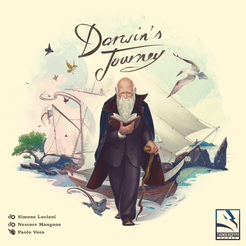
Train workers with distinct wax-seal expertise, explore the Galapagos, research and deliver specimens, and turn correspondence, round goals, and evolutionary study into points over five rounds.
Darwin's Journey supports 1–4 players; community best: 3 players; playing time: 60–120 minutes. A WANGO browser trial has not been confirmed.
Background & introduction
Darwin’s Journey, designed by Simone Luciani and Nestore Mangone, revisits the Galapagos expedition. Each worker’s wax seals determine which action spaces they can use. Further study unlocks distinction bonuses, allowing a worker to perform stronger tasks as the journey develops.
Island exploration and ocean navigation offer specimen research and campsites, while Museum deliveries convert researched specimens into coins and Theory of Evolution progress. Correspondence stamps compete for round-end actions, and Beagle goals with penalties for lagging ships give each round a changing research priority.
The base game supports two to four competitors and includes solo rules against Alfred. This overview covers the five-round core game. Fireland’s Tierra del Fuego map, Time track, and Adventures, along with Collector’s edition additional modules, use their own optional rules and are not automatic features of a retail base game.
Core rules & scoring
Use the board side for your player count and prepare Special Actions, Correspondence, and 5 Beagle goals. Each player starts with 4 available workers, 3 Crew cards, one silver and one golden starting Objective, 4 Coins, and 1 Temporary Knowledge token. Unlock the fifth worker through its golden Objective reward.
Play 5 rounds, each with Action, Turn Order, Reward, and Cleanup phases. In turn order, place one worker on a legal main-board location and perform its actions; players without workers pass. Multiple action icons can usually be resolved in your chosen order, using earlier benefits to pay for later actions.
The particular worker placed must meet the location’s wax-seal colors and quantities. Purple seals are wild; spend Temporary Knowledge to cover placement requirements, but keep ordinary seals. Academy actions buy seals, paying both Scroll and personal-board costs. A worker’s fourth and sixth seals grant silver and golden distinctions.
Entering a Diary Section already containing any worker normally costs 3 Coins with two players or 2 with three or four, regardless of how many workers are there. Circular magnifying glasses accept several workers, unlocked Lens spaces only one; square and rectangular areas accept several without this placement penalty.
An unlock action pays the cost to place a personal Lens and immediately performs that location’s actions without another worker or its seal requirements. Everyone may subsequently use it. When another player later places a worker on your Lens, take 1 Coin from the supply; that opponent does not pay you an extra Coin.
Navigation moves your Ship, adding an Explorer to a new island when you cross its silver banner. Exploration moves one Explorer, skipping intermediate spaces occupied by opponents. A specimen action places a Research token on your board. Ordinary delivery requires a researched specimen absent from the Museum; its row and column’s empty and filled spaces determine benefits.
Correspondence moves the indicated Stamps from your board to a single Envelope; emptying stacks activates their rewards. At round end, score Envelopes top to bottom. First and second place take their actions; ties grant full rewards and tied first place does not cancel second. Players who actually perform a majority-reward action remove half their Stamps there, rounded up.
Objectives require meeting conditions without spending the listed assets, though their personal-board slots can cost Coins. Complete a Crew card with seals in a single worker’s row, at most one Crew card per worker. Purple seals count for Crew, not Objectives or regular-color Beagle goals; Temporary Knowledge counts for neither Crew nor Objectives.
Score the current Beagle goal each round, subtracting lagging penalties for ships behind the Beagle, to a minimum of zero. After rounds 1–4, retrieve workers, advance the Beagle, and refresh tiles. After round 5 add personal-board Objective, seal, and campsite points, one point per 5 Coins and per Temporary Knowledge, and Evolution books multiplied by 2 plus completed Museum rows. Highest score wins; multiplayer ties compare Evolution position, then Coins, then share victory.
Rules & gameplay questions
Does my own worker trigger the Diary placement penalty?
Yes. Any worker in that Diary Section triggers it, not just opponents or workers on the same action. At lower player counts, do not split a whole Diary into two sections without a red bookmark.
Can purple seals and Temporary Knowledge complete Objectives?
No. Purple seals meet placement and Crew requirements, not an Objective’s regular-color requirement. Temporary Knowledge only supplements worker placement. Crew requires one worker’s seals, while an Objective can count regular seals across workers.
Is researching a specimen the same as delivering it?
No. Research records your knowledge on your personal board; delivery separately places the matching Museum tile in the shared display. Once delivered, it cannot be delivered normally again. A specific Special Action explicitly allows repeat delivery.
Does everyone discard Stamps after Correspondence rewards?
The rule applies to players who actually perform a majority-reward action. Each removes half their own Stamps from that Envelope, rounded up. Do not automatically halve every player’s Stamps.
Is there a solo mode?
Yes. Use Alfred’s board, Action cards, and dedicated setup. You follow the core flow while Alfred follows special priorities and always goes first each round. Removing the other players alone is not the complete solo mode.
Are Fireland and Collector’s contents part of the core rules?
No. Fireland replaces the map and adds Time and Adventures; additional Collector’s contents also have module-specific rules. Agree which modules are enabled rather than assuming they appear in every base game.
Rules & introduction sources
- Edition
- Darwin’s Journey base game for two to four players over five rounds, with Alfred solo scope. Uses the publisher’s English rules, including the distinction that players actually performing Correspondence rewards remove Stamps. Excludes detailed Fireland, Oceania, Collector’s, and promotional module procedures.
- Rule references
- Introduction source
- BoardGameGeek
WANGO editorial
| Parameter | Recorded value |
|---|---|
| BGG overall rank (snapshot) | #90 |
| Complexity Weight | 3.91 / 5 |
| Best player count (community) | 3 |
| Player range | 1–4 |
| Playing time (minutes) | 60–120 |
| Core mechanisms | Contracts · Ownership · Pick-up and Deliver · Point to Point Movement · Set Collection · Solo / Solitaire Game · Turn Order: Claim Action · Variable Set-up · Worker Placement · Worker Placement, Different Worker Types |
| Chinese publication | Unconfirmed |
| WANGO browser play | No confirmed WANGO trial |
| Year published | 2023 |
| Suggested age | 14+ |
BGG statistics are stored snapshots, not live rankings. Source checked:2026-09-27
Player questions
What is the best player count for Darwin's Journey, and can I play online?
Darwin's Journey supports 1–4 players; community best: 3 players; playing time: 60–120 minutes. A WANGO browser trial has not been confirmed. Recorded mechanism tags: Solo / Solitaire Game.
How complex is Darwin's Journey, and which mechanisms does it use?
Weight: 3.91 / 5. Mechanisms: Contracts · Ownership · Pick-up and Deliver · Point to Point Movement · Set Collection · Solo / Solitaire Game · Turn Order: Claim Action · Variable Set-up · Worker Placement · Worker Placement, Different Worker Types. Chinese publication: Unconfirmed.
Where can I learn Darwin's Journey?
No rule guide, strategy article or WANGO trial has been confirmed for this record.