Hegemony: Lead Your Class to Victory
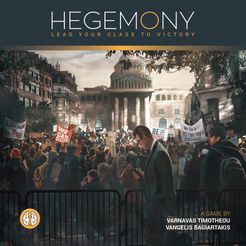
Hegemony: Lead Your Class to Victory puts players in charge of the Working Class, Middle Class, Capitalist Class, or State, competing for victory points through production, consumption, and legislation within one shared economy.
Hegemony: Lead Your Class to Victory supports 2–4 players; community best: 4 players; playing time: 90–180 minutes. A WANGO browser trial has not been confirmed.
Background & introduction
This is asymmetric competition within a shared society. The Working Class earns wages and meets its population’s needs to increase prosperity; the Capitalist Class runs companies, sells goods and services, and accumulates after-tax capital. The Middle Class both works for wages and operates smaller businesses, balancing production with consumption.
A four-player game adds the State, which manages public companies, addresses events, and builds legitimacy with the three classes. Its aim is broader than enriching one class: each round it scores the two lowest legitimacy tracks, alongside its political agenda.
Workers, businesses, and policy constrain one another. Labor policy changes minimum wages, fiscal policy changes the public sector, and healthcare, education, and taxation affect spending and demand. Trade can benefit both parties, but each role scores independently rather than belonging to a fixed team.
Core rules & scoring
Player count determines roles: two players use the Working Class and Capitalist Class; three add the Middle Class; four add the State. Public companies, the treasury, and policy still function at lower counts, and two-player elections still include Middle Class voting cubes.
Play five rounds of preparation, actions, production, elections, and scoring; skip preparation in round one. Action order is Working Class, Middle Class, Capitalist Class, then State. Each takes five turns, playing one card for its effect or discarding it for a basic action, plus at most one free action per turn.
Role development: the Working and Middle Classes spend health, education, or luxury equal to population to gain prosperity and immediately score its new value. Healthcare also gives 2 VP and a worker; education improves a worker’s skills. Working Class unions provide influence and 2 VP each round. The Middle Class can gain another prosperity during scoring if fully operational companies outnumber its prosperity value. The Capitalist Class transfers after-tax revenue to capital and scores total capital, with bonuses for new wealth milestones.
Policy and the State: propose a change to an adjacent policy section, with no competing bill already on that policy; spend 1 influence to call an immediate vote. Fiscal policy controls public companies, labor policy sets minimum wages, and other policies affect tax, welfare, trade, and immigration. In four-player games, unresolved events penalize the State before it scores the sum of its two lowest legitimacy values and its agenda; legitimacy is then halved, rounded up, and permanent tokens are added.
Production resolves each step completely before the next: produce and pay wages, cover food needs, check IMF intervention, then pay taxes. Within each step, order is State, Capitalist Class, Middle Class, Working Class. A company’s listed wage covers its entire workforce, not each worker separately.
For each bill, draw five voting cubes and let players secretly add influence. A tied vote passes. If the bill passes, the proposer earns 3 VP; other supporters earn 1 VP only if they actually contributed a supporting cube or influence.
After round five, the Capitalist Class loses 5 VP per loan. Other roles may repay loans at 55 each, losing 1 VP per unpaid 5. Add each role’s policy, inventory, and cash bonuses where applicable; the State scores 1 VP per 30 cash and counts only media influence in its inventory scoring.
Most VP wins. Break ties by matching policies 1–5: A for Working Class, B for Middle Class, C for Capitalist Class, and the agenda for State. If still tied, a tied State wins; otherwise compare voting cubes, then share victory if necessary.
Rules & gameplay questions
Can newly assigned workers move again immediately, or have their wages reduced?
Usually no. Assigned workers are committed: they cannot be reassigned, their wages cannot be lowered, and their company cannot normally be sold until production releases that commitment. Explicit exceptions, such as fiscal policy forcing public companies to close, still apply.
Do striking workers receive wages without producing?
No. An operational company still on strike at production, with wages below level 3, skips the affected production and pays no wage. In a Middle Class company, only the Working Class employee’s production bonus is skipped; the Middle Class worker still produces.
Can I voluntarily borrow money to build a company?
No. Loans cover payments you are forced to make, such as wages, taxes, and necessary food, rather than optional purchases or actions. A loan provides 50 and requires 5 interest during subsequent preparation phases.
Can the Middle Class consume healthcare directly from its own production storage?
No. First use Buy Goods & Services to transfer it to the personal Goods & Services area. Buying from yourself costs no money, but uses one of the action’s two sources and remains limited to your population per source. A later applicable free action consumes it.
Rules & introduction sources
- Edition
- Hegemonic Project English base rulebook v1.2 (40 pages, copyright 2022), for 2–4 players, including its rules and card FAQ on pages 35–38. No expansion solo automas; Crisis & Control, Historical Events, and other expansions are outside this overview.
- Rule references
- Introduction source
- BoardGameGeek
WANGO editorial
| Parameter | Recorded value |
|---|---|
| BGG overall rank (snapshot) | #41 |
| Complexity Weight | 4.26 / 5 |
| Best player count (community) | 4 |
| Player range | 2–4 |
| Playing time (minutes) | 90–180 |
| Core mechanisms | Action / Event · Hand Management · Simulation · Variable Player Powers · Voting · Worker Placement, Different Worker Types |
| Chinese publication | Unconfirmed |
| WANGO browser play | No confirmed WANGO trial |
| Year published | 2023 |
| Suggested age | 14+ |
BGG statistics are stored snapshots, not live rankings. Source checked:2026-09-27
Player questions
What is the best player count for Hegemony: Lead Your Class to Victory, and can I play online?
Hegemony: Lead Your Class to Victory supports 2–4 players; community best: 4 players; playing time: 90–180 minutes. A WANGO browser trial has not been confirmed.
How complex is Hegemony: Lead Your Class to Victory, and which mechanisms does it use?
Weight: 4.26 / 5. Mechanisms: Action / Event · Hand Management · Simulation · Variable Player Powers · Voting · Worker Placement, Different Worker Types. Chinese publication: Unconfirmed.
Where can I learn Hegemony: Lead Your Class to Victory?
No rule guide, strategy article or WANGO trial has been confirmed for this record.