MicroMacro: Crime City
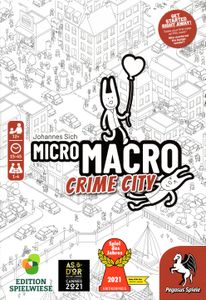
MicroMacro: Crime City is a cooperative investigation game in which players study one shared city map, trace characters and scenes, and answer the tasks in a case deck together.
MicroMacro: Crime City supports 1–4 players; community best: 2 players; playing time: 15–45 minutes. A WANGO browser trial has not been confirmed.
Background & introduction
MicroMacro: Crime City turns a densely illustrated city map into a shared investigation surface. Players do not compete as opposing detectives or belong to different teams; everyone works on the same case and looks at the same map. Each case card directs the group toward an event or a particular scene, and the team must find a matching image on the map before it can move the investigation forward.
A case is revealed through a deck of task cards rather than one uninterrupted narrative. Each prompt asks players to identify a person, place, or action in the city and connect details that may appear far apart on the map. A character can appear in more than one scene, so tracing a route and its sequence often matters more than reading the prompt in isolation. The rules require the map to confirm an answer; a guess alone does not resolve a task.
This mechanism makes the city itself both setting and evidence board. Players can examine the same locations from different viewpoints, discuss where a character appears, and follow the visual clues together. The case cards control how information is revealed: after the group solves a prompt, the Lead Investigator checks its answer and reads the result before the next card becomes the new task. The story therefore unfolds in steps as the team solves it.
The base game is a cooperative investigation. One player serves as Lead Investigator, reads cards, and verifies answers while still helping search the map. The rules recommend bright light and a clear space so every player can see the detailed artwork; cards and drinks should not cover the map. Groups who enjoy careful observation, discussion, and shared puzzle-solving can treat the box as a sequence of city cases. There is no individual score or player elimination.
Core rules & scoring
Objective and format: Work together on one case from the base box and resolve all of its tasks in card order. Each task requires the group to find a specific scene on the city map, after which the Lead Investigator checks the answer printed on the reverse. The rules provide no action points, resource system, individual score, or competitive winner; the group shares the investigation. (English rules, pp. 1, 3)
Sort the case cards: The box contains one city map, 120 case cards, 16 case envelopes, and a magnifying glass with a sticker. Apply the sticker to the glass during first setup. Each case card has a case icon and card number in its upper-right corner; sort cards by icon and place each numbered deck in its matching envelope. Do not inspect card fronts while sorting, so you do not reveal tasks or answers early. (English rules, p. 2)
Set up the map: Spread the whole city map where everyone can see it and move around it; a table, floor, or wall can work. Turn on bright lighting and keep the map unobstructed. Place case cards beside the map rather than on top of it, and move drinks or other objects away. The small characters and scene details are the evidence, so covered areas or dim light make investigation harder. (English rules, p. 2)
Choose a case and begin: Take one case deck from its envelope and stack it beside the map in order. The start card introduces the event and gives its background. The Lead Investigator reads it, then reads the prompt on the next task card. Everyone studies the map and discusses possible scenes. Keep the card face up until the group finds a candidate scene, then let the Lead Investigator turn it over to verify. (English rules, p. 3)
Lead Investigator: Each case assigns one player this role. The Lead Investigator reads card text, checks the answer, and reads the explanation when the group is correct. They still help search and discuss the current prompt. Once the Lead Investigator has seen a particular answer, they may not solve that specific task with the group; they may offer a hint if the others are on the wrong track. (English rules, p. 3)
Verify a correct answer: A task asks for a specific scene on the map; the group should not declare success from a guess alone. The Lead Investigator checks the coordinates and illustration on the reverse. If they match, the investigator reads the answer text and sets the resolved card aside. The newly revealed card becomes the next task. Continue this process until every task in that case has been answered correctly. (English rules, p. 3)
When an answer is wrong: The Lead Investigator does not read the answer. They return the card to the top of the deck and tell the group that the scene is not correct; everyone keeps searching. The rules do not impose a score penalty, lost turn, or elimination, because the game has no scoring or turn-taking action system. The map must confirm the answer. A Lead Investigator who has already seen it stops solving that specific task, but can give a hint if the team is off track. (English rules, p. 3)
Symbols, simultaneous tasks, and markers: A light-bulb symbol marks a scene that may help with a later task. A two-card symbol tells players to move the current card aside so the prompt below is visible; the group may then work on two tasks at once, and repeated symbols can reveal more. The rules suggest coins or bottle caps to mark useful map locations. These objects are reminders only; they do not score points or create rule effects. (English rules, p. 4)
Case order and difficulty stars: New players are advised to start with the first five cases in the listed order, but this is an introduction rather than a mandatory sequence for every play. Stars beside a case indicate approximate difficulty and duration, not points or extra challenge requirements. A group may choose a case that suits its interest; if several prompts are visible, it should confirm each scene from the map rather than treat the stars as a rule. (English rules, p. 4)
Optional advanced play and ending: After learning the game, players may use the advanced option on page 6: read only the start card and try to solve the whole case without consulting the task cards, then reveal them and answer the questions in order. If stuck, uncovering already-solved prompts can check a theory or offer a hint. Standard and advanced play both finish when all case tasks are correctly resolved. Hidden riddles are optional official extras, not part of the base procedure. (English rules, pp. 3, 6)
Rules & gameplay questions
Is MicroMacro: Crime City cooperative or competitive?
It is a cooperative investigation. Everyone solves the same case together rather than competing for personal points or trying to defeat another player. All clues appear on the shared city map, so players can observe from different positions and compare ideas. The Lead Investigator reads cards and checks answers but still joins the search. Only a task whose answer that player has already seen is off limits for their own solving.
Do players take turns or spend action points?
The standard rules do not use turns or action points. The Lead Investigator reads the start card and the current prompt, then the whole group studies the map and discusses a possible scene. Once players find a candidate, the Lead Investigator checks the answer. Their role is to read and verify, not to control play; everyone can contribute observations and help decide whether the scene matches the task.
Can we guess an answer without finding its scene on the map?
No. The rules require the group to locate a specific scene that confirms the answer. The Lead Investigator compares the coordinates and illustration on the card reverse with the place the group found; only a match resolves the prompt. This keeps each step grounded in visual evidence and prevents the team from skipping observation based on memory or a plausible guess.
Do we lose points or a turn after a wrong answer?
No. There is no personal score, action allowance, or turn penalty. If an answer is wrong, the Lead Investigator does not reveal it, returns the card to the top, and tells the group to keep investigating. The team can re-examine routes and details. A Lead Investigator who has seen the answer no longer solves that specific task, though they may offer a hint if the group is on the wrong track.
Can the Lead Investigator keep helping after seeing an answer?
They can continue helping on other tasks, but not on the particular prompt whose answer they have already read. The Lead Investigator still needs to read the card, check a map location, and explain a correct answer. If other players are following the wrong track, the rules allow the investigator to offer a hint. This limit prevents answer knowledge from spoiling the current search while preserving the role’s reading and checking duties.
What do the light-bulb and two-card symbols mean?
A light-bulb marks a scene that could help with a later task, so the group may want to remember or mark that location. A two-card symbol tells players to move the current card aside to reveal the prompt underneath; the team can then work on two or more tasks at the same time. These symbols do not award points or create extra actions. Each task still needs a map-based answer check before it is resolved.
Do the stars give points or force a case order?
No. Stars are approximate indications of a case’s difficulty and duration, not scores or conditions for solving it. The rules recommend that new players begin with the first five cases in the listed order as a gentle introduction. That is advice, not a requirement that every group follow the same sequence. Once familiar with the system, players can choose another base-box case and still resolve its cards in order.
When does a case end, and how does advanced play differ?
A standard case ends when the group has correctly resolved all of its tasks; there is no total-score tally afterwards. Experienced groups can try the optional advanced method on page 6: read only the start card, attempt the whole case without opening the task prompts, then reveal the cards and answer them in sequence. If the group gets stuck, it may uncover already-solved questions to test a theory or get a hint. The cooperative objective stays the same.
Rules & introduction sources
- Edition
- This entry covers the original standalone MicroMacro: Crime City base box (BGG 318977), published by Edition Spielwiese and distributed by Pegasus Spiele, using Pegasus’s official six-page English rules for the original 16 cases. It excludes Full House, All In, Showdown, the Bonus Box, the mobile game, and other maps or cases. The PDF has no printed version number; its metadata and copyright page identify the 2021 rules text.
- Rule references
- Introduction source
- BoardGameGeek
WANGO editorial
| Parameter | Recorded value |
|---|---|
| BGG overall rank (snapshot) | #302 |
| Complexity Weight | 1.11 / 5 |
| Best player count (community) | 2 |
| Player range | 1–4 |
| Playing time (minutes) | 15–45 |
| Core mechanisms | Cooperative Game · Deduction · Scenario / Mission / Campaign Game · Solo / Solitaire Game |
| Chinese publication | Unconfirmed |
| WANGO browser play | No confirmed WANGO trial |
| Year published | 2020 |
| Suggested age | 12+ |
BGG statistics are stored snapshots, not live rankings. Source checked:2026-09-27
Player questions
What is the best player count for MicroMacro: Crime City, and can I play online?
MicroMacro: Crime City supports 1–4 players; community best: 2 players; playing time: 15–45 minutes. A WANGO browser trial has not been confirmed. Recorded mechanism tags: Solo / Solitaire Game.
How complex is MicroMacro: Crime City, and which mechanisms does it use?
Weight: 1.11 / 5. Mechanisms: Cooperative Game · Deduction · Scenario / Mission / Campaign Game · Solo / Solitaire Game. Chinese publication: Unconfirmed.
Where can I learn MicroMacro: Crime City?
No rule guide, strategy article or WANGO trial has been confirmed for this record.