Imperium: Classics
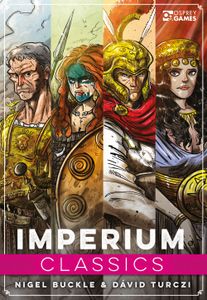
Imperium: Classics is an asymmetric civilization deck-builder. Players develop ancient civilizations through card actions, expansion, and unrest management; the official solo rules add a civilization-driven bot.
Imperium: Classics supports 1–4 players; community best: 1–2 players; playing time: 40–160 minutes. A WANGO browser trial has not been confirmed.
Background & introduction
Imperium: Classics asks each player to lead an ancient civilization as it competes for territory, develops culture and technology, and builds a more capable deck. Its eight civilizations—Carthaginian, Celt, Greek, Macedonian, Persian, Roman, Scythian, and Viking—have different cards, abilities, and development patterns. Players are not simply choosing a different leader for the same starting puzzle; each civilization changes the way its engine grows and scores.
The theme of a rising empire is expressed through changing card circulation and a shared market. Players choose how to use cards from hand, turning them into actions, resources, or lasting advantages, while also handling unrest, cleanup, and seasonal effects. Adding cards is not always enough: players must decide when to expand, when to advance their state, and when to return Unrest cards from hand to the Unrest pile.
The base game supports competitive play for two to four people and includes an official solo system in a separate rulebook. In solo, each civilization can be used by either the human player or a bot, whose behavior follows a civilization-specific reference table rather than normal card text. Multiplayer games may end in a conventional score comparison or in Collapse, triggered by the Unrest pile running out; Collapse changes the comparison and makes unrest control a central strategic concern.
Core rules & scoring
Objective and civilizations: Each player selects a Classics civilization, manages its starting deck and state, and gradually changes its card cycle while seeking more victory points than the opponents. The eight choices are Carthaginian, Celt, Greek, Macedonian, Persian, Roman, Scythian, and Viking. Each has its own cards and rules that alter its strategy; do not assume every civilization follows the same upgrade path.
Setup and shared market: Take the chosen civilization’s deck, ability cards, and state board, then build the public market and Unrest pile according to player count. Each player begins with five cards in hand. The region, uncivilised and civilised decks each use six cards with two players, seven with three, or eight with four; the fame deck has its own player-count reduction. Place the specified cards and resources in the shared area, and follow the chosen civilization’s setup table for its starting state.
Choose one main action per turn: Players take turns clockwise. On a turn, choose one of Activate, Innovate, or Revolt. Activate lets the player use cards from hand according to the action resources and card text, place cards in the appropriate areas, or trigger available Exhaust abilities on deployed cards. Pay the costs shown by the card or state board. Ordinary actions and Exhaust abilities may be sequenced as permitted, subject to timing and resource limits. Normally, Activate starts with three action tokens and five Exhaust tokens. Playing a normal card costs an action token; using an Exhaust ability spends its separate token, subject to extra-action and free-play effects.
Innovate and Revolt: Innovate discards the entire hand, then performs one Break Through for a permitted suit as defined in the main rules; this is distinct from developing a Development card. Revolt returns any number of Unrest cards from hand to the Unrest pile. Each is an alternative to Activate, so the player cannot also take ordinary Activate actions or use Exhaust abilities that turn. Innovate can reshape a hand and advance the state; Revolt can remove unwanted cards, but also changes the position of the Unrest pile.
Cleanup and Solstice: After the selected action, resolve Clean Up, handle used cards and state, adjust the market, and draw back to five cards. If the draw pile is exhausted, follow the main rules for the civilization’s Nation or Development cards before reshuffling its discard pile. After every player has taken a turn in the round, resolve Solstice effects from the current season, civilization, and cards, then begin the next round. Resolve each printed effect rather than assuming all civilizations share one result.
Deck circulation and development: Players change their civilization through drawing, deploying, acquiring, and developing cards. An empty draw pile does not itself cause defeat: the rules may require the player to process a Nation or Development card according to the current state, then shuffle the discard pile into a new deck. Card locations and availability affect later Activate actions and resource planning. Civilization-specific development rules vary and must be followed instead of applying one universal engine formula.
Multiplayer ending and score: A normal ending can be triggered by the shared main deck running out, the last Development card being developed, a specific civilization card condition, or King of Kings. In the normal sequence, finish the current round and play a final round, then score VP from the player’s areas, hand, deck, discard, History area, and card text. The highest VP total wins, with a shared victory on a tie. Follow the triggering card and main rulebook for the exact condition.
Unrest and Collapse: If the Unrest pile runs out, Collapse triggers immediately instead of the usual round completion and VP procedure. Compare the number of Unrest cards in each player’s hand, play area, draw deck, discard pile, and History; the fewest Unrest cards wins. If players tie on card count, proceed to scoring as specified by the rules. Managing Unrest can therefore affect whether a game ends through development or social collapse.
Solo bot: The official Solo Rulebook adds an automated opponent. In each round, the human player takes a turn first, the bot acts next, and Solstice follows. The bot rolls to determine which face-down card in its action sequence is skipped or removed, then executes cards from the lowest-numbered position using its civilization’s reference table. It does not play and interpret cards as a human would. All eight Classics civilizations can be used by the player or bot.
Solo victory, difficulty, and campaign: Solo uses the main ending framework but changes the comparison: the player must score more than the bot to win, and a tie goes to the bot. Collapse is an immediate player loss. Five difficulty levels, from Chieftain to Overlord, adjust the bot’s action count and starting resources. Campaign Mode links multiple solo games; win five games to complete it, while four accumulated losses end the campaign.
Rules & gameplay questions
How many civilizations and players are in the base box?
Classics contains eight civilizations: Carthaginian, Celt, Greek, Macedonian, Persian, Roman, Scythian, and Viking. Osprey lists one to four players and about forty minutes per player. Two to four players use the competitive rules; a single player uses the separate official Solo Rulebook and its bot procedure. Each civilization has distinct starting cards, abilities, and development, so there is no single generic deck that represents all eight.
What can I choose on my turn?
Choose one of three main actions: Activate, Innovate, or Revolt. Activate uses cards and available Exhaust abilities within the rules for resources and timing. Innovate discards the whole hand and performs one Break Through for a permitted suit. Revolt returns any number of Unrest cards from hand to the Unrest pile. Innovate and Revolt replace Activate, so they do not permit extra ordinary activations afterward that turn.
How does the hand and deck cycle work?
Players begin with five cards and draw back to five during Clean Up. Running out of cards in the draw pile does not immediately lose the game. The main rules require the player to process Nation or Development cards according to the current civilization state, then reshuffle the discard pile into a new deck. Acquiring and deploying cards changes the cycle, but development differs among the eight civilizations and should follow their own rules.
What happens during Solstice?
Solstice occurs after every player has taken a turn in the round. Resolve the current season’s effects along with effects printed on civilization and other cards, then begin a new round. It is not a player-selected Activate action and does not happen separately during each individual turn. Since civilizations have different abilities, check the relevant text instead of assuming every Solstice produces the same result.
How does multiplayer end and score?
A normal ending may be triggered when the shared main deck is exhausted, the last Development card is developed, a civilization card condition is met, or King of Kings occurs. Usually the current round is completed and a final round is played; then score VP in player areas, hand, deck, discard, History area, and card effects. The most VP wins, with a shared win on a tie. If Unrest runs out first, Collapse immediately changes the procedure.
How is Collapse different from a normal ending?
Collapse occurs immediately when the Unrest pile runs out and does not use the ordinary final-round VP procedure. Players compare the number of Unrest cards in their hands, play areas, draw decks, discard piles, and History areas; the fewest Unrest cards wins, with the rules specifying how to proceed if counts tie. A normal ending instead finishes the required rounds and totals victory points. The two endings reward different approaches to handling cards and unrest.
How does the solo bot take its turn?
In solo, the human acts first each round, the bot takes its turn next, and then Solstice is resolved. The bot rolls to select a face-down card in its action sequence to skip or remove, then uses a civilization-specific table to execute actions from the lowest-numbered position. It does not interpret card text in the same way a human player does. The player must finish with more points than the bot; a tie goes to the bot.
What are solo difficulty levels and Campaign Mode?
The official solo rules provide five levels—Chieftain, Warlord, Imperator, Sovereign, and Overlord—that adjust the bot’s actions and starting resources. Campaign Mode strings solo games together: the player must win five games to complete the campaign, and four accumulated losses end it. This optional campaign procedure belongs to the Solo Rulebook and does not change multiplayer endings or scoring.
Are Legends or Horizons rules part of Imperium: Classics?
No. Classics is a standalone game. Osprey permits it to be combined with the separate Imperium: Legends box under compatibility rules, adding civilizations and public cards, but that requires the other product. Horizons has its own civilization set and rulebook, so features such as Trade Routes or Practice Mode should not be applied to Classics merely because the games share a series name.
Rules & introduction sources
- Edition
- This entry covers Osprey Games’ 2021 Imperium: Classics (BGG 318184), an eight-civilization base game for 1–4 players, about 40 minutes per player according to Osprey. Multiplayer and Solo Rulebook procedures follow the update1-0 PDFs currently listed on Osprey’s resource page. That page also lists Errata and Corrected Cards, but their current PDF revision could not be confirmed; this entry avoids relying on unverified card-specific rulings. The solo bot is manually run from its separate rules. Legends, Horizons, and cooperative content are not folded into the Classics base box.
- Rule references
- Introduction source
- BoardGameGeek
WANGO editorial
| Parameter | Recorded value |
|---|---|
| BGG overall rank (snapshot) | #335 |
| Complexity Weight | 3.63 / 5 |
| Best player count (community) | 1–2 |
| Player range | 1–4 |
| Playing time (minutes) | 40–160 |
| Core mechanisms | Deck, Bag, and Pool Building · End Game Bonuses · Hand Management · Move Through Deck · Open Drafting · Scenario / Mission / Campaign Game · Solo / Solitaire Game · Take That · Variable Player Powers · Variable Set-up |
| Chinese publication | Unconfirmed |
| WANGO browser play | No confirmed WANGO trial |
| Year published | 2021 |
| Suggested age | 14+ |
BGG statistics are stored snapshots, not live rankings. Source checked:2026-09-27
Player questions
What is the best player count for Imperium: Classics, and can I play online?
Imperium: Classics supports 1–4 players; community best: 1–2 players; playing time: 40–160 minutes. A WANGO browser trial has not been confirmed. Recorded mechanism tags: Solo / Solitaire Game.
How complex is Imperium: Classics, and which mechanisms does it use?
Weight: 3.63 / 5. Mechanisms: Deck, Bag, and Pool Building · End Game Bonuses · Hand Management · Move Through Deck · Open Drafting · Scenario / Mission / Campaign Game · Solo / Solitaire Game · Take That · Variable Player Powers · Variable Set-up. Chinese publication: Unconfirmed.
Where can I learn Imperium: Classics?
No rule guide, strategy article or WANGO trial has been confirmed for this record.