7 Wonders (Second Edition)
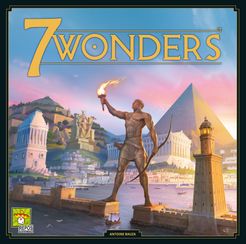
Draft simultaneously across three Ages to develop a city and score through production, warfare, science, and civic achievements.
7 Wonders (Second Edition) supports 3–7 players; community best: 4–5 players; playing time: 30 minutes. A WANGO browser trial has not been confirmed.
Background & introduction
Keep one card and pass the rest. Every selection also shapes the opportunities reaching your neighbors.
Production supports repeated construction; trade fills gaps while funding rivals. Wonder stages turn otherwise awkward cards into another development route.
Military compares neighbors, science rewards combinations, and Guilds value particular developments. Adapt to the cards circulating around the table.
Core rules & scoring
The second-edition base game supports three to seven. Choose a Wonder side and start with three Coins.
Filter Age decks by player count; randomly add player count plus two Guilds to Age III.
Deal seven each Age. Everyone selects and reveals one card, choosing one use.
Pay to construct its Building. Identical names cannot coexist in your City.
Alternatively pay for a Wonder stage, hiding any card beneath it. Build stages left to right; they are optional.
Sell a card for three Coins. Normally choose one of the final two; discard the other without income.
Pass left in Ages I and III, right in II; normally play six turns per Age.
Resources renew each turn. Buy neighbors' starting, Brown, or Grey production, normally for two Coins each; exclude Yellow and Wonder production.
Chains permit free construction. Compare shields with each neighbor after every Age: victories earn one, three, or five; defeats lose one; ties give nothing.
After Age III, total all scoring categories. Science scores squares per symbol plus seven per complete set; three Coins score one. Break ties by remaining Coins, then share victory.
Rules & gameplay questions
Does buying consume production?
No. Its owner and both neighbors can use it; purchases cannot be refused.
Can income fund construction immediately?
No. Use it next turn; newly built neighbor production is also unavailable this turn.
Does a buried card retain its effects?
No; it only marks the constructed stage.
Does Olympia Day reset its free colors each Age?
No. A color already in your City cannot qualify again.
Which card does Babylon Night let me play?
The normally discarded seventh card, as an extra turn under normal rules, beginning in the Age the stage is built.
Rules & introduction sources
- Edition
- 2020 second-edition 7 Wonders base game for three to seven, using current EN02 rules, effects sheet, and applicable official FAQ. Excludes the 2010 edition, expansions, promotional Wonders, two-player variants, and 7 Wonders Duel.
- Rule references
- Introduction source
- BoardGameGeek
WANGO editorial
| Parameter | Recorded value |
|---|---|
| BGG overall rank (snapshot) | #193 |
| Complexity Weight | 2.27 / 5 |
| Best player count (community) | 4–5 |
| Player range | 3–7 |
| Playing time (minutes) | 30 |
| Core mechanisms | Closed Drafting · Hand Management · Neighbor Scope · Set Collection · Simultaneous Action Selection · Variable Player Powers |
| Chinese publication | Unconfirmed |
| WANGO browser play | No confirmed WANGO trial |
| Year published | 2020 |
| Suggested age | 10+ |
BGG statistics are stored snapshots, not live rankings. Source checked:2026-09-27
Player questions
What is the best player count for 7 Wonders (Second Edition), and can I play online?
7 Wonders (Second Edition) supports 3–7 players; community best: 4–5 players; playing time: 30 minutes. A WANGO browser trial has not been confirmed.
How complex is 7 Wonders (Second Edition), and which mechanisms does it use?
Weight: 2.27 / 5. Mechanisms: Closed Drafting · Hand Management · Neighbor Scope · Set Collection · Simultaneous Action Selection · Variable Player Powers. Chinese publication: Unconfirmed.
Where can I learn 7 Wonders (Second Edition)?
No rule guide, strategy article or WANGO trial has been confirmed for this record.