Meadow
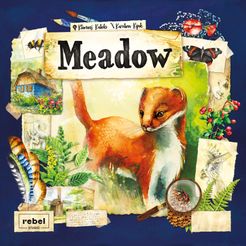
Choose nature cards with path tokens, build visible-symbol connections in your meadow, and claim campfire goals.
Meadow supports 1–4 players; community best: 2 players; playing time: 60–90 minutes. A WANGO browser trial has not been confirmed.
Background & introduction
Meadow casts players as nature observers assembling an illustrated record of their travels. Grounds and observations form a meadow, while landscapes and discoveries occupy a separate surroundings area, together creating both points and opportunities for further cards.
Path tokens serve as action opportunities and drafting coordinates. A token inserted beside the main board selects a card by distance; placing it at the campfire instead uses its other action and may allow a limited goal reward.
Observations cover old symbols while retaining the covered cards’ points, balancing immediate scoring against future requirements. Northern cards change the available choices halfway through. Official solo adds Rover, who blocks spaces and collects cards without building a conventional tableau.
Core rules & scoring
The base game supports 1–4. Two/three players play six rounds with five path tokens each; four play eight rounds with four tokens each, omitting the question mark. Use the matching campfire board and blocked notches. Start the main board with W, S, and E cards, reserving N for halfway.
Normally start with four cards from one chosen row plus one N card. Choose rows in reverse starting order and refill after each selection. Choose a side of your starting ground card and take one road token. For a first game, the rulebook permits a specified random five-card deal instead.
On a turn, put one unused path token in a vacant main-board or campfire notch. On the main board, count its printed distance in its pointing direction, take that card, and refill immediately. Then optionally play one hand card. The question mark chooses any distance from one to four.
Ground cards extend left or right of existing grounds, with at most ten columns and their ground symbols always visible. Play observations by meeting visible requirements and covering the appropriate symbol/ground column. Covered observation symbols cease to count, but covered cards still score. Played cards cannot move.
For multiple observation requirements, have every required symbol visible before covering one applicable symbol. A slash means choose either requirement; arrows require adjacent columns. A ground requirement permits placement atop its ground column even if the top observation symbol differs, provided other requirements are satisfied.
Discard two other hand cards to ignore one missing requirement symbol, returning discards to their matching deck bottoms. Repeat if needed, but an observation must still have at least one requirement actually met. This cannot replace a road token or the landscape symbol needed to place a discovery.
Play landscapes horizontally in surroundings, spending one road token and meeting any additional symbols without consuming those symbols. A discovery covers an unused landscape’s symbol and requires any other visible symbols. Do not mix these surroundings cards into the meadow’s observation columns.
Campfire specials take any main-board card, gain two roads, look at three cards from an active deck and keep one, or play up to two hand cards. The first three do not allow a card play. A question mark copies any special. An unused bench allows one card play but does not qualify for goal claiming.
Claim goals only after placing in a campfire notch: both paired symbols must be visible and the reward space empty. Place at most one bonus per turn, in value order 2, 3, 4, before, during, or after the special. After all tokens are used, retrieve them, pass first player, and advance the round. At halfway, return the display to deck bottoms, replace S with N, and refill.
After the last round, score all played meadow/surroundings cards and campfire bonuses; hand cards and unused bonuses score nothing. Highest total wins, then most played discoveries, then shared victory. Solo lasts six rounds against Rover, who always starts and alternates blocking/drafting without a tableau or bonuses. Score Rover’s collected cards; match or exceed that total before consulting the solo rating.
Rules & gameplay questions
Do covered cards still score?
Yes. A covered observation symbol cannot be reused, but the card’s points remain. Ground symbols must stay visible and may satisfy requirements repeatedly.
Must I play the card I just drafted?
No. After refilling the board, you may play that card or a different hand card, or decline to play. Taking the indicated card is normally mandatory.
Can two discarded cards substitute for anything?
No. Each pair ignores one missing symbol. An observation still needs at least one requirement actually satisfied; the road for a landscape and the landscape symbol covered by a discovery cannot be substituted.
Can a campfire take-card action also play a card like main-board drafting?
No. Taking any card, gaining two roads, and looking at three to keep one do not include a play. The play-up-to-two special and the bench have their own explicit play allowances.
Does Rover’s question mark draft any card in solo?
No. It occupies any unused campfire notch and does nothing else, or is discarded if none is free. Other tokens draft from the main board using the solo locator and color markers; an occupied indicated notch shifts to the closest clockwise vacant one.
Rules & introduction sources
- Edition
- Original 2021 Rebel Meadow, first-edition base game for 1–4, using the current base product page’s 16-page English rules including official Rover solo on pages 14–15. The five box envelopes are optional extra sets, without detailing their advanced rules here. Excludes Downstream, Adventure Book, and other expansions.
- Rule references
- Introduction source
- BoardGameGeek
WANGO editorial
| Parameter | Recorded value |
|---|---|
| BGG overall rank (snapshot) | #220 |
| Complexity Weight | 2.25 / 5 |
| Best player count (community) | 2 |
| Player range | 1–4 |
| Playing time (minutes) | 60–90 |
| Core mechanisms | Hand Management · Layering · Open Drafting · Set Collection · Solo / Solitaire Game · Worker Placement, Different Worker Types |
| Chinese publication | Unconfirmed |
| WANGO browser play | No confirmed WANGO trial |
| Year published | 2021 |
| Suggested age | 10+ |
BGG statistics are stored snapshots, not live rankings. Source checked:2026-09-27
Player questions
What is the best player count for Meadow, and can I play online?
Meadow supports 1–4 players; community best: 2 players; playing time: 60–90 minutes. A WANGO browser trial has not been confirmed. Recorded mechanism tags: Solo / Solitaire Game.
How complex is Meadow, and which mechanisms does it use?
Weight: 2.25 / 5. Mechanisms: Hand Management · Layering · Open Drafting · Set Collection · Solo / Solitaire Game · Worker Placement, Different Worker Types. Chinese publication: Unconfirmed.
Where can I learn Meadow?
No rule guide, strategy article or WANGO trial has been confirmed for this record.