Agricola
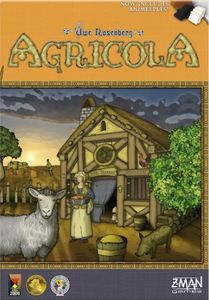
Run a seventeenth-century family farm, growing your household, crops, and livestock while managing limited actions and the pressure of harvest feeding.
Agricola supports 1–5 players; community best: 3–4 players; playing time: 30–150 minutes. A WANGO browser trial has not been confirmed.
Background & introduction
Agricola, in its original 2007 edition, takes players to central Europe around 1670. Each family starts with two people and two wooden rooms, using its labour to develop a small farm.
New public actions become available as the game progresses, but an action space can normally hold only one family member each round. Growing the family gives you more actions and more mouths to feed. Fields, animals, rooms, occupations, and improvements must develop together.
Core rules & scoring
The game has fourteen rounds in six stages. Each round reveals a new round-action card and replenishes accumulating resources. Starting with the Starting player and proceeding clockwise, place one family member at a time on an empty action space and resolve it immediately; everyone returns home when all placements are finished. The Starting player marker does not rotate automatically and must be claimed through its action.
Ordinary Family growth requires more rooms than existing family members; the later Family growth without room action is an exception. A newborn does not act that round and becomes an additional worker from the next round onward. Each family is limited to five members.
New rooms must be orthogonally adjacent to existing rooms and built from the same material. The ordinary cost is five of the matching building resource plus two reed per room. Renovate the whole house one step at a time, from wood to clay to stone; a wooden house cannot jump straight to stone.
To sow, place one grain or vegetable from your supply in an empty field, then add from the general supply to make a stack of three grain or two vegetables. Harvest one crop from each sown field at a time. An emptied field can be sown again without ploughing it again. A pasture normally holds two animals of one type per space; a stable inside it doubles that pasture’s capacity.
Harvest after rounds 4, 7, 9, 11, 13, and 14, in the order field harvest, feeding, then breeding. Normally feed each family member two Food, but a member born that round needs only one. Take a Begging card for each missing Food, losing three points per card at game end. Unprocessed grain or vegetables each provide one Food; converting animals requires an appropriate improvement.
During breeding, each animal type with at least two animals produces only one offspring if it can be housed legally. More pairs or more pastures do not increase this. Breeding comes after feeding, so newborn animals cannot supply the Food for that same harvest.
Score after the fourteenth round’s harvest. Use the scoring table for fields, pastures, crops, and the three animal types; add rooms, fenced stables, family members, and card points, then subtract unused-space and Begging penalties. Each family member scores three points, each clay room one, and each stone room two; wooden rooms score no room points. Highest total wins, with tied players sharing victory.
Rules & gameplay questions
Can a newborn act immediately in the round of ordinary Family growth?
No. Put the newborn on top of the family member taking the growth action; it reaches the farm when the family returns home and can be placed from the next round. If there is a harvest this round, the newborn needs only one Food.
Does the Starting player marker automatically pass to the next farm each round?
No. It changes hands only when someone takes the action that claims it. Otherwise the same player continues to act first.
Will four sheep produce two lambs during one harvest?
No. Each animal type produces at most one offspring once it has at least two animals and legal space for the newborn. Splitting the animals between pastures does not change that limit.
Does an emptied field still score, and do crops in fields count as personal stock?
An empty ploughed field still scores as a field. Endgame grain and vegetable totals include crops both in fields and in your personal supply. However, crop costs for playing improvements must be paid from your personal supply, not taken directly from fields.
Rules & introduction sources
- Edition
- The original 2007 Agricola, using Lookout’s official 12-page English Rules_Agricola_EN rulebook (©2007 Lookout; English publication ©2008 Z-Man). Focuses on the complete 2–5-player base game, not the 2016 Revised Edition. Excludes the solo campaign, expansion decks, and individual occupation-card combination rulings. The Family game has separate changes, including omitting Occupations and Minor Improvements.
- Rule references
- Introduction source
- BoardGameGeek
WANGO editorial
| Parameter | Recorded value |
|---|---|
| BGG overall rank (snapshot) | #66 |
| Complexity Weight | 3.64 / 5 |
| Best player count (community) | 3–4 |
| Player range | 1–5 |
| Playing time (minutes) | 30–150 |
| Core mechanisms | Automatic Resource Growth · Closed Drafting · Enclosure · Increase Value of Unchosen Resources · Solo / Solitaire Game · Turn Order: Claim Action · Worker Placement |
| Chinese publication | Unconfirmed |
| WANGO browser play | No confirmed WANGO trial |
| Year published | 2007 |
| Suggested age | 12+ |
BGG statistics are stored snapshots, not live rankings. Source checked:2026-09-27
Player questions
What is the best player count for Agricola, and can I play online?
Agricola supports 1–5 players; community best: 3–4 players; playing time: 30–150 minutes. A WANGO browser trial has not been confirmed. Recorded mechanism tags: Solo / Solitaire Game.
How complex is Agricola, and which mechanisms does it use?
Weight: 3.64 / 5. Mechanisms: Automatic Resource Growth · Closed Drafting · Enclosure · Increase Value of Unchosen Resources · Solo / Solitaire Game · Turn Order: Claim Action · Worker Placement. Chinese publication: Unconfirmed.
Where can I learn Agricola?
No rule guide, strategy article or WANGO trial has been confirmed for this record.