Lost Ruins of Arnak
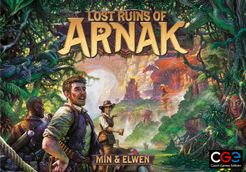
Lead an expedition to a lost island, combining worker placement, deck building and temple research over five rounds to score the most successful discoveries.
Lost Ruins of Arnak supports 1–4 players; community best: 3 players; playing time: 30–120 minutes. A WANGO browser trial has not been confirmed.
Background & introduction
Published by CGE, Lost Ruins of Arnak sends rival archaeological expeditions to an uncharted island to discover sites, collect artifacts and face guardians. The base game combines worker placement and deck building, with research, exploration and cards all contributing to the final score.
Each player normally has just two archaeologists. Cards provide either travel or an effect, never both from the same use. Discovering a site requires extra compasses but opens a new place for later digging. Guardians do not block sites, although returning from them can bring Fear.
Items improve your future deck, while newly purchased artifacts can provide their effects immediately. On the Bird Temple research track, the magnifying glass leads and the notebook follows, earning resources and assistants. A five-round deadline makes the conversion of present resources into further actions and final points central to planning.
Core rules & scoring
Rounds and actions: Play five rounds, drawing up to five cards at each round’s start. On each of your turns, take one main action plus any available free actions before, during or after it. Free actions are restricted to your own turn. Passing ends your turns for that round.
Digging and travel: Send an archaeologist from your board to an unoccupied, unblocked action space, pay its travel cost and resolve the site. A card supplies travel or its effect. Planes cover any travel; any travel covers boots; cars and ships cannot replace each other. Two coins can generate a plane.
Discovery: Pay the region’s compass cost and the space’s travel cost, place your archaeologist, take its idols and resolve only the face-up idol reward. Reveal the matching-level site, resolve it, then awaken a guardian. Later digging does not pay the discovery compass cost again.
Guardians and idols: With your archaeologist at its site, pay a guardian’s cost as a main action to claim it for five points and a one-use boon. Each idol scores three points. Slotting one for an effect is a free action that sacrifices the empty slot’s points, but preserves the idol’s three points.
Buying and playing cards: Pay coins for an item and put it on your deck’s bottom. Pay compasses for an artifact and put it in your play area; you may immediately resolve its effect without its corner tablet cost. Playing its effect from hand later costs that tablet; other effect costs still apply. Effects without lightning take a main action.
Bird Temple research: Pay a bridge cost to advance one token one connected row. The notebook may reach the magnifying glass’s row but cannot pass it or enter the Lost Temple row. On ordinary research spaces, only the first arrival gets a bonus tile; every arrival still resolves its row effect. At the Lost Temple, each arriving magnifying glass chooses a bonus tile from the stack; later research actions may buy temple tiles. Specified notebook rows recruit or upgrade assistants; upgrading also refreshes one.
Round end: After everyone passes, retrieve archaeologists and gain one Fear for each returning from a guardian’s site. Keep leftover hand cards or discard them to your play area, shuffle only that area and put it beneath your deck. Refresh assistants, update the staff and card row, and pass the start marker. After round five, only retrieval and Fear precede scoring.
Scoring and scope: Score both research tokens, temple tiles, idols and empty slots, guardians and cards; subtract one per Fear card. Highest total wins. Break ties by earliest Lost Temple arrival, or highest research score if nobody arrived; remaining ties share victory. The Snake Temple reverse has separate research changes, and the base solo rival uses action tiles.
Rules & gameplay questions
Can free actions interrupt another player’s turn?
No. Use them only before, during or after the main action on your own turn. If you take no other main action, you must pass; you cannot delay with a turn containing only free actions.
Can I use a new item this round, and do I shuffle an empty deck?
A purchased item goes to your deck’s bottom, so a draw effect might draw it this round. An empty deck does not trigger recycling. Shuffle the play area and place it beneath the deck only at round end.
Does an undefeated guardian prevent digging?
No. Guardians do not block their sites. At round end, each archaeologist you retrieve from a site with a guardian gives you one Fear, whoever awakened it. This also happens after round five.
Can the notebook catch the magnifying glass?
Yes, it may reach the same row or space, but cannot pass the glass or enter the Lost Temple row. On Bird Temple, specified notebook rows recruit or upgrade assistants. Snake Temple has separate rules including magnifying-glass assistant rescue.
Is solo play included, and is it a cooperative campaign?
The base game includes a solo rival with ten action tiles; the number of red tiles sets difficulty. It always acts first and gains neither resources nor Fear. This coverage excludes the downloadable solo campaign and cooperative expansion campaigns such as The Missing Expedition.
Rules & introduction sources
- Edition
- Lost Ruins of Arnak 2020 base game, 1–4 players; core explanation uses Bird Temple, with Snake Temple and base solo rules identified separately. Excludes Expedition Leaders, The Missing Expedition, Twisted Paths, Surprise Shipment, promos and downloadable campaigns.
- Rule references
- Introduction source
- BoardGameGeek
WANGO editorial
| Parameter | Recorded value |
|---|---|
| BGG overall rank (snapshot) | #30 |
| Complexity Weight | 2.93 / 5 |
| Best player count (community) | 3 |
| Player range | 1–4 |
| Playing time (minutes) | 30–120 |
| Core mechanisms | Area Movement · Contracts · Deck, Bag, and Pool Building · Delayed Purchase · End Game Bonuses · Hand Management · Multi-Use Cards · Once-Per-Game Abilities · Open Drafting · Resource to Move · Solo / Solitaire Game · Track Movement · Turn Order: Progressive · Worker Placement |
| Chinese publication | Unconfirmed |
| WANGO browser play | No confirmed WANGO trial |
| Year published | 2020 |
| Suggested age | 12+ |
BGG statistics are stored snapshots, not live rankings. Source checked:2026-09-27
Player questions
What is the best player count for Lost Ruins of Arnak, and can I play online?
Lost Ruins of Arnak supports 1–4 players; community best: 3 players; playing time: 30–120 minutes. A WANGO browser trial has not been confirmed. Recorded mechanism tags: Solo / Solitaire Game.
How complex is Lost Ruins of Arnak, and which mechanisms does it use?
Weight: 2.93 / 5. Mechanisms: Area Movement · Contracts · Deck, Bag, and Pool Building · Delayed Purchase · End Game Bonuses · Hand Management · Multi-Use Cards · Once-Per-Game Abilities · Open Drafting · Resource to Move · Solo / Solitaire Game · Track Movement · Turn Order: Progressive · Worker Placement. Chinese publication: Unconfirmed.
Where can I learn Lost Ruins of Arnak?
No rule guide, strategy article or WANGO trial has been confirmed for this record.