Anno 1800: The Board Game
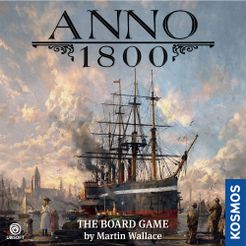
Anno 1800: The Board Game is an industrial development strategy game for 2–4 players. Players build industries, shipyards, and fleets, use their population to produce and trade resources, meet residents’ needs, and play population cards to gain influence.
Anno 1800: The Board Game supports 2–4 players; community best: 3 players; playing time: 120 minutes. A WANGO browser trial has not been confirmed.
Background & introduction
Anno 1800: The Board Game turns island management in the industrial age into an interdependent production network. Each player starts with a developing home island and arranges population, industries, shipyards, and ships on limited space. Farmers, workers, artisans, engineers, and investors match different workplaces and determine which resources can be produced. Players move timber, bricks, steel beams, goods, and other resources through the economy to support new industries, population, and technologies.
Population cards represent the needs of residents. To play one, a player must meet the requirements printed on it; the card then remains in their player area and represents both a developed population and influence. Increasing the workforce brings more labor but also adds more cards that must be fulfilled. Expansion therefore increases capability while lengthening the player’s hand and production chain, so players must pace population growth, upgrades, and the industries they need.
Island construction and sea travel provide space and connections for production. Industries occupy land, shipyards go on coastal land, and merchant and exploration ships occupy sea spaces. Trading lets a player use another player’s industry; opening the Old World adds construction space and a one-time benefit, while exploring the New World supplies special resources that only its owner can use. Ships support trade, exploration, expeditions, and some population-card requirements.
Each turn offers one main action, so players must decide whether they most need to build, play or swap cards, grow or upgrade the workforce, or explore. Population cubes and naval tokens become temporarily exhausted when used. Players may pay gold to refresh individual population cubes or use a festival to refresh everything. When someone plays their last hand card, all players finish the current round and take one final round before scoring influence from population cards, expeditions, objectives, gold, and the fireworks token; the size of an island alone does not determine the winner.
Core rules & scoring
Aim and setup: Each player takes a home island and places 4 farmers, 3 workers, and 2 artisans in its residential districts. Put 1 trade token on each of two merchant ships and 1 exploration token on the exploration ship. Each player starts with 7 farmer/worker population cards and 2 artisan/engineer/investor cards. Set out five objective cards and the supply of resources and construction tokens. The game supports 2–4 players; the highest influence total wins. (English rulebook, printed pp. 1–3, 11)
Turn structure: Starting with the first player, players take turns clockwise and perform one main action: expand, play a population card, swap population cards, increase the workforce, upgrade, open the Old World, explore the New World, take expedition cards, or celebrate a festival. Activating played population cards and available objective-card effects is free, subject to their resource requirements; Alonso Graves, Aarhant, and The Editor can each be used at most once per turn. (Printed pp. 4, 12–13, 16)
Production and exhaustion: To produce a resource, move a population cube from its residential district to a free workplace that matches its tier. This immediately produces the depicted resource once, and the resource must be used during the same turn. A cube on a workplace does not produce again. If an action directly requires a population cube or naval token, move it to the exhausted area. Components on workplaces or in the exhausted area cannot be reused until refreshed by spending gold or holding a festival. (Printed pp. 4–5)
Trade and shift end: A player may trade for a resource if another player owns an industry that can produce it and the active player has enough trade tokens. Farmer/worker resources cost 1 trade token, artisan resources cost 2, and engineer resources cost 3. The other player cannot refuse and receives 1 gold from the supply. A player cannot trade with themselves, and the same resource may be traded only once per turn, though different resources may be traded separately. New World island resources, population cubes, and exploration tokens cannot be traded. During a turn, gold may be spent to return used population cubes to their residential districts for immediate reuse. (Printed pp. 5, 16)
Expand: An expand action builds 1 industry or shipyard and may also build as many ships as the player has shipyards. Industries go on land, shipyards on coastal land, and ships on sea spaces. Each shipyard may build at most 1 ship per action, at or below its strength; the ship immediately receives the corresponding naval tokens. Normally, a player may have only one of each industry; an Old World island benefit may grant a duplicate. New tokens may cover built or pre-printed tokens; covered tokens return to the supply, and population cubes on them become exhausted. Under the first-edition errata, only 1 built token may be removed during an expand action. (Printed pp. 6, 16; Kosmos first-edition errata)
Population cards: Produce the resources shown in a card’s purple bar before playing it face up below the home island. Each card has a one-time effect that may be activated for free during the current or a later turn. After activation, turn the card face down; it stays in the player area and still scores influence. To swap cards, return up to 3 hand cards under their respective stacks, then draw the same number from those stacks. A card type cannot be swapped if its stack is empty. (Printed p. 7)
Increase the workforce and upgrade: The workforce action adds up to 3 population cubes. Pay the resources shown above the relevant residential district for each new cube and draw its corresponding population card. If that stack is empty, pay the indicated gold for each card that cannot be drawn; if unable to pay, the corresponding increase cannot be made. An upgrade action may make up to 3 adjacent tier changes in order: farmer → worker → artisan → engineer → investor. Replace each cube with one of the new tier; upgrades do not increase the total number of cubes, so no population card is drawn. If the cube was on a workplace, the replacement remains there. (Printed pp. 8, 16)
Opening the two worlds: Each action opens or explores at most 1 island, and each island type is counted separately. A player may have at most 4 Old World islands and 4 New World islands. Their first, second, third, and fourth island of the same type cost 1, 2, 3, and 4 exhausted exploration tokens respectively. An Old World island adds spaces and a one-time benefit. Exploring the New World adds an island to the player area and draws 3 New World cards. Use a resource from one’s own New World island by exhausting 1 trade token; these resources cannot be traded from another player, and no construction tokens may be built on New World islands. (Printed pp. 9, 16)
Expeditions and festivals: Take expedition cards by exhausting 2 exploration tokens to draw up to 3 cards and place them face down below the home island. They are not hand cards and may be viewed at any time. At the end of the game, use eligible population cubes to fill animal or artifact spaces on expeditions; each cube can fill only 1 space, each occupied space scores separately, and cards need not be fully occupied. A festival returns every population cube and naval token from workplaces and the exhausted area to residential districts or ships. (Printed pp. 10–11, 16)
End and scoring: When a player plays their last hand card, they take the fireworks token. Finish the current round so everyone has the same number of turns, then play one final round. Population cards score whether face up or down: farmer/worker cards are worth 3 points, artisan/engineer/investor cards 8, and New World cards 5. Score occupied expedition spaces, 1 point per 3 gold, 7 points for the fireworks token, and objective cards. Ties go first to the player with the most industries, shipyards, and ships (uncovered pre-printed tokens count), then the fewest hand cards; any further tie is shared. (Printed pp. 10–12)
Errata applied: This entry incorporates the public file Kosmos labels as first-edition errata. It clarifies that an expand action can remove at most 1 built token; only an Old World island benefit can grant a duplicate identical industry, while an alternative starting industry is not identical; players can trade different resources with different players in one turn, but each resource can be traded only once per turn; and shipyard strengths cannot be combined to build a stronger ship. Apply these clarifications in those situations. (Kosmos first-edition errata, p. 1; rulebook printed p. 6)
Source scope: The rulebook cover lists Martin Wallace, 2–4 players, and ages 12 and up; its last-page identifier is 680428-VE-18032021-GB. Kosmos’s product page separately lists solo-mode material and a later expansion, neither of which is covered here. No standalone base-game FAQ was found while checking the official product page and the Thames & Kosmos manual index; this describes the scope of this search, not proof that the publisher has never offered other answers.
Rules & gameplay questions
How do you win the game?
The player with the most influence points at the end wins. Played population cards score even after they have been turned face down: farmer/worker cards are worth 3 points, artisan/engineer/investor cards 8, and New World cards 5. Players also score spaces occupied on expedition cards, gold, the fireworks token, and the objective cards in play. If influence is tied, compare total industries, shipyards, and ships, then the number of hand cards remaining; if still tied, the players share the victory.
How many actions may I take on a turn?
Each turn has one main action, chosen from expanding, playing or swapping population cards, increasing or upgrading the workforce, opening the Old World, exploring the New World, taking expedition cards, or celebrating a festival. Effects from played population cards and usable objective cards are free actions, so they may be combined with the main action when their conditions are met; some objective effects are limited to once per turn. Resources produced for an action must be used during that same turn and cannot be saved for a later turn.
Can a population cube produce again after being placed on a workplace?
No. Moving a population cube from its residential district to a matching free workplace produces the resource shown there once, immediately, and that resource must be spent during the current turn. The cube stays on the workplace and cannot produce again or be assigned to another workplace. A player may pay the required gold to return a used cube to its residential district and free the workplace. A festival refreshes all population cubes and naval tokens from workplaces and the exhausted area at once.
What do I need to trade for another player’s resource?
You need enough trade tokens, and another player must own an industry that can produce the required resource. The token cost depends on the population tier required to produce it: 1 for a farmer or worker resource, 2 for an artisan resource, and 3 for an engineer resource. The other player cannot refuse and receives 1 gold, even when their workplaces are already occupied. You cannot trade with yourself, and the same resource can be traded at most once per turn.
Can I build over an existing construction token?
Yes. A new token may cover a built token or a pre-printed home-island token. The covered token returns to the common supply, and any population cube on it moves to the exhausted area. Industries go on land, shipyards on coastal land, and ships on sea spaces. A player normally has at most one of each industry, but an Old World island’s one-time benefit can provide a duplicate. The first-edition errata limits each expand action to removing at most one built token.
What is the difference between adding and upgrading population?
Increasing the workforce adds new population cubes from the supply, up to 3 in one action. Each new cube requires resources and a corresponding population card; if that card stack is empty, pay the indicated gold instead or the increase cannot be completed. Upgrading replaces an existing cube with the next population tier and can be done up to 3 times in one action. The total number of cubes does not increase, so no population card is drawn. If the original cube was on a workplace, its replacement remains there.
Do the Old World and New World islands work the same way?
No. Opening an Old World island extends the player’s island group with additional sea and land spaces for construction and immediately grants that island’s one-time benefit. Exploring a New World island places it in the player area, displays three resources, and gives the player 3 New World cards. Only the owner can use the island’s resources by exhausting trade tokens; those resources cannot be traded to other players, and construction tokens cannot be built on New World islands. Each island type has a separate exploration-token cost and a limit of four per player.
Does the game end immediately when someone plays their last hand card?
No. The player who plays their last hand card takes the fireworks token, but the current round continues so every player completes the same number of turns. After that, everyone takes one final turn before scoring. If the player who triggered the end later gains more hand cards, the end remains triggered and they keep the fireworks token. Finishing first is therefore not an automatic win: the final comparison still includes population cards, expeditions, gold, and the objective cards.
Rules & introduction sources
- Edition
- This entry covers the base game BGG 311193 Anno 1800: The Board Game for 2–4 players. Detailed rules are based on the Thames & Kosmos English base-game rulebook 680428-VE-18032021-GB (printed pp. 1–16), with the first-edition errata listed on Kosmos’s product page applied. It excludes the solo-mode material, Anno 1800 – Die Erweiterung, and promotional content. The rulebook does not state a separate rules-edition number, so its file identifier and date are used as source markers without inferring a later edition. As of 2026-10-27, no standalone base-game FAQ was found on the publisher pages checked.
- Rule references
- Introduction source
- BoardGameGeek
WANGO editorial
| Parameter | Recorded value |
|---|---|
| BGG overall rank (snapshot) | #303 |
| Complexity Weight | 3.13 / 5 |
| Best player count (community) | 3 |
| Player range | 2–4 |
| Playing time (minutes) | 120 |
| Core mechanisms | Contracts · End Game Bonuses · Hand Management · Hidden Victory Points · Income · Market · Modular Board · Once-Per-Game Abilities · Open Drafting · Ownership · Race · Simulation · Solo / Solitaire Game · Tags · Tech Trees / Tech Tracks · Tile Placement · Variable Set-up · Worker Placement, Different Worker Types |
| Chinese publication | Unconfirmed |
| WANGO browser play | No confirmed WANGO trial |
| Year published | 2020 |
| Suggested age | 12+ |
BGG statistics are stored snapshots, not live rankings. Source checked:2026-09-27
Player questions
What is the best player count for Anno 1800: The Board Game, and can I play online?
Anno 1800: The Board Game supports 2–4 players; community best: 3 players; playing time: 120 minutes. A WANGO browser trial has not been confirmed. Recorded mechanism tags: Solo / Solitaire Game.
How complex is Anno 1800: The Board Game, and which mechanisms does it use?
Weight: 3.13 / 5. Mechanisms: Contracts · End Game Bonuses · Hand Management · Hidden Victory Points · Income · Market · Modular Board · Once-Per-Game Abilities · Open Drafting · Ownership · Race · Simulation · Solo / Solitaire Game · Tags · Tech Trees / Tech Tracks · Tile Placement · Variable Set-up · Worker Placement, Different Worker Types. Chinese publication: Unconfirmed.
Where can I learn Anno 1800: The Board Game?
No rule guide, strategy article or WANGO trial has been confirmed for this record.