Carnegie
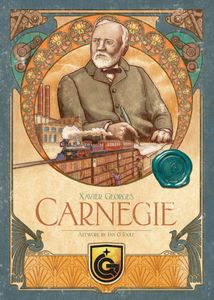
Run a growing company, organize employees, develop projects and American transport links, and turn commercial success into prestige through philanthropy.
Carnegie supports 1–4 players; community best: 4 players; playing time: 90–120 minutes. A WANGO browser trial has not been confirmed.
Background & introduction
Carnegie combines company management with shared action selection. Departments work through active employees stationed inside them. Adding a powerful department is only part of the task: employees must reach it and be activated before its capabilities become useful.
Over twenty rounds, one player chooses an action type and everyone uses their matching departments in turn. The associated timeline also determines income and donation events, so an action choice affects who can recover employees from missions and when cash can become a scoring opportunity.
Construction transfers project disks from company tabs onto the American map, exposing income and sending employees on regional missions. Research prepares further projects and improves transportation. Staff circulation, cash flow and the map must work together to sustain the company and support final donations.
Core rules & scoring
Setup: adjust the department supply, Action Choice tiles and neutral blocking disks to player count. Four random timeline tiles form twenty rounds. Each player receives a company, four project tabs, $12 and four goods; arrange employees, initial housing and a reserved department, then perform initial movement and activation.
Round order: select a timeline, resolve events, use departments, activate employees and advance the marker. The current first player chooses Human Resources, Management, Construction or R&D. Everyone follows that type clockwise from that player, then the first-player marker passes onward.
Income events: optionally return one or more employees from the indicated mission area to your lobby inactive. Each returns the transport income at your current position in that region. Returning at least one also grants your built-project income across the map once; returning none grants neither income.
Departments: use matching departments in any order, normally once per active employee. Finish one department before starting another and do not return to it later in the same turn. Working in place leaves an employee active; moving or going on a mission changes that state.
Human Resources and Management: allocate orthogonal employee moves, leaving moved employees inactive; the permanent starting HR employee ensures at least three moves. Management generates money or goods and builds departments. A normal new department costs one good on a free space containing an employee, otherwise two; duplicate departments are forbidden.
Construction and R&D: normal construction sends the acting employee on a mission to the chosen region, pays the goods cost and moves the rightmost available project disk to a matching vacant site there; small cities accept any project type. Spend study points on project tabs or transport tracks; unspent study points expire at turn end.
Donations and activation: a donation event allows one donation each onto an unoccupied objective. Your first, second and third normally cost $5, $10 and $15. Each donation normally scores at most 12 VP, with project-tab bonuses able to raise that limit. Only after all actions may inactive employees be activated by paying workstation costs. Events in the four rightmost timeline columns allow taking income and/or making a donation, including both.
Timeline ends and special abilities: a completed action row may still be chosen. Cycle downward to the next marker that can advance, turn it over, trigger its event and advance it at round end. Department abilities can modify ordinary costs or mission requirements. A following player in the prescribed three/four-player setup may discard an Action Choice tile once to choose a different action from the first player; it scores 3 VP unused.
Final scoring: after twenty rounds and all four timelines are complete, add immediate VP, active employees, built departments, project tabs, city projects, donations and major-city connections. Each ordinary active employee scores 1 VP; the permanent starting HR employee does not. Score only your best connected major-city network, at most 36 VP. Most VP wins; ties share victory.
Rules & gameplay questions
Does using an employee exhaust them and require another salary payment?
No. An employee who works in place remains active. Movement or a mission changes their state. Moved employees and those returning to a lobby are inactive; normally they must reach a department and pay its workstation cost during end-of-round activation.
Does returning three employees give project income three times?
No. Each returning employee provides the current regional transport income, but the full set of built-project income is collected only once. Without returning an employee from the active region, you receive neither type of income.
Can a disk exposed by research immediately be built on the map?
Research only prepares a project. Normal construction still requires the corresponding employee, goods payment, and the rightmost available disk from that project tab, placed in a legal site in the mission region. Specific department abilities can create exceptions.
Do donations score immediately and always cost $5?
No. Donations normally score at game end with a 12 VP limit each, which project-tab bonuses can raise. Your donation cost increases by $5 each time. Communications can modify costs; Charitable Giving can copy another player’s objective under its rules, but cannot duplicate your own donation.
Does choosing a completed timeline shorten the game?
No. Perform the chosen action but cycle downward to another action marker that can advance. Trigger that marker’s next event and advance it at round end, preserving the twenty-round game length.
Rules & introduction sources
- Edition
- Carnegie (2022) base game, using the current Quined Games-linked 20-page English rulebook. This summary focuses on 2–4 players; solo uses Andrew under pages 18–19. Expansion departments are excluded.
- Introduction source
- BoardGameGeek
WANGO editorial
| Parameter | Recorded value |
|---|---|
| BGG overall rank (snapshot) | #129 |
| Complexity Weight | 3.82 / 5 |
| Best player count (community) | 4 |
| Player range | 1–4 |
| Playing time (minutes) | 90–120 |
| Core mechanisms | Action Retrieval · Area Movement · Connections · End Game Bonuses · Follow · Grid Movement · Income · Movement Points · Network and Route Building · Resource to Move · Solo / Solitaire Game · Square Grid · Tech Trees / Tech Tracks · Turn Order: Progressive · Variable Phase Order · Worker Placement, Different Worker Types |
| Chinese publication | Unconfirmed |
| WANGO browser play | No confirmed WANGO trial |
| Year published | 2022 |
| Suggested age | 12+ |
BGG statistics are stored snapshots, not live rankings. Source checked:2026-09-27
Player questions
What is the best player count for Carnegie, and can I play online?
Carnegie supports 1–4 players; community best: 4 players; playing time: 90–120 minutes. A WANGO browser trial has not been confirmed. Recorded mechanism tags: Solo / Solitaire Game.
How complex is Carnegie, and which mechanisms does it use?
Weight: 3.82 / 5. Mechanisms: Action Retrieval · Area Movement · Connections · End Game Bonuses · Follow · Grid Movement · Income · Movement Points · Network and Route Building · Resource to Move · Solo / Solitaire Game · Square Grid · Tech Trees / Tech Tracks · Turn Order: Progressive · Variable Phase Order · Worker Placement, Different Worker Types. Chinese publication: Unconfirmed.
Where can I learn Carnegie?
No rule guide, strategy article or WANGO trial has been confirmed for this record.