Praga Caput Regni
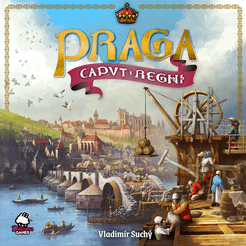
Time your choices on a rotating action crane, connecting mines, buildings, walls, and civic projects into a productive development route.
Praga Caput Regni supports 1–4 players; community best: 3 players; playing time: 45–150 minutes. A WANGO browser trial has not been confirmed.
Background & introduction
Praga Caput Regni casts players as wealthy citizens contributing to Prague’s construction. Six actions remain available, but the crane changes their extra costs and benefits. Choosing when to take an action matters alongside deciding what you want to build.
Upgrading your personal action board strengthens later actions. Walls and city buildings supply further rewards through matching edges, corners, and plaza claims. Mines and quarries fund construction, while university and technology progress convert longer development plans into endgame value.
The King’s Road leads to Charles Bridge, and the Hunger Wall and Cathedral reward both height and sideways movement. Each player has sixteen turns. Windows and one-use technologies offer extra opportunities, making well-connected rewards especially useful within that limited time.
Core rules & scoring
The main procedure is for 2–4 players. Set the action crane, counters, and plazas for the player count, with a resource board and six-action board per player. Take clockwise turns until everyone has taken exactly sixteen. The box rules also provide a solo variant.
Take one action tile, perform one of its two depicted actions, and receive the wheel bonus. Pay a red-zone cost immediately before taking the tile. Green has no additional positional cost; blue awards points. The wheel bonus may normally be delayed until later in your turn.
Manage Mines or Quarries either adds one production capacity and one corresponding resource, or produces according to existing capacity with unlocked bonuses to its left. Gold and stone each cap at nine. Each marked wealth-threshold bonus is gained only once.
Upgrade an Action takes an available upgrade tile onto its matching action hex, in any orientation, and advances University one or two spaces according to its era. A new upgrade replaces rather than stacks with an old one. Its bonus can apply retroactively to that action already performed this turn and applies whenever that action is performed later.
Constructing a wall or building requires paying its tile cost before taking rewards and placing it legally. Old Town sites add printed costs and points. Matching edge symbols on walls and upgrades grant adjacency rewards; matching corners grant the relevant red or blue bonus tokens.
Each city building borders one plaza. A building with a cube space establishes its owner’s claim; one without a cube scores immediately for buildings currently around that plaza. When enclosed, claimants choose one reward; the most cubes earns both. Ties first compare total gold-plus-stone cost of the tied players’ cube-bearing buildings.
The King’s Road advances to your next colored space. Egg-dependent effects on the first three spaces are optional; entering spaces IV and V requires an egg. A completed bridge still allows tile benefits but no plank-placement bonuses. After reaching V, you cannot take this action again.
Wall/Cathedral icons move you sideways on the matching civic project. Two silver windows buy an upward move; crossing tiers also requires printed gold and stone costs. Once per turn, two gold windows or one gold plus one silver buys an extra action; technology actions follow their own effects. Level I/II technologies begin next turn; III/IV are one-use benefits usable now or later.
End your turn with at most two windows, rotate the crane, return your tile to the start of red, and advance the timer as directed. Replace tiles with Era II around halfway; two players use the star-marked transition. At game end score unresolved plazas, University times technology advances, both civic projects, walls, personal scoring abilities, and eggs. Highest score wins; ties favor the player who started later.
For the printed solo variant, use two-player setup and take the first turn. After your turns, recycle the oldest action tile nearest the blue zone through the normal crane procedure, without performing its actions. Aim for a high personal score; the manual suggests over 140 as good. The separately published Peter Parler card opponent is a different solo procedure.
Rules & gameplay questions
Can I pay a red-zone tile cost after its action earns me money?
No. Pay that cost before taking the tile, and pay wall/building costs before receiving benefits. Wheel rewards can be delayed, such as buying the wheel’s offered egg once you gain gold later that turn.
Does a new upgrade reward the action I already took this turn?
Yes. Apply the new bonus retroactively to that matching action this turn, and to further uses. Covering an old upgrade does not combine the old and new abilities.
Can a purchased extra action take the rightmost special tile?
Normally no. Special-tile permission applies only to the action chosen from your crane tile, and requires the wheel’s special-tile bonus. It does not transfer to the window-purchased extra action.
Do University and technology advances both score immediately?
Normally no. University height sets the final value per technology advance; marked technology spaces award tiles. Further advances after either track is full become two points. Explicit depicted rewards still apply.
Do the red and blue tokens score with matching construction colors?
Use the scoring rules rather than the appearance of structures. Hunger Wall sideways position values blue tokens, while Cathedral position values red tokens; project height scores separately.
Rules & introduction sources
- Edition
- Original 2020 Praga Caput Regni, using Delicious Games’ currently linked English rules v13, including printed reminders/timing clarifications, main 2–4-player procedure, and simple solo on p17. The public product page lists no separate errata document; fan FAQs are not adopted as official changes. Separately published Peter Parler solo v2 was read to distinguish modes but is not detailed. Excludes unspecified expansions and house rules.
- Introduction source
- BoardGameGeek
WANGO editorial
| Parameter | Recorded value |
|---|---|
| BGG overall rank (snapshot) | #196 |
| Complexity Weight | 3.72 / 5 |
| Best player count (community) | 3 |
| Player range | 1–4 |
| Playing time (minutes) | 45–150 |
| Core mechanisms | Action Drafting · Area Majority / Influence · Enclosure · End Game Bonuses · Hexagon Grid · Income · Three Dimensional Movement · Tile Placement · Track Movement · Variable Set-up |
| Chinese publication | Unconfirmed |
| WANGO browser play | No confirmed WANGO trial |
| Year published | 2020 |
| Suggested age | 14+ |
BGG statistics are stored snapshots, not live rankings. Source checked:2026-09-27
Player questions
What is the best player count for Praga Caput Regni, and can I play online?
Praga Caput Regni supports 1–4 players; community best: 3 players; playing time: 45–150 minutes. A WANGO browser trial has not been confirmed.
How complex is Praga Caput Regni, and which mechanisms does it use?
Weight: 3.72 / 5. Mechanisms: Action Drafting · Area Majority / Influence · Enclosure · End Game Bonuses · Hexagon Grid · Income · Three Dimensional Movement · Tile Placement · Track Movement · Variable Set-up. Chinese publication: Unconfirmed.
Where can I learn Praga Caput Regni?
No rule guide, strategy article or WANGO trial has been confirmed for this record.