Pax Renaissance: 2nd Edition
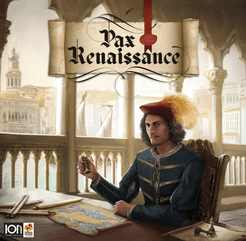
Pax Renaissance: 2nd Edition is a strategy game about banking and political influence in Renaissance Europe. Players buy cards from eastern and western markets, build personal tableaus, and deploy agents to shape monarchies, republics, trade, religion, and society’s future.
Pax Renaissance: 2nd Edition supports 1–4 players; community best: 2–3 players; playing time: 60–120 minutes. A WANGO browser trial has not been confirmed.
Background & introduction
Pax Renaissance: 2nd Edition places players in the financial and political networks of fifteenth- and sixteenth-century Europe. Each player is a banker with capital and influence, financing rulers, backing republics, sponsoring voyages, trading, and sometimes supporting pirates or religious actions. The map links powers, cities, trade routes, and political structures, so influence can redirect history without relying only on direct military expansion.
Two markets, one eastern and one western, offer cards whose prices and availability change as players buy. Cards enter a hand before they can be played into a personal tableau. A tableau card represents a relationship or source of power and can provide actions. Agents then project that influence onto cities, borders, royal houses, republics, religious groups, and sea routes. A purchase affects both immediate resources and future options.
The central tension comes from four possible directions for Europe: imperialism, global trade, religious rule, and a Renaissance of art and science. Each route needs a different mix of public conditions and player influence. Opponents can alter the market, contest key positions, change regimes, or trigger conflicts, so a visible lead is rarely safe. Players must read the tableau, map, and other players’ resources before choosing what to do next.
The second edition weaves finance, warfare, religion, and political influence into a layered contest. Card draws and player decisions create a different landscape in each game. It suits players who enjoy dense icons, action timing, and long-term planning. The goal is not simply to collect points: players use limited actions to establish influence for a social transformation and make their preferred future prevail before the situation shifts.
Core rules & scoring
Objective and edition: Players are bankers influencing Europe through markets, tableaux and agents. Multiplayer victory normally requires spending an action to declare an activated social-transformation victory whose conditions you meet. If the decks can no longer refresh the market, Patron Prestige determines the fallback winner. King, Republic, religious colors and Prestige are rules terms; use the second-edition components and definitions rather than inferring thresholds from the theme.
Setup and markets: Take a banker board, colored agents and its starting Concession, then prepare Florins, Empires and map pieces as instructed. Each East and West market has six spaces, with the leftmost card face down and the others face up. Each draw deck contains two Comets, and all four Victory Squares begin inactive. East tableau cards go right of the banker board and West cards left. Follow Book I’s player-count setup for deck sizes, positions and starting money.
Action limits: Take one or two actions per turn, in either order, and each must change the game state. Purchase, play and sell may each be chosen up to twice; East Ops, West Ops, an East trade fair, a West trade fair and victory may each be chosen once. Refresh the markets only after the turn’s actions. Buying then playing is possible, but a second action cannot activate the same tableau side again.
Purchasing and hand limit: Buy a face-up card by placing one Florin on each card to its left in the same row. The first face-up card costs one, increasing by column. Collect money already on the purchased card, but not to fund that purchase. Your hand limit is two; play or sell a card before buying a third. Comets resolve immediately and bypass this normal limit. A card on which you placed money this turn cannot be purchased by you that turn.
Playing and agents: Play a hand card into its corresponding tableau side and resolve permitted agent placement. If you choose its One-shot, perform the required steps. Bishops, Knights, Rooks, Concessions and Pirates have different legal positions and roles. Wars, coronations and other regime changes can move Empire Squares into tableaux as Kings, Vassals or Republics; their type and location affect later actions and victory.
Operations and selling: Activating one side lets each card there perform at most one Op, in any order, with at least one valid target overall. Multiple icons on a card do not permit multiple Ops from that card. Pay costs and obey target-type and location limits. Selling normally discards an eligible card for two Florins. A coronated royal pair sells together for four; sold Empires and their Vassals return as the rules specify.
Trade and refresh: East and West trade fairs are separate actions. Discard the chosen market’s leftmost face-down card, then resolve trade-route profits and taxation; money on that card enters the profits. After the turn, slide cards and money left into gaps and refill from the appropriate deck. If one deck empties, use the other to continue. Patron victory occurs only when no cards remain to complete a required market refresh, not merely when one side’s deck first empties.
Comets and declaring victory: A purchased Comet is immediately discarded to activate one inactive Victory Square. Any player can then pursue that condition; the purchaser neither wins automatically nor owns the route. A Comet reaching the leftmost face-down slot is no longer normally purchasable, and discarding it for a trade fair activates nothing. Spend a separate victory action on your own turn and meet all conditions at that time.
Imperial and Globalization: Imperial requires at least two more King-side Empire Squares than each opponent, or three more in a two-player game; Suzerains and Vassals both count. Globalization requires at least two more Concessions than each opponent and more Discovery Prestige than every opponent. These are simultaneous comparisons against all rivals, not fixed totals or a lead over just one player.
Holy and Renaissance: Holy first requires a Supreme Religion: its Bishops in tableaux or Thrones exceed both other religions combined, and its matching unrepressed ruling-class pieces and Pirates in its Theocracies likewise exceed the other two religions combined. The claimant must also lead every opponent in that religion’s Prestige. Renaissance requires more Republics than each rival and at least two more Law Prestige than each rival. Apply the precise definitions of repression, Theocracy and counted locations.
Exhaustion and ties: If a required refresh cannot draw from either deck, the highest Patron Prestige wins. The final tiebreak is most Florins, with a shared victory if still tied. This fallback does not total every kind of Prestige together. Book II separately provides solo material; because the complete current guide could not be read, consult that guide for its setup, automated procedure and victory conditions.
Rules & gameplay questions
What kind of game is Pax Renaissance: 2nd Edition?
It is a strategy game set in Renaissance Europe. Players act as bankers, buying cards from two markets, building a tableau, and using agents to influence rulers, republics, trade, and religion. Economic choices, area influence, and several possible victory routes are intertwined, so the political landscape changes as players act.
How do players shape Europe?
Players play cards into a tableau and use their listed operations. Operations can place agents, alter cities and trade, support rulers or republics, and trigger religious or military events. Influence is not only a score: it creates a board position and future actions that can make a victory route achievable.
What do the eastern and western markets do?
Each East and West market has six positions, the leftmost face down and the others face up. Buy a face-up card by placing Florins on cards to its left in the same row. Collect money already on it, but not to pay for that purchase. The hand limit is two, except that Comets resolve immediately. Gaps refresh only after the turn. A card to which you added money this turn cannot be purchased by you that turn.
What can a player do on a turn?
Take one or two actions per turn, each changing the game state. Purchase, play and sell may each be chosen up to twice. East Ops, West Ops, East trade fair, West trade fair and victory may each be chosen once. East and West are separate options, so one activation of each is possible; activating the same side twice is not. Choose action order freely within the rules and refresh the market after completing the turn.
How are tableau operations used?
One activation of East or West Ops can use each card on that side once, for one of its Op icons, in an order you choose. At least one Op must have a valid target. Multiple icons on a card do not let it act several times. Location, target type, religion and cost restrictions depend on the Op. An activation is therefore neither limited to one card nor permission to activate that same side a second time in the turn.
What are the victory paths?
Imperial, Globalization, Holy and Renaissance are active victory routes, first enabled by buying a Comet and then claimed with a victory action. Imperial normally requires two more King-side Empires than each rival, or three more with two players. Globalization requires two more Concessions and a Discovery Prestige lead; Renaissance requires a Republic lead and two more Law Prestige. Holy also requires a Supreme Religion and a lead in its Prestige.
What do the agents represent?
Bishops, knights, rooks, pawns, and pirates are agents used to extend influence. Cards can send them into a tableau, city, border, or sea route, where they may support control, repression, religious or military operations, and political change. Their positions determine which actions remain available, so moves have tactical and long-term effects.
Can first- and second-edition rules be mixed?
They should not be mixed casually. ION lists separate rule files for the first and second editions, and the second edition reorganizes rules, components, and card text. This entry follows the second-edition baseline. If a copy includes promotional cards or other material, check its compatibility and matching rules before adding it.
Rules & introduction sources
- Edition
- This entry covers Pax Renaissance second edition (BGG 308119), using the publisher-authored Book I rules hosted by a third party, especially sections D–L. The current Living Rules directory’s Book I PDF was deleted and the Book II master could not be read, so a full comparison with the 2024 living rules or detailed solo procedure is not claimed. Official product and directory pages establish the edition and resources. The core explanation is for multiplayer; solo requires Book II.
- Rule references
- Introduction source
- BoardGameGeek
WANGO editorial
| Parameter | Recorded value |
|---|---|
| BGG overall rank (snapshot) | #371 |
| Complexity Weight | 4.65 / 5 |
| Best player count (community) | 2–3 |
| Player range | 1–4 |
| Playing time (minutes) | 60–120 |
| Core mechanisms | Action Points · Increase Value of Unchosen Resources · Market · Open Drafting · Simulation · Take That |
| Chinese publication | Unconfirmed |
| WANGO browser play | No confirmed WANGO trial |
| Year published | 2021 |
| Suggested age | 12+ |
BGG statistics are stored snapshots, not live rankings. Source checked:2026-09-27
Player questions
What is the best player count for Pax Renaissance: 2nd Edition, and can I play online?
Pax Renaissance: 2nd Edition supports 1–4 players; community best: 2–3 players; playing time: 60–120 minutes. A WANGO browser trial has not been confirmed.
How complex is Pax Renaissance: 2nd Edition, and which mechanisms does it use?
Weight: 4.65 / 5. Mechanisms: Action Points · Increase Value of Unchosen Resources · Market · Open Drafting · Simulation · Take That. Chinese publication: Unconfirmed.
Where can I learn Pax Renaissance: 2nd Edition?
No rule guide, strategy article or WANGO trial has been confirmed for this record.