Puerto Rico
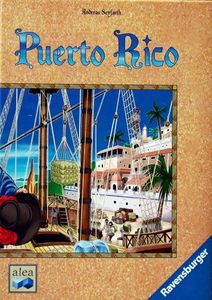
Select roles that let everyone act, develop plantations and a city, and time the choice between selling goods, shipping for points, and investing in buildings.
Puerto Rico supports 3–5 players; community best: 4 players; playing time: 90–150 minutes. A WANGO browser trial has not been confirmed.
Background & introduction
Puerto Rico is a classic economic strategy game designed by Andreas Seyfarth. Players place plantations and quarries on their islands, build production facilities and special buildings in their cities, and assign the workers called colonists in the rulebook. Goods can be sold to finance construction or shipped for victory points; buildings and occupied large-building bonuses provide another scoring route.
Beginning with the governor, each player selects one unused role per round. The chooser usually acts first and receives a privilege, while everyone else follows clockwise with the ordinary action. The prospector is the exception: only its chooser receives money. Unselected roles collect a doubloon at round end and the governorship passes left, making timing depend on how prepared the other players are.
Planting, staffing, production, trading, and shipping form an interdependent economy. Corn needs only an occupied corn plantation, while other goods also require matching processing capacity. Expensive goods sell for more money, but every shipped barrel normally earns the same point. Ship restrictions, limited capacity, and the storage check after shipping make role timing and turn order central to the competition.
Core rules & scoring
Use the classic base-game setup for 3–5 players, including the appropriate supplies, starting money, plantations, and three cargo ships. Each player selects a different role once per round and takes its accumulated doubloons. Ordinary actions are generally optional, but legal loading in the captain phase is compulsory. After everyone has selected, add one doubloon to each of the three unused roles, return the roles, and pass the governor clockwise.
The settler may take a face-up plantation; the privilege allows a quarry instead. The island holds at most 12 tiles, which cannot be removed. The mayor may first take one bonus colonist from the supply, then distributes the ship’s colonists one at a time clockwise, starting with the mayor. Players may rearrange all old and new colonists; they cannot leave colonists in San Juan while posts remain empty. Refill the ship to the total empty building posts, with a minimum equal to the player count; plantation and quarry vacancies do not count.
In the builder phase, each player may build at most one building and may own only one of each kind. Large buildings occupy two adjacent city spaces; the city has 12 spaces. The builder pays one doubloon less, and occupied quarries reduce costs by at most 1/2/3/4 doubloons according to the building’s column, to a minimum cost of zero. New buildings normally need staffing in a mayor phase before functioning; buildings such as the university provide exceptions.
In the craftsman phase, occupied corn plantations produce corn directly. Indigo, sugar, tobacco, and coffee production is limited by the smaller of the occupied matching plantations and staffed processing posts, and by the public goods supply. After everyone produces, the craftsman may take one extra barrel of a kind they can produce if it remains available.
In the trader phase, each player may sell at most one barrel. The trading house holds four barrels and normally rejects kinds already present; an occupied office bypasses the kind restriction, but not the capacity limit. Corn/indigo/sugar/tobacco/coffee sell for 0/1/2/3/4 doubloons before bonuses; the trader gains one extra doubloon on a sale. Empty the house at phase end only if it is full.
In the captain phase, players repeatedly load clockwise from the captain. Legal loading is compulsory: choose one kind per loading turn and load as many of that kind as possible. When several empty ships are available, choose one allowing the most barrels of the chosen kind; different legal kinds may still be chosen freely. Each ship carries one kind, and no two public ships may carry the same kind. Each barrel earns 1 VP; the captain earns just one additional VP on their first shipment in the phase.
Only when nobody can load further do players check storage. Everyone may retain one barrel; an occupied small warehouse additionally protects all barrels of one kind, and a large warehouse protects two kinds. Both together protect three kinds. Return excess goods to the supply; warehouses do not prevent compulsory shipping. Finally empty full ships, leaving goods on partially filled ships for the next captain phase.
The end is triggered by insufficient colonists to refill the ship at the end of a mayor phase, a player filling their twelfth city space during building, or the VP-chip supply running out during shipping. Finish the entire current round so everyone completes their role selection; record further shipping points separately if chips run out. Score chips plus every building’s printed VP plus occupied large-building bonuses. Break a VP tie by the combined number of remaining doubloons and goods barrels.
Rules & gameplay questions
Does choosing a role always let everyone else act?
Everyone else receives the ordinary action opportunity clockwise, but must meet its conditions and may generally decline. The prospector has no shared action. Privileges belong only to the chooser, and legal loading during the captain phase cannot simply be declined.
Can a full ship be emptied immediately to ship the same kind again?
No. Public ships retain their goods throughout the captain phase. Empty full ships only after nobody can load further and storage has been checked. Partially filled ships are not emptied, so their cargo can restrict later shipping.
Does a small warehouse protect just one extra barrel, and is storage checked after production?
A small warehouse protects all barrels of one chosen kind, in addition to the single barrel everyone may keep. Storage losses are checked only at the end of a captain phase; goods gained in other phases may remain without this limit until then. The warehouse must be occupied to work.
Does filling the island end the game, and do unoccupied buildings score?
Filling the plantation/quarry island spaces does not trigger the end; filling all 12 city spaces does. Buildings score their printed VP even when unoccupied, but a large building must be occupied to award its extra bonus. Complete the current round after an end condition is triggered.
Does this cover the 1897, anniversary, or two-player versions?
No. This guide uses the classic 3–5-player base game. Extra buildings and nobles from anniversary/deluxe editions, Puerto Rico 1897, and the separately supplied two-player variant are outside its scope. Do not import their components, setup counts, or role-selection procedures.
Rules & introduction sources
- Edition
- Classic Puerto Rico (2002), 3–5-player base game, using the 12-page Rio Grande/Ravensburger English rulebook mirrored by 1jour-1jeu. Covers the core sequence and common exceptions, rather than every building. Excludes the two-player variant, anniversary/deluxe expansions, and Puerto Rico 1897.
- Introduction source
- BoardGameGeek
WANGO editorial
| Parameter | Recorded value |
|---|---|
| BGG overall rank (snapshot) | #58 |
| Complexity Weight | 3.27 / 5 |
| Best player count (community) | 4 |
| Player range | 3–5 |
| Playing time (minutes) | 90–150 |
| Core mechanisms | Action Drafting · End Game Bonuses · Follow · Hidden Victory Points · Increase Value of Unchosen Resources · Turn Order: Progressive · Variable Phase Order |
| Chinese publication | Unconfirmed |
| WANGO browser play | No confirmed WANGO trial |
| Year published | 2002 |
| Suggested age | 12+ |
BGG statistics are stored snapshots, not live rankings. Source checked:2026-09-27
Player questions
What is the best player count for Puerto Rico, and can I play online?
Puerto Rico supports 3–5 players; community best: 4 players; playing time: 90–150 minutes. A WANGO browser trial has not been confirmed.
How complex is Puerto Rico, and which mechanisms does it use?
Weight: 3.27 / 5. Mechanisms: Action Drafting · End Game Bonuses · Follow · Hidden Victory Points · Increase Value of Unchosen Resources · Turn Order: Progressive · Variable Phase Order. Chinese publication: Unconfirmed.
Where can I learn Puerto Rico?
No rule guide, strategy article or WANGO trial has been confirmed for this record.