Pandemic
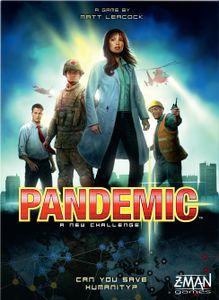
A team of disease-control specialists cooperates to discover cures and contain outbreaks before four deadly diseases overwhelm the world.
Pandemic supports 2–4 players; community best: 4 players; playing time: 45 minutes. A WANGO browser trial has not been confirmed.
Background & introduction
Pandemic is a cooperative game about a specialist response team facing four spreading diseases. Roles such as Dispatcher, Medic, Scientist, Researcher and Operations Expert help players travel, build research stations, share knowledge and discover all four cures.
Each turn has actions, drawing and infection. Take up to four actions, moving, building, treating or sharing; at a research station, normally discard five matching-color City cards to discover a cure. Then draw two Player cards, resolve any Epidemics and infect cities at the current rate.
A city that needs another cube when it already has three of that color outbreaks into its neighbors. Discovering every cure wins immediately; eight outbreaks, insufficient cubes when placement is required, or inability to draw two Player cards loses. Coordinating roles and limited actions helps the team manage these pressures.
Core rules & scoring
Setup: two to four players take roles and start at Atlanta’s research station. Deal four/three/two initial Player cards for two/three/four players. Infection rate starts at two; reveal nine cities, placing three cubes on each of three, two on each of three and one on each of three. Shuffle four/five/six Epidemics separately into near-equal Player-deck piles and stack them.
Turns proceed clockwise: take up to four actions, repeating or taking fewer if desired; draw two Player cards, resolve Epidemics and the seven-card limit, then infect cities. Everyone may discuss, but the active player decides their actions.
Movement: drive/ferry along a connection; discard the destination’s card for a Direct Flight or your current city’s card for a Charter Flight anywhere; Shuttle between research-station cities. Each normally costs one action, with explicit role/event exceptions.
Build a station by discarding your current city’s card; if all six stations are built, relocate one. Share Knowledge requires agreement and both players in the same city, normally transferring that city’s card for one action per card. The Researcher may give any City card from her hand, not arbitrarily take one from another player.
Treat normally removes one chosen-color cube from the current city, or all that color if cured. Discover a Cure at any research station by discarding five same-color City cards, four for the Scientist; station-city color is irrelevant. The Medic treats all cubes of one color even before a cure, and automatically removes/prevents cured colors at his location.
After actions draw two Player cards together. Inability to draw both loses; never reshuffle Player discards. Resolve and remove Epidemics without replacements. City and Event cards share a seven-card hand limit: immediately discard/play Events to seven after resolving drawn Epidemics, including after a Share Knowledge transfer. Role/reference cards do not count.
Epidemic: advance infection rate; draw the Infection-deck bottom card. Unless eradicated, an empty city gets three cubes; a city already containing that color is filled to three and outbreaks. Shuffle only the Infection discard pile onto the existing deck. Resolve two drawn Epidemics completely one after another, then still perform normal infection.
Infect one top card at a time up to the current rate, normally adding one cube of its city color. A fourth same-color cube instead triggers an outbreak: advance the outbreak track and add that disease color to connected cities. Each city outbreaks at most once in a single card’s chain; later cards form separate chains.
Events cost no action, can be used on other turns and are directed by the playing player. Do not interrupt between drawing a card and resolving it, except for explicit card timing permissions. With two Epidemics, an Event may follow complete resolution of the first. Follow other roles’ specific movement, action or prevention text rather than sharing their privileges across the team.
All four cures win immediately without clearing or eradicating every disease. A cured color becomes eradicated when its last board cube is removed, preventing future placement. The eighth outbreak, insufficient required cubes of a color, or inability to draw two Player cards immediately loses for everyone.
Rules & gameplay questions
How do treating, curing and eradicating differ?
Treat removes cubes locally. Discover a Cure normally discards five same-color City cards at any research station, four for the Scientist, without automatically clearing the map; treatment then removes that color more efficiently. Eradication requires a cure and no cubes of that color anywhere. Victory needs four cures, not four eradications.
Do normal infections still happen after an Epidemic?
Yes. Resolve increase, bottom-card infection and shuffling only Infection discards onto the deck, then normal infection. Resolve two Epidemics separately and remove them without replacement draws. A bottom city already containing the color fills to three and outbreaks rather than receiving three additional cubes.
Can neighboring full cities outbreak back and forth forever?
No. Each city outbreaks at most once in the chain from a single Infection card, and that chain does not add cubes back to already-outbroken cities. Each actual outbreak advances the track. Neighboring cities receive the outbreak disease’s color, not their printed color. A later card can start another chain.
When does the seven-card limit apply, and do Events or roles count?
City and Event cards together have a seven-card limit; Role/reference cards do not. Resolve drawn Epidemics first, then immediately discard/play Events to seven; a Share Knowledge transfer also checks immediately. The Contingency Planner’s one stored Event is outside the hand and is removed when played.
Can two players in one city exchange any City cards?
Normally only their current city’s card, with agreement and one action per card. The Researcher may give any City card from her hand, including when another player takes it using Share Knowledge. This privilege transfers cards out of her hand; it does not let her take arbitrary cards from others.
Rules & introduction sources
- Edition
- Pandemic base game using the current publisher-linked ©2013 rules, two to four players and four/five/six-Epidemic difficulties. Excludes Legacy, expansions, Survival competition and the separately published official solo variant.
- Introduction source
- BoardGameGeek
WANGO editorial
| Parameter | Recorded value |
|---|---|
| BGG overall rank (snapshot) | #175 |
| Complexity Weight | 2.39 / 5 |
| Best player count (community) | 4 |
| Player range | 2–4 |
| Playing time (minutes) | 45 |
| Core mechanisms | Action Points · Chaining · Contracts · Cooperative Game · Events · Hand Management · Multi-Use Cards · Point to Point Movement · Set Collection · Simulation · Solo / Solitaire Game · Tags · Trading · Variable Player Powers · Variable Set-up |
| Chinese publication | Unconfirmed |
| WANGO browser play | No confirmed WANGO trial |
| Year published | 2008 |
| Suggested age | 8+ |
BGG statistics are stored snapshots, not live rankings. Source checked:2026-09-26
Player questions
What is the best player count for Pandemic, and can I play online?
Pandemic supports 2–4 players; community best: 4 players; playing time: 45 minutes. A WANGO browser trial has not been confirmed. Recorded mechanism tags: Solo / Solitaire Game.
How complex is Pandemic, and which mechanisms does it use?
Weight: 2.39 / 5. Mechanisms: Action Points · Chaining · Contracts · Cooperative Game · Events · Hand Management · Multi-Use Cards · Point to Point Movement · Set Collection · Simulation · Solo / Solitaire Game · Tags · Trading · Variable Player Powers · Variable Set-up. Chinese publication: Unconfirmed.
Where can I learn Pandemic?
Available resources: Strategy https://wangogame.com/wiki/analysis/pandemic