Endless Winter: Paleoamericans
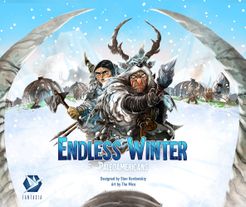
Endless Winter: Paleoamericans combines worker placement and deck building in a tribal development game. Explore, migrate, hunt, develop culture, and build megaliths to score after four generations.
Endless Winter: Paleoamericans supports 1–4 players; community best: 3 players; playing time: 60–120 minutes. A WANGO browser trial has not been confirmed.
Background & introduction
Endless Winter: Paleoamericans is a competitive strategy game combining deck building, worker placement and influence on a shared terrain map. Players lead tribes in prehistoric North America through four generations, developing culture, migrating camps, building villages and hunting animals. Sacred Stones and Megaliths offer additional rewards. These mechanisms are abstractions of the setting, rather than evidence that individual card effects reproduce historical events.
Each player has only three figure placements per generation. Tribe cards can supply Labor for actions now, or be saved for the Eclipse phase to contest turn order and activate Eclipse abilities. Food pays particular costs and can also generate Added Labor through the personal track. Spending every card on immediate work can weaken the coming Eclipse, while saving too many may surrender useful cards or terrain positions.
The theme connects to recurring resources and generational change. Camps and villages establish influence over terrain. Animals may remain upright for set scoring or be tipped for immediate benefits. Sacred Stones score during Eclipses and Megalith placement grants rewards immediately; final scoring then evaluates Offering, Honor, cards and upright animals. The base game includes a dedicated Nomad solo opponent, whose card-driven procedure represents competition rather than a cooperative companion.
Core rules & scoring
Objective and structure: Play four rounds, each representing a generation. Rounds one to three have Action, Eclipse and Preparation phases; after the fourth Eclipse, proceed directly to final scoring. Add final points to those already earned. The highest total wins, with ties going to the tied player ahead in final turn order. The fixed action count makes immediate efficiency and recurring Eclipse rewards central to development.
Setup: Prepare the Main, Animal, Idol and Megalith boards and the Terrain map. Sort Tribe cards into five types and Culture cards into Era I and Era II decks; initially display eight Era I Culture cards. Each player takes a personal board, Chief, two Tribe figures, starting cards, Camps, Villages and Megaliths, then gains the benefits on their Setup card. Shuffle the starting deck and draw five cards. Complete player-count and turn-order setup using the retail manual’s diagrams.
Turn sequence: Optionally play Culture cards first. The first requires no extra discard; for every card beyond the first, discard one additional hand card. Resolve each card immediately. Then place one available Chief or Tribe figure on a Main-board Action Column or your personal Rest space. Discard the cards played this turn afterward, without a normal hand refill. On your third turn, secretly select cards from your remaining hand for your Eclipse pile; unselected cards remain in hand.
Columns and Labor: The four columns are Initiate, Develop, Migrate and Hunt. Resolve top, middle and bottom in that order. Top actions may be repeated by paying their costs, or skipped; the middle action is available once. Only the first figure to reach a column’s bottom this round receives its bottom reward. Later figures may still use the column. Tribe cards generate Labor; spending Food moves its marker left and generates Added Labor for icons crossed, rather than a universal one-Food-for-one-Labor exchange.
Cards and Sacred Stones: Initiate’s top action buys different types of Tribe cards with Labor and Tools; newly gained Tribe cards cannot immediately generate Labor that turn. Its middle action can gain a Tribe card and bury a card by paying Food. Develop’s top action gains Culture cards, while its middle action takes a Sacred Stone after paying the personal-board placement cost. A player holds at most three Sacred Stones, which cannot be removed. Era I restricts the available Stone area, and Stones score during Eclipses.
Terrain, hunting and Megaliths: Migrate places or moves Camps and builds Villages, while Hunt reveals and acquires Animals as indicated by its actions. Pay printed Labor, Tools and other costs. Each Camp gives one Influence to its hex; each Village gives two to each of its three hexes. Tipping an Animal grants its immediate benefit but normally removes it from final animal sets. Megalith placement grants its positional and stacking rewards immediately; do not add those same placement points again during final scoring.
Rest and the Eclipse pile: A figure placed on the personal Rest space draws one card and may tip one Animal. Each figure there contributes one-and-a-half Labor to the coming Eclipse. You cannot play Tribe cards for Labor when taking Rest, though applicable Chief abilities still work. After your third turn, secretly commit any number of Tribe and Culture cards to your Eclipse pile. Culture cards can bluff opponents about its size but contribute no Eclipse Labor.
Eclipse: Reveal all Eclipse piles simultaneously. Total the Labor on committed Tribe cards plus one-and-a-half per resting figure; Food cannot generate Added Labor here. Culture cards contribute no Labor and return to hand. Higher Labor acts earlier, with ties favoring the player who acted later in the current round. In the new order, gain turn-order benefits, resolve Tribe Eclipse abilities, take benefits from individual hexes where you have most or tied-most Influence, and collect exposed personal-board benefits and Sacred Stone points. Discard resolved Tribe cards afterward.
Preparation: After the first three Eclipses, advance the round, recover figures and refill the Animal display. After round one, fill Culture gaps from Era I. After round two, clear the display and reveal eight Era II cards; after round three, refill gaps from Era II. Every player draws five additional cards, retaining existing hand cards; this is not a refill to a five-card hand, and there is no hand limit. Reshuffle your discard pile when your draw deck runs out.
Final scoring: After the fourth Eclipse, convert combined leftover Food and Tools using the Offering-track ratio, discarding remainders; an unmoved marker scores nothing here. Honor-track rank selects the buried-card scoring chart, with earlier arrival breaking a same-level tie, and an unmoved marker scores nothing. Add printed points on all personal Tribe and Culture cards and sets of upright Animals. Argentavis can join another animal set as a wild but cannot form its own set. Break a total-score tie by final turn order. Do not score previously awarded Sacred Stone or Megalith points twice.
Solo and scope: The separate solo rules provide the Nomad opponent, with its board, Nomad cards, Sacrifice and Map decks, priorities, Eclipse procedure and scoring. Multiplayer procedures do not replace those specific automa instructions. This entry describes the checked retail base rules; Ancestors, Cave Paintings, Rivers & Rafts, additional Big Box content and promotional modules are not automatically included.
Rules & gameplay questions
What is the objective and when does the game end?
The game ends after four fixed generations, proceeding to final scoring after the fourth Eclipse. Players develop their tribes through cards, Camps, Villages, hunting, Sacred Stones and Megaliths. Each generation gives three figure actions per player and an Eclipse for order, abilities and terrain benefits. The highest total wins; a tie favors the player ahead in final turn order. There is no journal-track finish trigger.
How many Culture cards can I play on a turn?
You may play none or several; there is no fixed two-card maximum. The first needs no extra discard, while each additional Culture card requires discarding another hand card. Resolve each played card immediately, then place the turn’s figure and perform its action. Discard played cards afterward. Available cards and the discard cost constrain the sequence; one discarded card cannot also count as a played Culture card.
How do Tribe cards and Food provide Labor?
Tribe cards played for a Main-board action provide their Labor icons, sometimes with Added Labor tied to a particular column. Spending Food moves its marker left and generates Added Labor for icons crossed, rather than always one Labor per Food. A Tribe card just acquired through Initiate cannot immediately be played for Labor that turn. Rest and Eclipse have separate restrictions, so do not apply the Main-board procedure indiscriminately.
Can I repeat every section of an Action Column?
No. Repeatable top actions may be used as often as you pay their costs, the middle section is available once, and the bottom reward goes only to the first figure reaching that column this round. Resolve sections in order and skip optional actions you do not want. Existing figures do not block later placements. Repetition depends on the section and its icon, not on treating the entire column as one repeatable action.
How do Rest and Eclipse Labor interact?
Rest draws one card and then lets you tip one Animal. Each resting figure contributes one-and-a-half Labor at Eclipse. You cannot play Tribe cards for Labor during the Rest action. Eclipse compares committed Tribe Labor plus resting figures, without spending Food for Added Labor. Culture cards provide no Labor and return to hand after revelation; they can bluff opponents about pile size but cannot increase the actual total.
How do Camps and Villages earn terrain benefits?
Each Camp contributes one Influence to its hex, and each Village contributes two to each of its three hexes. During Eclipse, compare Influence on each individual hex; everyone with most or tied-most receives that hex’s benefit. Do not aggregate all hexes of the same terrain type into one majority contest. Migration and Village placement can therefore change the next Eclipse reward, so consider both immediate costs and the generations remaining.
Do I refill my hand to five between generations?
No. In Preparation you draw five additional cards and keep cards already in hand; there is no hand limit. Also recover figures, refill Animals and update Culture cards according to the round: refill Era I gaps after round one, replace the display with Era II after round two, then refill Era II gaps after round three. Skip Preparation after the fourth Eclipse and score instead, so no fifth generation or its new hand is created.
Do Sacred Stones and Megaliths score again at the end?
Do not count their previously awarded points again. Sacred Stones score during Eclipses and Megalith placement rewards are immediate. Final scoring adds Offering conversion of leftover Food and Tools, Honor-based buried-card points, printed points on personal Tribe and Culture cards, and upright Animal sets. Tipped Animals do not count for sets. Argentavis may join another species as a wild but cannot form its own set. Final turn order breaks a total-score tie.
Does the base game support solo play, and is Nomad a teammate?
The base game includes dedicated solo rules. Nomad is an automated competitor, not a cooperative teammate. Use its board, Nomad cards, Sacrifice and Map decks and the solo instructions for actions, targeting, Eclipse and scoring. The player still manages their own deck and figures, but normal multiplayer player procedures cannot replace Nomad’s instructions. An expansion such as Ancestors is not required to obtain the solo mode.
Rules & introduction sources
- Edition
- This entry covers Fantasia Games’ base game Endless Winter: Paleoamericans (BGG 305096), using the publisher’s current core and separate solo rulebooks, checked on 27 October 2026. The base game includes the competitive Nomad solo opponent. Ancestors, Cave Paintings, Rivers & Rafts, additional Big Box content and promotional modules are separate. Prototype manuscripts are not a retail-rules baseline.
- Rule references
- Fantasia Games — Endless Winter: Paleoamericans core-game product page
- Fantasia Games — publisher-authored retail English rulebook, third-party DesktopGames mirror
- Fantasia Games — official core rulebook, 2023 second reprint, pp. 1–19 (publisher PDF link)
- Fantasia Games — official solo rulebook, 2023 second reprint (publisher PDF link)
- BoardGameGeek — official English core rulebook file record and reprint notes
- BoardGameGeek — official English solo rulebook file record and reprint notes
- Fantasia Games — Endless Winter: Paleoamericans, game ID 305096
- Introduction source
- BoardGameGeek
WANGO editorial
| Parameter | Recorded value |
|---|---|
| BGG overall rank (snapshot) | #349 |
| Complexity Weight | 3.33 / 5 |
| Best player count (community) | 3 |
| Player range | 1–4 |
| Playing time (minutes) | 60–120 |
| Core mechanisms | Area Majority / Influence · Deck, Bag, and Pool Building · End Game Bonuses · Hand Management · Income · Modular Board · Multi-Use Cards · Set Collection · Solo / Solitaire Game · Tech Trees / Tech Tracks · Turn Order: Auction · Variable Player Powers · Variable Set-up · Worker Placement |
| Chinese publication | Unconfirmed |
| WANGO browser play | No confirmed WANGO trial |
| Year published | 2022 |
| Suggested age | 12+ |
BGG statistics are stored snapshots, not live rankings. Source checked:2026-09-27
Player questions
What is the best player count for Endless Winter: Paleoamericans, and can I play online?
Endless Winter: Paleoamericans supports 1–4 players; community best: 3 players; playing time: 60–120 minutes. A WANGO browser trial has not been confirmed. Recorded mechanism tags: Solo / Solitaire Game.
How complex is Endless Winter: Paleoamericans, and which mechanisms does it use?
Weight: 3.33 / 5. Mechanisms: Area Majority / Influence · Deck, Bag, and Pool Building · End Game Bonuses · Hand Management · Income · Modular Board · Multi-Use Cards · Set Collection · Solo / Solitaire Game · Tech Trees / Tech Tracks · Turn Order: Auction · Variable Player Powers · Variable Set-up · Worker Placement. Chinese publication: Unconfirmed.
Where can I learn Endless Winter: Paleoamericans?
No rule guide, strategy article or WANGO trial has been confirmed for this record.