Hadrian's Wall
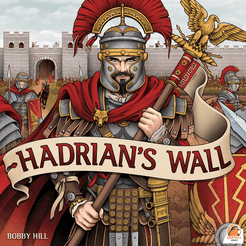
Turn workers and resources into cascading rewards over six years, while keeping three sections of your frontier ready for the annual Pict invasion.
Hadrian's Wall supports 1–6 players; community best: 1 players; playing time: 30–60 minutes. A WANGO browser trial has not been confirmed.
Background & introduction
Your assignment is a milecastle and its adjoining defences. Two sheets connect military construction with civic life: the Fort limits progress on the Wall and Cippi, while trade, performances, temples and five citizen tracks open different ways to develop the settlement.
Each year, two personal cards create a lasting choice. One becomes an endgame Path objective; the other supplies immediate prospects and information for trading and scouting. Players act simultaneously, and a reward uncovered by one action can supply the worker needed for the next.
The satisfying chains have a deadline. Each of three Cohorts must handle its own direction of attack, and unblocked attacks leave Disdain that reduces the final score. Borrowing a neighbour’s information helps that neighbour; solo play replaces this exchange with neutral prospects that make the coming invasion stronger.
Core rules & scoring
Setup: Give each player both sheets, a Player Board and the 12 Player Cards with one matching general. Shuffle the Fate deck, prepare the shared worker/resource supply and agree on difficulty. Play six Years.
Begin a Year: Reveal a Fate Card and give everyone the workers/resources at its bottom. Each player draws two personal cards, secretly assigns one as a Path and one as a Prospect, then reveals both. Take Prospect benefits and annual income from Resource Production, Hotel, Workshop and Road.
Act simultaneously: Pay the specified workers/resources, mark legal boxes and immediately receive the covered rewards. Tracks generally fill left to right. Mark the current Year in numbered-use boxes and respect each activity’s annual limit.
Build the defences: A Fort box costs one Builder or Soldier; a Wall or Cippi box costs one Resource. Fort progress gates the adjoining Wall/Cippi sections and raises Infrastructure. A Medium or Large Granary is also required before entering the middle or right column of the relevant tracks.
Develop the city: Spend Civilians to advance the five Citizen Tracks. Their thresholds unlock buildings and activities; follow each printed cost, construction order, access requirement and yearly limit. Rewards gained during ordinary actions can fuel further actions that Year.
Trade and scout: After constructing the Market, spend a Resource for a neighbour’s Prospect good or a Fate-deck good. Duplicates occupy a Market space without further Renown. Scouting spends a Soldier to use your own or a neighbour’s Prospect pattern; rotate or reflect it, but never overlap marked boxes or extend beyond the map. Pay the neighbour when using their information.
Face the invasion: Once everyone stops, return unused workers/resources, then reveal Fate Cards according to Year and difficulty. Compare attack arrows with filled boxes in each matching Cohort. Temple Favour ignores any one revealed card; a Diplomat’s Favour only ignores a card for its assigned Cohort.
Resolve defence: Each unblocked attack gives one Disdain, capped at the current grey-flag value. Gain Valour equal to that value minus the Disdain received. Workers triggered by this Valour carry into the next Year; ordinary unused action supplies do not.
Score after the sixth invasion: Add the four Attribute totals and six Path-card scores, then apply the Disdain penalty table. Highest score wins; ties favour less remaining Disdain, then more Path-card points, then a shared victory.
One or two players: Shuffle an unused 12-card personal set as a Neutral Deck. Reveal two neutral Prospects each Year in solo, one with two players. Put the Resource or Soldier paid for a neutral good or pattern on its card; each token adds one Fate Card to that Year’s invasion. Base solo compares scores without an AI opponent.
Rules & gameplay questions
Can I save workers and resources for the next Year?
Not from ordinary actions: return all unused supplies before the invasion. Workers newly awarded by the Valour track during defence do carry into the next Year. Workers gained after the sixth invasion are wasted.
Why can I not extend my Wall even though the Fort is far enough ahead?
Check the Granary column gates as well. The middle column needs the Medium Granary and the right column needs the Large Granary. Wall and Cippi progress must also respect their linked Fort sections; Infrastructure alone is not permission.
Are neutral prospects free in solo?
No. Goods still cost a Resource and scouting still costs a Soldier. Leave the payment on the neutral card, then reveal one additional invasion card for each such token. Neutral cards provide information choices, not an AI player.
Can the Baths prevent Disdain that I expect to receive later this Year?
No. A Baths action removes Disdain already circled on your sheet. You may make at most two bribes per Year and must meet their citizen and Resource requirements. With no current Disdain, you cannot take the action in advance.
How does the official solo campaign differ from base solo?
Base solo ends after six Years and compares your score with the rank thresholds. The optional official campaign has 16 Forts with specific win conditions, possible rule changes, optional challenges and setup rewards for the next Fort. Its objectives are not universal base-game victory conditions.
Rules & introduction sources
- Edition
- Covers the physical Hadrian’s Wall base game for 1–6 players using the Garphill-authored 24-page English manual, including the 1–2-player adjustments. The official 16-Fort solo campaign is distinguished rather than explained Fort by Fort. Excludes New Fates and The Anarchy; individual facility boxes and Path conditions still require their printed rules.
- Rule references
- Introduction source
- BoardGameGeek
WANGO editorial
| Parameter | Recorded value |
|---|---|
| BGG overall rank (snapshot) | #173 |
| Complexity Weight | 3.17 / 5 |
| Best player count (community) | 1 |
| Player range | 1–6 |
| Playing time (minutes) | 30–60 |
| Core mechanisms | Hand Management · Paper-and-Pencil · Solo / Solitaire Game · Tech Trees / Tech Tracks |
| Chinese publication | Unconfirmed |
| WANGO browser play | No confirmed WANGO trial |
| Year published | 2021 |
| Suggested age | 12+ |
BGG statistics are stored snapshots, not live rankings. Source checked:2026-09-27
Player questions
What is the best player count for Hadrian's Wall, and can I play online?
Hadrian's Wall supports 1–6 players; community best: 1 players; playing time: 30–60 minutes. A WANGO browser trial has not been confirmed. Recorded mechanism tags: Solo / Solitaire Game.
How complex is Hadrian's Wall, and which mechanisms does it use?
Weight: 3.17 / 5. Mechanisms: Hand Management · Paper-and-Pencil · Solo / Solitaire Game · Tech Trees / Tech Tracks. Chinese publication: Unconfirmed.
Where can I learn Hadrian's Wall?
No rule guide, strategy article or WANGO trial has been confirmed for this record.