Paleo
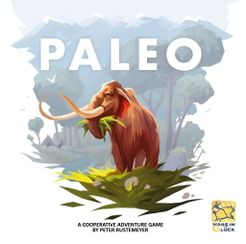
Guide a Stone Age tribe together through unknown cards, balancing food, tools and recurring missions to complete a cave painting before crises overwhelm the group.
Paleo supports 2–4 players; community best: 2–3 players; playing time: 45–60 minutes. A WANGO browser trial has not been confirmed.
Background & introduction
Each player looks after their own humans, but everyone wins or loses together. Food, wood and stone go into the shared camp while tools belong to individual groups. Choosing who explores and who gives up their own opportunity to help drives each day.
Card backs provide clues to the top three locations, but you commit before revealing them together. Discards are both a time cost and a possible source of damage from red-backed cards. Sleeping early avoids danger while reducing the day’s work.
Two base-game modules combine into an adventure. At night, feeding humans and resolving recurring missions compete for supplies. Tools and new cards gradually change the tribe’s capabilities; this overview explains the common procedure without solving card puzzles.
Core rules & scoring
The standard base game is cooperative for two to four players. Collecting the fifth victory token wins immediately, while collecting the fifth skull loses immediately. Gaining the fifth skull and fifth victory token during the same action is a win.
Normally choose two modules and prepare them with the base cards as directed; keep human, dream, idea and secret sets separate. Each player starts with two humans and their tools, and the camp starts with five food. Deal exploration cards facedown as evenly as possible. For a first four-player game, two players should share one group, leaving three groups in play.
During the day, everyone simultaneously chooses one of their top three cards by its back only, returning unchosen cards without changing their relative order. Reveal together, agree on resolution order and choose one option on each card. You may still choose when fewer than three cards remain.
An ordinary action card lets you resolve an action, help another group or ignore it. Meet all ability requirements and pay all costs before receiving rewards. Abilities are thresholds and do not consume humans; discard costs must come from the revealing player’s own deck top.
Pay discard costs facedown without viewing card fronts. Each red-backed card discarded causes one separate damage. Danger cards cannot be ignored: if a positive action cannot be completed, choose a negative action under its rules, resolving as much as possible if full resolution is impossible.
A player choosing help adds their group’s abilities and advantages to the assisted group, can use tools, take damage and share rewards, but cannot pay that player’s card-discard costs. Tools cannot simply be traded or gifted. Multiple groups may help one player.
All damage from a single card goes onto one human and cannot be split. If damage remains after all hearts are filled, place one damage on the skull: that human dies, enters the graveyard and adds a skull token; ignore excess damage. Draw a replacement human after the last human in a group dies.
Use a craft action to pay for ideas on the workbench and gain tools; torches, hand axes and spears are available initially. A tool’s symbols determine whether using it spends it; abilities without a spending arrow can be reused. A tool paid as a cost cannot also provide its ability.
An empty deck sends your group to sleep, preventing further actions or help. Before choosing a card, you may instead discard your remaining deck facedown without effect to sleep early. Once everyone sleeps, pay one food per human; each unfed human adds one skull but does not die. Then resolve every mission and night card.
Choose and resolve one action on each mission/night card; they cannot be ignored. Missions remain for later nights unless instructed otherwise. Finally shuffle the faceup and facedown wilderness discards together and redeal as evenly as possible for a new day. Cards removed to the graveyard are not reshuffled.
Rules & gameplay questions
Can modules be freely combined?
The base rules allow custom module combinations; the seven prepared scenarios are suggested routes. Follow each module’s supplemental setup rather than shuffling the entire box together. This entry supplies no story or card-puzzle solutions.
Does missing food kill humans, or add just one skull per group?
Neither. Every unfed human adds one skull but does not die from hunger. Nighttime mission costs are resolved separately; feeding does not also complete a mission.
Can I explore with only one or two cards, or take rewards before paying a shortfall?
You can still choose and reveal a remaining card. However, all costs for a positive action must be paid; insufficient cards do not permit a reduced payment followed by a reward. Choose another legal option instead.
Can a newly gained tool pay for or prevent damage from that same action?
It cannot apply retroactively. The official FAQ requires all costs and damage before rewards, so a tool received as a reward is available from the next action. The exception awarding victory for the fifth skull and fifth victory token in one action still applies.
Does this entry include solo rules?
It covers only the two-to-four-player cooperative scope of the publisher base rules read. Solo has a separate variant; this entry does not treat playing multiple hands or a third-party solo summary as verified publisher solo rules.
Rules & introduction sources
- Edition
- Checked against the current CundCo 12-page English base-rule download (no visible version number; read in full) and Hans im Glück first-edition 2020 FAQ pages 1–3. Uses the current unchanged order for unchosen cards and symbol-dependent tool spending. Covers common two-to-four-player play. Module supplement not read; module-specific setup, secret-card solutions, expansions and solo variants excluded. The older v4a English rules were compared, not mixed in: their rearrangement and all-tools-single-use wording is superseded here.
- Rule references
- Introduction source
- BoardGameGeek
WANGO editorial
| Parameter | Recorded value |
|---|---|
| BGG overall rank (snapshot) | #236 |
| Complexity Weight | 2.66 / 5 |
| Best player count (community) | 2–3 |
| Player range | 2–4 |
| Playing time (minutes) | 45–60 |
| Core mechanisms | Action / Event · Cooperative Game · Deck, Bag, and Pool Building · Memory · Scenario / Mission / Campaign Game · Simultaneous Action Selection · Variable Set-up |
| Chinese publication | Unconfirmed |
| WANGO browser play | No confirmed WANGO trial |
| Year published | 2020 |
| Suggested age | 10+ |
BGG statistics are stored snapshots, not live rankings. Source checked:2026-09-27
Player questions
What is the best player count for Paleo, and can I play online?
Paleo supports 2–4 players; community best: 2–3 players; playing time: 45–60 minutes. A WANGO browser trial has not been confirmed.
How complex is Paleo, and which mechanisms does it use?
Weight: 2.66 / 5. Mechanisms: Action / Event · Cooperative Game · Deck, Bag, and Pool Building · Memory · Scenario / Mission / Campaign Game · Simultaneous Action Selection · Variable Set-up. Chinese publication: Unconfirmed.
Where can I learn Paleo?
No rule guide, strategy article or WANGO trial has been confirmed for this record.