Samurai
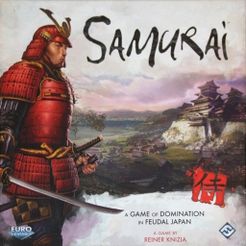
Reiner Knizia's Samurai is an influence-placement game about majorities. Place tiles around Japanese settlements to influence Buddha, Rice, and Castle figures; winning one or more distinct caste majorities is the key to victory.
Samurai supports 2–4 players; community best: 3 players; playing time: 30–60 minutes. A WANGO browser trial has not been confirmed.
Background & introduction
Samurai turns the Japanese islands into a map of cities, villages, coastlines, and empty spaces. Players compete for three types of figures: Buddha represents religious influence, Rice represents economic influence, and Castles represent military power. There is no conventional unit movement or dice combat. Instead, players place hidden-value tiles around settlements to build influence and wait for a city or village to be surrounded so its figures can be captured.
On a turn, a player normally places one influence tile, with the option to use fast, move, or switch tiles when allowed. A tile's number determines its influence strength and its symbol determines which figures it can affect; wild tiles count for all three castes. As empty spaces fill, a city or village becomes surrounded and each figure is resolved separately. Placing a tile first is not always best: a low-value tile can build control gradually, while a strong tile can change the majority at the decisive moment.
Captured figures remain with their players until the end, when Buddha, Rice, and Castle are compared separately. The winner is not simply the player with the largest total collection. Unique majorities earn leader tokens, then the FFG 2015 scoring rules use those tokens and additional comparisons to determine the winner. Because a tied influence removes a figure from play, every surround can affect both a caste majority and the timing of the endgame. Players must judge the consequences of closing a settlement instead of focusing only on one immediate capture.
Core rules & scoring
Edition and setup: This entry follows Fantasy Flight Games' 2015 edition for the Reiner Knizia Samurai record, BGG 3, not other games with the same title. A two-player game uses three of the five board pieces, a three-player game uses four, and a four-player game uses all five. Take 7 figures of each caste for two players, 10 for three, or 13 for four. Each player takes 20 influence tiles in one color, secretly keeps five as a starting hand, and shuffles the other 15 into a personal draw stack. Place one Buddha, Rice, and Castle in Edo, then place remaining figures in cities and villages as shown. The normal starting hand is deliberately chosen, not randomly dealt. Starting with the youngest player, populate cities with two different caste pieces each, then villages with one each; Edo holds one of each caste. Random hands and distribution are a separate beginner setup.
Hand and Turn: On a Turn, a player may place a tile on an empty land space; tiles cannot be placed on a settlement space. Fast-icon tiles may be added, and the Turn may consist only of fast tiles. The hand limit is five. After placement and any permitted actions, draw from the player's stack until the hand again contains five tiles; if the stack is empty, draw only what remains. Tiles normally have an influence value from 0 to 4. A caste tile affects figures of its matching type, while Samurai and Ronin wild tiles affect all castes.
Fast and one-use tiles: Tiles with a fast icon may be played in addition to the normal tile, in any number allowed by the player's supply; a Turn may also consist only of fast tiles. A one-use Switch tile exchanges the positions of two caste figures on the board and is then removed. It cannot leave two figures of the same caste in one settlement. A one-use Move tile relocates one of the player's tiles placed on a previous turn without a fast icon to another empty land space, then occupies the old space. Resolve subsequent draws and placements under the normal rules.
Influence: Hex spaces are adjacent when they share a border; influence is not directional and does not extend across intervening spaces. A tile affects every adjacent settlement, with caste-specific tiles contributing only to their matching caste and Samurai, Ronin and Ships wild for all three. For each caste piece, sum each player’s adjacent valid values separately. Do not combine different castes into one settlement total or count distant tiles merely because they share a color.
Surrounding and capture: At the end of a Turn, a settlement is surrounded if every adjacent land space contains a tile. Adjacent sea spaces do not need tiles, although a Ship tile may occupy one. Resolve each figure in the settlement separately by comparing every player's influence for its caste. The player with the highest influence captures that figure; if the highest value is tied, nobody captures it and the figure is removed from the game. If several figures are in the same newly surrounded settlement, the active player chooses the order in which they are resolved.
Ships and sea spaces: Only Ship tiles can be placed on empty sea spaces; all other tiles must be placed on empty land spaces. A Ship is wild and contributes to influence for each adjacent caste figure. Surrounding a settlement checks only adjacent land spaces, so an empty sea space cannot prevent an otherwise complete surround. Sea placement affects influence but is not required to close a settlement.
End check and hidden pieces: Finish the turn’s placement, capture and hand refresh, then check. End if any caste has no pieces left on the board, or four pieces have been set publicly beside it due to tied influence. Captured pieces go behind each player’s screen and do not count toward the four public tied pieces. Do not wait for every caste to be cleared or give the other players a final extra round.
2015 scoring: Reveal captured figures and count Buddha, Rice, and Castles separately. For each caste, the player with a unique highest count receives that caste's Leader token; a tied caste gives no token. A player with more Leader tokens than every opponent wins. If the leading players each have exactly one Leader token, each sets aside figures of the caste represented by their own token and compares the other two castes. If still tied, compare all three castes; if still tied, share the win. If no one receives any Leader token, compare total captured figures across all castes; a tie is a shared win.
Scoring example and eligibility: If two leaders each hold one token and each totals three pieces outside their own leading caste, compare their totals across all three castes next; with six versus seven, seven wins. A player without a Leader token is already eliminated from this comparison, even with a larger collection. Only when nobody receives a Leader token do all players compare total pieces directly. Apply these steps to the specified FFG2015 edition.
Rules & gameplay questions
Does the player with the most captured figures automatically win?
Not usually. In the FFG 2015 edition, first compare Buddha, Rice, and Castles separately and award a Leader token for each unique caste majority. In most cases the player with the most Leader tokens wins; only certain tie situations lead to further figure comparisons. Do not add all three castes together at the start and declare the player with the largest total the winner.
Which figures can an influence tile affect?
A tile with a caste symbol affects adjacent figures of that matching caste, while a wild tile can affect Buddha, Rice, and Castles. For each figure, total only the adjacent tiles that show its caste or a wild symbol. A tile dedicated to one caste does not count toward the influence on another figure, so both the tile's location and its symbol matter when settlements are surrounded.
Do sea spaces need tiles before a settlement can be surrounded?
No. Under the FFG 2015 rules, a settlement is surrounded when every adjacent land space contains a tile; adjacent sea spaces do not have to be filled. A Ship tile may be placed on empty sea and contributes wild influence to nearby figures, but other tiles cannot be placed there. An empty sea space does not keep a settlement open when all adjacent land spaces are occupied.
Can two players both capture a figure when their influence is tied?
No. Compare each player's valid influence for that particular caste figure. If the highest total is tied, nobody captures the figure and it is removed from the game. That removal can contribute to the four-figure end trigger or eliminate all figures of a caste, so a tie is not a shared capture or a point awarded to both players.
Who chooses the order for resolving several figures in one city?
The active player chooses the order, but each caste piece is resolved separately. A Buddha might go to Green and rice to Red, with another tied piece going publicly beside the board. Complete all captures for this turn, then refresh and check the end. Clearing one caste during the first capture does not let you ignore the other pieces in that settlement or grant an additional final round.
Must I place an ordinary influence tile on every Turn?
A player normally places one tile on an empty land space and may also use any number of fast-icon tiles. The rules allow a Turn made only of fast tiles. Tiles cannot be placed on settlement spaces, and only a Ship can be placed on an empty sea space. After playing and resolving actions, draw back up to five tiles if the personal stack still has cards.
Can Switch and Move tiles be used more than once?
Each player has one of each. Switch swaps two caste pieces without duplicating a caste within one settlement, then returns to the box. Move repositions one of your non-fast tiles placed on a previous turn, filling its old space with Move. Do not move an opponent’s tile, a fast tile such as a Ship, or one just played this turn. The new destination must be empty land; then resolve the normal capture and refresh sequence.
When does the game end, and what happens in a final tie?
Check after each Turn. The game ends when all figures of any one caste have left the board or when four figures have been removed by tied influence. Under the 2015 scoring, award Leader tokens for unique caste majorities and follow the stated tie comparisons; if no one has any Leader token, compare total captured figures. A remaining tie is shared rather than automatically decided by an extra round.
Can the largest total collection win without a Leader token?
If someone has a Leader token, a player with none cannot re-enter the leading players’ tie comparison using a larger collection. First compare tokens; tied one-token leaders compare their other two castes, then all three, then share a remaining tie. Only when every Leader token is unclaimed do all players compare total pieces directly. Follow that eligibility order in the FFG2015 edition.
Rules & introduction sources
- Edition
- Reiner Knizia’s Samurai, BGG3, using the complete eight-page Fantasy Flight Games 2015 Rules of Play with its capture and scoring diagrams. This entry applies that edition’s components, Leader tokens and scoring without generalizing to other printings; excludes digital implementations and unrelated same-title games.
- Rule references
- Introduction source
- BoardGameGeek
WANGO editorial
| Parameter | Recorded value |
|---|---|
| BGG overall rank (snapshot) | #285 |
| Complexity Weight | 2.44 / 5 |
| Best player count (community) | 3 |
| Player range | 2–4 |
| Playing time (minutes) | 30–60 |
| Core mechanisms | Area Majority / Influence · Enclosure · Hand Management · Hexagon Grid · Hidden Victory Points · Once-Per-Game Abilities · Set Collection · Tile Placement · Variable Set-up |
| Chinese publication | Unconfirmed |
| WANGO browser play | No confirmed WANGO trial |
| Year published | 1998 |
| Suggested age | 10+ |
BGG statistics are stored snapshots, not live rankings. Source checked:2026-09-27
Player questions
What is the best player count for Samurai, and can I play online?
Samurai supports 2–4 players; community best: 3 players; playing time: 30–60 minutes. A WANGO browser trial has not been confirmed.
How complex is Samurai, and which mechanisms does it use?
Weight: 2.44 / 5. Mechanisms: Area Majority / Influence · Enclosure · Hand Management · Hexagon Grid · Hidden Victory Points · Once-Per-Game Abilities · Set Collection · Tile Placement · Variable Set-up. Chinese publication: Unconfirmed.
Where can I learn Samurai?
No rule guide, strategy article or WANGO trial has been confirmed for this record.