Clash of Cultures: Monumental Edition
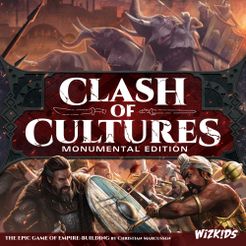
Build a civilization across an unexplored map: advances unlock capabilities, city mood shapes production, and cultural influence competes with warfare for a place in history.
Clash of Cultures: Monumental Edition supports 2–4 players; community best: 3–4 players; playing time: 180–240 minutes. A WANGO browser trial has not been confirmed.
Background & introduction
Clash of Cultures: Monumental Edition places exploration, city management, and conflict on the same gradually revealed map. New cities provide resource bases and raise the growth ceiling of older cities. Expansion therefore opens capacity throughout your economy rather than merely extending your footprint.
Each turn offers just three main actions, so research, movement, and city activation compete for time. Repeatedly working a happy metropolis can secure immediate output, but additional activations lower its mood afterward. Restoring happiness, founding another production center, and investing in advances create a persistent economic tension.
Cultural influence can replace an opponent's building with your color and redirect its scoring without taking over its functions; military attacks change ownership on the map. The box also includes distinctive civilizations, leaders, and additional unit types. Adding that marked module gives technological development more varied rhythms.
Core rules & scoring
The standard game supports 2 to 4 players and lasts 6 Ages. Each Age has 3 rounds; in each round every player takes one clockwise turn and must perform 3 main actions. An Age ends with a Status Phase.
Start with Farming and Mining, 2 Food and zero other resources, a happy city and a Settler on your starting Plains, plus 1 Action card and 1 Objective card. Regular Regions begin facedown and are revealed through exploration.
An Advance action normally costs 2 Food; Ideas and Gold substitute one for one. Acquire a category's top advance before its other advances. Government categories have prerequisites and only one may be held at a time. Every third advance taken through the Event tracker triggers an Event, then replenishes its 3 cubes.
To found a city, remove a Settler and replace it with a Settlement on non-Barren land without a city, enemy units, or Exhausted Land marker. Maximum city size is 5, and growth cannot raise a city above your current number of cities.
Activate exactly one city to collect, recruit, or construct. Additional activations of that city during the same turn lower its mood one step after resolution. Happy cities collect or recruit their size plus 1; angry cities get only 1 and cannot construct buildings.
Collect from the city space and adjacent spaces according to terrain, with each space supplying 1 resource per activation. Enemy units, Exhausted Land, and other cities block collection. Ordinary resources are capped at 7; Food is capped at 2 until Storage.
Constructing a building normally costs 1 Food, 1 Ore, and 1 Wood, requires its advance, and permits only one of each building type per city. Increase Happiness can affect several cities; each step costs Mood tokens equal to that city's size.
A Move action moves up to 3 units/groups, each unit once per action. Army movement requires Tactics; land spaces hold at most 4 Army units. Entering enemy units or cities triggers immediate battle: in land battles, roll for participating Army units, apply Clash abilities, and divide modified Combat Value by 5, rounding down for hits, with simultaneous casualties. Units that fought or entered Mountains cannot move again that turn; Forest entry prevents further movement into battle.
Influence Culture targets a city with a building within a range equal to the originating city's size. A roll of 5 or 6 succeeds; each Culture token can add 1 range or 1 to the roll. Replacing a building with the same type in your color changes its scoring, not city control. Only one success is allowed per turn.
The Status Phase resolves objectives, a free advance, new Action and Objective cards, optional razing of one size-1 city for 1 Gold, optional government change for 1 Culture and 1 Mood, then first-player selection. After Age 6, or if someone enters this phase without cities, stop after objectives and score: 1 per Settlement/building, half per advance, 2 per objective, normally 4 per Wonder (split 2 each between its original builder and current owner when captured; specific Wonders may differ), plus Event and defeated-Leader points. Break ties by comparing these scoring categories in order, then share victory if still tied, subject to special Wonder text.
Rules & gameplay questions
Can one activation make several cities work?
No. Activate exactly one of your cities and perform one city action there. The publisher FAQ explicitly clarifies this restriction.
Does a happy city lose mood before its second activation pays out?
No. Resolve the activation using its current mood, then lower mood one step. Its second activation still benefits from being happy.
Does cultural influence let me command an opponent's city?
No. Its owner retains the building and its functions; its color and final scoring attribution change. Settlements and Wonders are not ordinary cultural-influence replacement targets.
Can I freely choose a Wonder from a public display?
Not under the standard rules. Obtain Wonder cards through Engineering, Monuments, and other effects, then construct a Wonder from your hand using Engineering and meeting its conditions and costs. Open Wonders is an optional variant.
Is the Civilizations module compulsory?
No. Its content is separately marked, so you may learn the Monumental Edition base procedures before adding its 15 civilizations, leaders, and extra units. This edition changes the older game: standard Wonders score 4 points and ordinary resources cap at 7.
Rules & introduction sources
- Edition
- Scope: WizKids Clash of Cultures: Monumental Edition, 36-page English WEB-RES 2021 FEB 05 rulebook; actually read pp.1,4-6,8-20,22-26,28-29,32,35, plus Frosted Games FAQ dated 28 June 2022, pp.1-2. Focuses on standard Monumental Edition base procedures and identifies the included Civilizations module as optional; excludes individual civilization abilities, a complete combat reference, and fan solo variants.
- Rule references
- Introduction source
- BoardGameGeek
WANGO editorial
| Parameter | Recorded value |
|---|---|
| BGG overall rank (snapshot) | #231 |
| Complexity Weight | 3.75 / 5 |
| Best player count (community) | 3–4 |
| Player range | 2–4 |
| Playing time (minutes) | 180–240 |
| Core mechanisms | Action Points · Dice Rolling · Grid Movement · Hand Management · Modular Board · Tech Trees / Tech Tracks · Trading · Variable Player Powers |
| Chinese publication | Unconfirmed |
| WANGO browser play | No confirmed WANGO trial |
| Year published | 2021 |
| Suggested age | 14+ |
BGG statistics are stored snapshots, not live rankings. Source checked:2026-09-27
Player questions
What is the best player count for Clash of Cultures: Monumental Edition, and can I play online?
Clash of Cultures: Monumental Edition supports 2–4 players; community best: 3–4 players; playing time: 180–240 minutes. A WANGO browser trial has not been confirmed.
How complex is Clash of Cultures: Monumental Edition, and which mechanisms does it use?
Weight: 3.75 / 5. Mechanisms: Action Points · Dice Rolling · Grid Movement · Hand Management · Modular Board · Tech Trees / Tech Tracks · Trading · Variable Player Powers. Chinese publication: Unconfirmed.
Where can I learn Clash of Cultures: Monumental Edition?
No rule guide, strategy article or WANGO trial has been confirmed for this record.