Marvel United
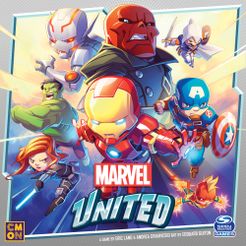
Marvel United is a cooperative superhero card game. Players build a shared Storyline, complete missions, and defeat a villain run by the game; the base rules also include a one-player S.H.I.E.L.D. mode controlling three heroes.
Marvel United supports 1–4 players; community best: 3 players; playing time: 40 minutes. A WANGO browser trial has not been confirmed.
Background & introduction
Marvel United turns a superhero team-up into a connected sequence of cards. Players control heroes who move between locations, rescue civilians, defeat thugs, and clear threats while adding Hero cards to a shared Storyline. The action icons on adjacent cards can link into combinations, allowing the team to coordinate movement, attacks, and rescues. This is not a contest for individual points: the players cooperate to stop the villain’s plan.
The villain is not controlled by another person. A Master Plan deck automates movement, token placement, and BAM! effects. Six locations can accumulate Threat cards and Crisis pressure; if ignored, the villain’s actions may harm heroes, worsen the city, or trigger that villain’s particular defeat condition. The team must read the next step in the sequence and decide whether its current action should rescue, attack, move, or resolve a threat.
Heroes cannot simply attack the villain from the start. The team first has to complete enough Missions—usually two—to unlock attacks, then use attacks while at the villain’s location. The core rulebook also includes S.H.I.E.L.D. Solo Mode: one player controls three heroes and manages their shared cards and action resources under special procedures. Villains do not all share the same actions or loss conditions, so consult the chosen villain’s cards and dashboard.
Core rules & scoring
Objective and cooperation: The players work together as superheroes against a villain operated by the rules. Choose a villain, heroes, six locations, and the matching mission and threat components, then prepare the Master Plan and Hero decks as instructed. The team completes Missions, handles location crises, and reduces the villain’s Health to zero before the villain’s plan causes a loss. Players do not compete for VP; the selected villain’s rules and the team’s actions determine victory or defeat.
Hero turn and Storyline: Draw one card, then play a Hero card from hand at the end of the Storyline. Use the bottom action symbols of that card and the previous Hero card, even if a Master Plan lies between them; the first Hero has no previous Hero card. Resolve available move, attack, heroic, and wild actions in any order, without borrowing another card’s Special Effect. At turn end, if the Hero’s location has no Threat covering its effect, optionally use that location effect once.
Movement, rescue, and combat: Each Move goes to an adjacent location; each Attack deals one damage to an enemy at the active Hero’s location. An ordinary Thug is defeated by one damage. A Henchman loses one Health token per damage and is cleared when all are removed. A Heroic Action rescues one Civilian or fills an action slot on the local Threat; Wild can serve as a Move, Attack, or Heroic Action. Heroes can attack the Villain directly only after two Missions are complete.
The Villain’s Master Plan: The Villain takes the first turn. Thereafter draw a Master Plan card into the Storyline and resolve it according to the current stage. Before the first Mission is completed, the usual sequence inserts a Villain plan after every three Hero cards; after the first Mission, the plan occurs after every two Hero cards. A card may move the Villain, add Civilians or Thugs, and trigger BAM! Ending movement at a location can also trigger a Threat. Resolve location and quantity from the card, Villain rules, and current stage.
Locations and Threats: Each location has slots for civilians, thugs, and possible Threat cards. A Threat can impose a lasting restriction, damage a Hero at a particular time, or trigger a BAM! effect. Players may need to clear Threats to complete a Mission or prevent them from disrupting later actions. If a location is full, resolve its Villain-specific Overflow effect; excess tokens do not universally move clockwise to the next location.
Missions and attacking the Villain: Setup places Missions such as rescuing Civilians, defeating Thugs, or clearing Threats. Complete each by accumulating the progress tokens required by its card and resolve its reward. Heroes generally need to finish the first two Missions before attacking the Villain. The rules allow that if the second Mission is completed and a Hero still has actions at the Villain’s location, that Hero may attack during the same turn. The third Mission is optional and lets all Heroes draw cards when completed. Reduce Villain Health to zero to win, subject to its location and special rules.
Villain victory and loss conditions: The team wins by reducing the Villain to zero Health first. The core rules give three general loss conditions: if the Villain has a Villainous Plot, it fulfills the condition on its dashboard; a Master Plan must be drawn when the Villain deck is empty; or a Hero begins their turn with no cards in both hand and deck. A Villain may also have additional special effects, so check its board and cards. During setup, identify the Plot and plan deck instead of watching Health alone.
S.H.I.E.L.D. Solo: One player chooses three Heroes, shuffles their decks into a shared deck, and draws five starting cards. On each Hero turn play any Hero card in hand, including the same Hero as the previous turn; that card’s Hero is active and benefits from the previous Hero card’s bottom symbols. The hand and Action tokens belong to the player and may serve any Hero. Set Villain Health for three Heroes. If the solo player is KO’d, the game ends in defeat.
Edition scope: CMON lists one to four players and about thirty minutes; the MUN001 rulebook presents standard two-to-four-player cooperation and separately includes a solo mode controlling three Heroes. The base box has seven Heroes, three Villains, and eight Location cards, but only six Locations are chosen for a game. Consult the selected Villain’s Threats, Master Plan and loss conditions. Later expansions and modes are outside this entry.
Rules & gameplay questions
How many people can play Marvel United? Is there a solo mode?
CMON currently lists one to four players, while the MUN001 rulebook introduction labels standard play as two to four and gives S.H.I.E.L.D. Solo Mode separately on page 11. In solo, one person controls three Heroes rather than choosing only one. The publisher lists thirty minutes and BGG lists forty, so treat these as different catalog estimates rather than a guaranteed fixed duration.
What does a Hero do on a turn?
Draw one card from the Hero deck, then play a Hero card from hand at the end of the Storyline. The active Hero can use the bottom symbols of that card and the previous Hero card, even with a Villain card between them. The other Hero’s Special Effect cannot be borrowed. Resolve available movement, attack, and heroic actions in the desired order; at turn end, a location whose Threat has been cleared may offer an optional location effect.
How does the Villain AI work?
After Hero actions, reveal a Master Plan at the cadence for the current stage: before the first Mission is completed, a Villain plan usually follows every three Hero cards; after that first Mission, it follows every two. The card directs movement, Civilian or Thug placement, and BAM! effects; ending movement can trigger a location Threat. Villain decks, Overflow rules, and loss conditions differ, so use the selected Villain’s board and Threat cards.
When can Heroes attack the Villain?
Usually the first two Missions must be completed before Heroes can damage the Villain. Before then, focus on rescuing Civilians, defeating Thugs, or clearing Threats. The rules allow that if the second Mission is completed and a player still has actions during that turn, a Hero at the Villain’s location may attack immediately. The third Mission is optional and lets all Heroes draw cards when completed. Damage still follows the Villain’s immunity rules and Hero action text.
What is the difference between Missions and Threats?
Missions are objectives for the team, such as rescuing Civilians, defeating Thugs, or clearing Threats; progress is tracked with the tokens required by the Mission card. Threats sit at locations and create ongoing effects, damage, or action restrictions that may interfere with Missions or add pressure. Players need to watch both mission progress and the state of all six locations, not just attack the Villain.
How do players win or lose?
The core rules give three general loss conditions: if the selected Villain has a Villainous Plot, that Plot condition is reached; the Villain must draw a Master Plan but its deck is empty; or a Hero starts their turn with no cards in both hand and deck. The team wins by reducing Villain Health to zero first. Some Villains do not have a Plot and others add special rules, so check the selected Villain board, Master Plan, and Threat cards during setup.
How does S.H.I.E.L.D. Solo manage three Heroes?
Choose three Heroes, shuffle their decks together, and draw five starting cards into the shared hand. On each turn play any Hero’s card, including the same Hero again; that card’s Hero becomes active and can use the previous Hero card’s bottom symbols. The hand and Action tokens belong to the player and may be used for any Hero. Set Villain Health for three Heroes. A solo KO immediately loses the game.
Can expansion Commander Solo or other modes be treated as core rules?
No. The MUN001 core rulebook already includes S.H.I.E.L.D. Solo Mode. Later files and expansions may add Commander Solo, Equipment, more Heroes, or additional Villains with different setups. Those modes can change Hero count, cards, or challenge procedures, so follow the matching rules file instead of presenting them as default rules for the original BGG 298047 box.
What happens when a Hero is KO’d?
In multiplayer, a Hero is KO’d immediately after damage causes the last card in hand to be discarded. Lay the piece down and resolve the Villain Dashboard’s BAM! effect; ignore the KO’d Hero for game effects until their next turn, when they stand up and draw up to four cards. A Hero who plays their last card completes that turn before being KO’d. In S.H.I.E.L.D. solo, any KO immediately causes a loss.
Rules & introduction sources
- Edition
- This entry covers the initial CMON/Spin Master Marvel United base game (BGG 298047), using the MUN001 rulebook and CMON product page. Standard cooperative play is for two to four; the rulebook includes the S.H.I.E.L.D. solo variant with three Heroes. CMON lists one to four players and about 30 minutes. The publisher-authored rulebook copy is hosted by a third party; later expansions and modes are outside scope.
- Rule references
- Introduction source
- BoardGameGeek
WANGO editorial
| Parameter | Recorded value |
|---|---|
| BGG overall rank (snapshot) | #340 |
| Complexity Weight | 1.85 / 5 |
| Best player count (community) | 3 |
| Player range | 1–4 |
| Playing time (minutes) | 40 |
| Core mechanisms | Cooperative Game · Hand Management · Modular Board · Solo / Solitaire Game · Variable Player Powers |
| Chinese publication | Unconfirmed |
| WANGO browser play | No confirmed WANGO trial |
| Year published | 2020 |
| Suggested age | 14+ |
BGG statistics are stored snapshots, not live rankings. Source checked:2026-09-27
Player questions
What is the best player count for Marvel United, and can I play online?
Marvel United supports 1–4 players; community best: 3 players; playing time: 40 minutes. A WANGO browser trial has not been confirmed. Recorded mechanism tags: Solo / Solitaire Game.
How complex is Marvel United, and which mechanisms does it use?
Weight: 1.85 / 5. Mechanisms: Cooperative Game · Hand Management · Modular Board · Solo / Solitaire Game · Variable Player Powers. Chinese publication: Unconfirmed.
Where can I learn Marvel United?
No rule guide, strategy article or WANGO trial has been confirmed for this record.