Cascadia
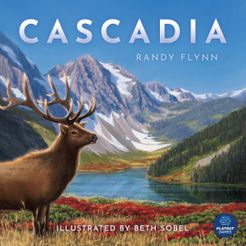
Cascadia builds a landscape of Pacific Northwest habitats and wildlife. Each choice brings a habitat tile and an animal token, balancing connected terrain against animal scoring patterns.
Cascadia supports 1–4 players; community best: 2–3 players; playing time: 30–45 minutes. A WANGO browser trial has not been confirmed.
Background & introduction
Mountains, forests, prairies, wetlands and rivers form each player’s ecosystem. Bears, elk, salmon, hawks and foxes score through the five wildlife cards selected for this game; changing those cards changes the patterns worth pursuing.
The shared display offers four tile-and-token pairs. Normally you draft a pair together, but its animal need not occupy its tile. Tiles must share an edge with your landscape; matching terrain matters for connected habitat scoring rather than placement legality.
Populating a keystone tile earns a nature token. These tokens let you break a draft pairing or refresh animals, while unused tokens score at the end. That creates a choice between immediate flexibility and a small guaranteed score.
Core rules & scoring
Turns: clockwise, draft a tile-and-token pair and place them in either order. A new tile must share a full edge with your landscape; do not overlap or move existing tiles. Place the animal on any empty tile showing its matching icon.
Overpopulation: before drafting, four matching animals must all be replaced, repeatedly if necessary. With exactly three matching animals, you may replace those three once per turn. Keep removed tokens aside until overpopulation is resolved, then return them to the bag.
Nature tokens: before drafting, spend one to choose any tile and any animal independently, or to replace any number of animals. You may spend several tokens in a turn. Populating a keystone tile earns one token; each unspent token scores 1 point.
Wildlife scoring: select one card per species during setup; use the A cards for a first game. Bears need separate groups of exact sizes; elk use the specified formations or groups; salmon need unbranched runs; hawks use separation or sight lines; foxes score neighboring animals. Apply the selected cards and the clarifications on page 11.
Ending and basic scores: each player takes exactly 20 turns. Play ends when the selected tile cannot be replenished. Score the five wildlife cards, then 1 point per tile in your largest connected corridor of each habitat type; separate corridors of the same type are not added together.
Habitat bonuses: with two players, the larger corridor earns 2 points, or 1 each if tied. With three or four players, first earns 3 and second 1; two tied for first earn 2 each, three or more tied for first earn 1 each, with no second-place award. Tied seconds earn nothing. A total-score tie favors more remaining nature tokens, then shared victory.
Solo: use two-player setup. After placing your selection, discard the tile and animal furthest from the draw stacks, slide the remaining two pairs and refill two pairs. Play 20 turns. Each habitat whose largest corridor has at least seven tiles earns a 2-point bonus instead of a majority comparison.
Rules & gameplay questions
Must the animal go on the tile just drafted?
No. It may go on any empty tile with the matching animal icon. If no legal space exists, or you choose not to place it, return it to the bag.
Must matching terrain touch when placing a tile?
No. Sharing an edge with your landscape is sufficient. Matching habitat edges form the connected corridors used for scoring.
Can I divide a connected salmon group into several scoring runs?
No. Every salmon in a run may touch at most two other salmon, and no salmon outside that run may touch it. Three salmon in a triangle can form a run, but no additional salmon may join it. Score using the selected salmon card.
How do the base game, Landmarks and Rolling differ?
This page covers the 1–4-player base tile-laying game, including solo. Landmarks is an expansion with landmarks and new scoring; Rolling is a separate dice, card and writing series. Their mechanisms are not base-game rules.
Rules & introduction sources
- Edition
- AEG/Flatout Games Cascadia English base rules, copyright 2021; current publisher-linked April 2025 optimized 16-page PDF (metadata April 3, 2025), core pages 4–11; 1–4 players including solo. Excludes Family/Intermediate scoring, achievements and scenario restrictions, Landmarks and the Rolling series.
- Rule references
- Introduction source
- BoardGameGeek
WANGO editorial
| Parameter | Recorded value |
|---|---|
| BGG overall rank (snapshot) | #61 |
| Complexity Weight | 1.84 / 5 |
| Best player count (community) | 2–3 |
| Player range | 1–4 |
| Playing time (minutes) | 30–45 |
| Core mechanisms | Chaining · End Game Bonuses · Hexagon Grid · Line of Sight · Open Drafting · Pattern Building · Solo / Solitaire Game · Tile Placement · Variable Set-up |
| Chinese publication | Unconfirmed |
| WANGO browser play | No confirmed WANGO trial |
| Year published | 2021 |
| Suggested age | 10+ |
BGG statistics are stored snapshots, not live rankings. Source checked:2026-09-27
Player questions
What is the best player count for Cascadia, and can I play online?
Cascadia supports 1–4 players; community best: 2–3 players; playing time: 30–45 minutes. A WANGO browser trial has not been confirmed. Recorded mechanism tags: Solo / Solitaire Game.
How complex is Cascadia, and which mechanisms does it use?
Weight: 1.84 / 5. Mechanisms: Chaining · End Game Bonuses · Hexagon Grid · Line of Sight · Open Drafting · Pattern Building · Solo / Solitaire Game · Tile Placement · Variable Set-up. Chinese publication: Unconfirmed.
Where can I learn Cascadia?
No rule guide, strategy article or WANGO trial has been confirmed for this record.