Distilled
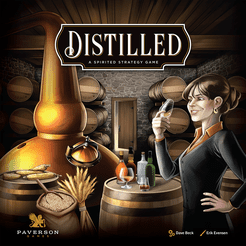
Distilled is a strategy game about running a distillery. Across seven rounds, players buy recipes, ingredients, and equipment, distill spirits, and choose whether to sell immediately or age them for more SP.
Distilled supports 1–5 players; community best: 3 players; playing time: 30–150 minutes. A WANGO browser trial has not been confirmed.
Background & introduction
Distilled begins with an inherited, neglected distillery. Each player runs a family operation for seven rounds in pursuit of the title of Master Distiller. Buying ingredients, equipment, and recipes is only part of the work: deciding when to bottle and sell a new spirit, and when to leave it in the warehouse to age, controls both cash flow and the timing of Spirit Points (SP).
The game borrows ideas from real-world spirits production and turns them into a playable sequence. Sugar types determine which recipes a batch can satisfy, barrels and bottles change value, and aging adds hidden Flavor cards. Players prepare ingredients in the market, accept uncertainty during distillation, then decide how to handle each batch according to their recipes and limited storage.
Selling spirits earns money, SP, and a label bonus; an aged batch can collect more flavor points but takes up warehouse space and delays its payout. Distillery upgrades, private goals, bottle-region collections, and public Spirit Awards add other scoring paths. The theme therefore centers on investment, waiting, quality, and sale timing rather than simply producing the largest number of bottles. The seven-round structure leaves room for several distinct paths: build a more efficient engine, pursue valuable recipes, or manage cash and storage so a premium batch can wait for the right moment. Each choice changes when resources return to the player.
Core rules & scoring
Setup and seven-round structure: Choose one Tasting Flight shared by all players. Each receives a Distillery board, recipe clipboard, starting Metal Barrel and Glass Bottle, three private goals, and a choice of two paired identities with their starting resources, powers and signature recipe. Moonshine, Vodka and your signature recipe are known from the start; buy cubes for other recipes. A signature recipe can be made once per game. Resolve Market, Distill, Sell and Age in that order, then round-end effects and pass first player clockwise, for seven rounds.
Market phase: Players take turns clockwise, buying one recipe cube, Basic or Premium ingredient/item card, or upgrade card, or passing. Players can make multiple purchases, one at a time, but passing ends their purchases for that round. Each player may buy at most two Basic Market cards per round. Premium cards refill immediately after a purchase; at phase end, discard the rightmost card from each Premium row (two cards in a two-player game) and refill the rows. Recipe cubes permanently unlock recipes.
Distill preparation: Each player distills one batch per round, concurrently if desired. At the start, optionally exchange one ingredient or item for a Basic ingredient of equal or lower printed market cost, never an item; do not trade away Yeast, Alcohol or starting items. Fill Yeast, Sugar and Water slots with at least one card each, with no upper limit. Recovered Alcohol can replace or accompany Yeast or Water. Add one new Alcohol per card in the central Sugar slot, then shuffle all slots together. These are game procedures, not a production guide.
Distill and label: Remove the shuffled top and bottom cards to the pantry. Match surviving sugar types, quantity, prohibited sugars and a suitable barrel to a known recipe; choose if several match. Any surviving sugars allow Vodka and no sugars means Moonshine, both with a Metal Barrel. Neither needs a purchased cube. Add the barrel and claim the label; turn order settles shortages. You may still make a spirit with no label available, but receive no label bonus when selling it. Yeast, Water and Alcohol need not survive the cut.
Sell phase: Non-aged spirits must sell this round; newly distilled aged spirits cannot sell yet, while older warehouse spirits may sell. In clockwise order sell one batch per turn, waiting for the order to return before another. Add a bottle, total printed sale money and SP from the applicable cards, barrel, bottle and recipe, and add the warehouse flavor-count bonus for an aged spirit. Gain money and SP, then use its label on an unused immediate bonus space. Starting barrel and bottle return for reuse; Premium bottles become collection pieces, Premium ingredients and barrels go to the truck, other cards return by type, and signature ingredients go to the box, not the truck.
Age phase: After selling, in player order place newly distilled aged spirits into the two warehouse spaces, stack face down with barrel and label face up. Add exactly one unseen Flavor card to each warehouse spirit, including newly stored and older batches. Do not add a Flavor during distillation and then a second for the same round’s Age phase. You may inspect a barreled stack except hidden Flavors. If full, sell an older batch during the preceding Sell phase. A final-round aged spirit still enters the warehouse and cannot sell later this game.
Round-end rewards: After everyone sells or ages, check the public Spirit Awards. If multiple players complete the same award in a round, divide its SP among them, rounding up, and flip the award so it cannot score again. A player who sold no spirit that round may trade up to 4 SP for the same amount of money. At the end of round three, discard one private Distillery Goal and keep two; after round seven, proceed to final scoring.
Final scoring: After seven rounds add warehouse ingredient, barrel and recipe SP, plus 1 SP per Flavor, without sale money, a bottle, label bonus or the aged-sale flavor-count bonus. Premium bottles of the same region score 2/4/7/10/15 SP for 2/3/4/5/6+ bottles, with another 5 SP for at least one bottle from each of three different regions; unregional bottles do not count. Add upgrade SP, achieved private goals and 1 SP per full 5 money. Exchange whole groups and retain the remainder for ties: most SP wins, then most remaining money, then share victory. A goal cannot be achieved with a zero result.
Solo path: Solo still has seven rounds but omits multiplayer Distillery Goals and Spirit Awards. Arrange the five A/B/C goal rows and reveal rows 1, 3 and 5. Start at the bottom, continuing beside a completed goal in the active row or above one into the next row; after moving up you cannot return below. Complete at least one per row and reach the combined completed A/B target. Once per game swap two goals within a row for +5 target score. Claim distill and sell goals immediately after their events, using a spirit for only one goal of that event type. A B-card back replaces normal market cleanup.
Rules & gameplay questions
Can I sell a spirit in the round when I distill it?
Check the recipe icon. A non-aged spirit must sell in its distillation round. A newly distilled aged spirit cannot sell in that round: it first enters the warehouse during Age and receives one hidden Flavor. On a later round you may sell it or leave it to gain another Flavor in Age. A spirit distilled for aging in round seven cannot sell before the game ends and scores only as unsold warehouse stock.
Why are the top and bottom cards removed during distillation?
After shuffling the washback, remove its top and bottom cards and return them to your pantry. The remaining stack determines the spirit. Recipe requirements must be checked against the sugars that survived those removals, so putting in exactly the minimum number of sugar cards is risky: a required sugar may be cut out and leave too few for the intended recipe.
Does a batch fail completely if it no longer fits my intended recipe?
Distill and label: Remove the shuffled top and bottom cards to the pantry. Match surviving sugar types, quantity, prohibited sugars and a suitable barrel to a known recipe; choose if several match. Any surviving sugars allow Vodka and no sugars means Moonshine, both with a Metal Barrel. Neither needs a purchased cube. Add the barrel and claim the label; turn order settles shortages. You may still make a spirit with no label available, but receive no label bonus when selling it. Yeast, Water and Alcohol need not survive the cut.
Must an Alcohol card remain in the spirit stack?
No. During preparation, add one Alcohol card for each Sugar card in the washback. Alcohol cards are shuffled with the other cards and can be removed as one of the top or bottom cuts, so the remaining spirit does not have to contain Alcohol. Alcohol cards from earlier batches can also be placed in the Yeast or Water slot for another distillation.
Can I change a purchase after I see what I need for distillation?
Only at the start of Distill may you exchange one ingredient or item for a Basic ingredient of equal or lower printed market cost, not a barrel or bottle. Yeast, Alcohol and starting items cannot be traded away. Trading does not reopen purchases after passing, reset the two-Basic-purchase limit or grant the Basic Yeast/Water purchase bonus. Premium purchases otherwise slide right and refill immediately.
What if both warehouse spaces are full when I distill a spirit that must age?
Age phase: After selling, in player order place newly distilled aged spirits into the two warehouse spaces, stack face down with barrel and label face up. Add exactly one unseen Flavor card to each warehouse spirit, including newly stored and older batches. Do not add a Flavor during distillation and then a second for the same round’s Age phase. You may inspect a barreled stack except hidden Flavors. If full, sell an older batch during the preceding Sell phase. A final-round aged spirit still enters the warehouse and cannot sell later this game.
What happens if several players meet the same Spirit Award at once?
At round end, divide that award’s SP among all players who met its condition during the round, rounding any remainder up. Then flip the public award so it cannot score again. Where the award condition allows it, a spirit label still in a warehouse can count toward meeting the condition.
How does the solo game differ from multiplayer?
Solo path: Solo still has seven rounds but omits multiplayer Distillery Goals and Spirit Awards. Arrange the five A/B/C goal rows and reveal rows 1, 3 and 5. Start at the bottom, continuing beside a completed goal in the active row or above one into the next row; after moving up you cannot return below. Complete at least one per row and reach the combined completed A/B target. Once per game swap two goals within a row for +5 target score. Claim distill and sell goals immediately after their events, using a spirit for only one goal of that event type. A B-card back replaces normal market cleanup.
Rules & introduction sources
- Edition
- Original Paverson Games Distilled, BGG 295895, using the publisher-authored ©2022 English base rulebook hosted as a third-party mirror, 13 PDF spreads with printed pages 2–24. Covers the 2023 base game for 1–5 players including its supplied solo mode; excludes expansions and later FAQ rulings not verified here.
- Rule references
- Introduction source
- BoardGameGeek
WANGO editorial
| Parameter | Recorded value |
|---|---|
| BGG overall rank (snapshot) | #277 |
| Complexity Weight | 3.04 / 5 |
| Best player count (community) | 3 |
| Player range | 1–5 |
| Playing time (minutes) | 30–150 |
| Core mechanisms | Hand Management · Income · Market · Set Collection · Turn Order: Progressive |
| Chinese publication | Unconfirmed |
| WANGO browser play | No confirmed WANGO trial |
| Year published | 2023 |
| Suggested age | 14+ |
BGG statistics are stored snapshots, not live rankings. Source checked:2026-09-27
Player questions
What is the best player count for Distilled, and can I play online?
Distilled supports 1–5 players; community best: 3 players; playing time: 30–150 minutes. A WANGO browser trial has not been confirmed.
How complex is Distilled, and which mechanisms does it use?
Weight: 3.04 / 5. Mechanisms: Hand Management · Income · Market · Set Collection · Turn Order: Progressive. Chinese publication: Unconfirmed.
Where can I learn Distilled?
No rule guide, strategy article or WANGO trial has been confirmed for this record.