My City
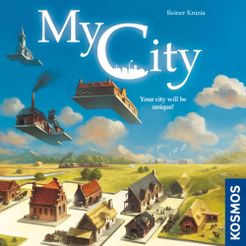
My City is Reiner Knizia’s 24-episode legacy tile-placement game. Build simultaneously, compete in each episode, and carry permanent changes into later chapters.
My City supports 2–4 players; community best: 4 players; playing time: 30 minutes. A WANGO browser trial has not been confirmed.
Background & introduction
My City is a legacy tile-placement game by Reiner Knizia. Players develop separate cities on a new land over 24 episodes, grouped into eight chapters of three. Stickers, notes, and newly opened areas stay on each personal board, so later episodes do not begin from identical blank maps. The game follows each city as it changes, while the other players make their own lasting choices.
In each round, a revealed Construction card tells everyone which building to place, and all players build at the same time. The city must grow from the river and connect along building edges, while players decide whether to preserve trees, cover rocks, and reduce empty buildable spaces. Buildings cannot move during the episode, so each placement affects the remaining space and current score. Clear them between episodes; stickers and development records carry forward rather than the placed building pieces.
A sealed envelope adds rules and materials at the start of each chapter, gradually changing how cities are developed; each envelope should remain closed until its chapter begins. Episode rankings award progress symbols, and after all 24 episodes the player with the most symbols wins the campaign. Players must optimize the episode in front of them while adapting to a board and ruleset that continue to evolve.
Core rules & scoring
Version and setup: This entry covers the original KOSMOS tabletop legacy game, item 69148, for 2–4 players and 24 episodes across eight chapters. Each player takes a personal board and 24 matching-color buildings: eight residential, eight public, and eight industrial. Put the scoring marker on 10 and shuffle the 24 Construction cards. Boards begin alike, then change through stickers and writing; the reverse-board Eternal Game is outside this entry.
Chapters and saved progress: Each chapter has three episodes. Open its sealed envelope only when beginning that chapter, read the new rules, and use its overview table for episode scoring and rewards. After an episode, remove the buildings and reset the scoring marker to 10, but keep the board’s stickers, notes, and added areas for the next episode. If players change, new players continue with the city state left by the previous group.
Simultaneous card reveal: Each round, reveal the top Construction card and place it in the discard pile. Every player takes the matching building and places it at the same time; no one waits for another player. If a building cannot or will not be placed, a player may pass or end their own participation, with different consequences. An episode lasts until everyone has left or all 24 cards have been revealed.
Legal placement: Buildings may be placed only on light-green buildable spaces, never in gray mountains or dark-green forest. The first building must border the river along a full side; touching it only at a corner is not enough. Every later building must share at least one full side with an existing building; a corner alone does not connect. A building may follow and partly cover the river, but cannot cross from one riverbank to the other. Placed buildings cannot be stacked or moved.
Passing, leaving, and the score track: When passing, place the unbuilt piece face down and move the scoring marker back one point, but remain in the episode and continue with later cards. A player at zero cannot pass. Ending participation requires announcing the choice and turning the current unbuilt piece over; this costs no point, but the player cannot build again that episode. Each episode starts at 10. If the score marker reaches 50 during assessment, color one progress symbol and leave the marker at 50; negative scores below zero carry forward against later positive points.
Episode scoring: Start from the score left after passing and any during-episode effects. Each visible tree on a light-green space adds one point, each visible rock subtracts one, and each empty light-green space subtracts one. Plain empty spaces are separate from visible tree or rock spaces: do not charge their ordinary empty-space penalty again for an icon space. Mountains and forests are outside this deduction. Count two trees or rocks as two icons, then apply the current episode sheet and overview.
Placements and campaign winner: In a three- or four-player game, the top score colors two progress symbols and second place colors one; in a two-player game, only first place colors two. If episode scores tie, compare the number of empty light-green spaces in the top row; fewer wins, then compare the next row if still tied. After 24 episodes, the player with the most progress symbols wins the campaign. The rules give no additional tiebreak for a tie in total symbols.
Envelopes and stickers: Open an envelope only when beginning its chapter, read the sheet and display its overview. Some stickers are allocated at an episode’s start and most at its end, so follow the indicated timing. Clear buildings before applying end-of-episode stickers; unless told otherwise, use empty light-green spaces with a small square in the center. Keep unused materials in the box. Buildings are cleared and rebuilt between episodes, while permanent city changes remain. The reverse-board Eternal Game has separate repeatable rules.
Rules & gameplay questions
Can the first building touch the river only at a corner?
No. The first building must lie alongside the river with at least one full side touching it; a single corner touching the river is not enough. Later buildings also need a full side adjacent to an existing building, so a corner-only contact is not a legal connection. Check the shape and river edge before placing the first tile, because placed buildings cannot be moved later.
May a building cover the river or cross to the other bank?
A building may follow the river and partly cover it, but it cannot lie on both sides of the river. If the river flows between two buildings, their edges can still count as bordering. The river itself is not a buildable space and does not split one building into separate pieces, so each placement must satisfy both the river restriction and the edge-adjacency rule.
Can I move a building or save the current piece for later?
No. A placed building stays fixed and cannot overlap another. On each reveal, use the indicated piece now, pass it at a cost of one point, or end your participation. A passed piece is turned face down and cannot be inserted on a later reveal; future cards designate different pieces. Check the whole outline, allowed terrain and edge connection before committing.
What is the difference between passing and ending my participation?
Passing costs one point, but you remain in the episode and may build a later card; a player whose score marker is already at zero cannot pass. Ending participation costs no point, but you announce it, turn over the current unbuilt building, and cannot place more buildings that episode. Passing skips one building with a penalty; leaving stops construction for the rest of the episode.
How do trees, rocks, and empty spaces score?
Episode scoring: Start from the score left after passing and any during-episode effects. Each visible tree on a light-green space adds one point, each visible rock subtracts one, and each empty light-green space subtracts one. Plain empty spaces are separate from visible tree or rock spaces: do not charge their ordinary empty-space penalty again for an icon space. Mountains and forests are outside this deduction. Count two trees or rocks as two icons, then apply the current episode sheet and overview.
Does second place earn a progress symbol in a two-player game?
No. In a three- or four-player game, first place colors two progress symbols and second place colors one. In a two-player game, only the first-place player colors two; second place earns none. Episode ranking drives campaign progress, so do not apply the larger-game reward to a two-player match. If scores tie, use the printed row-by-row empty-space tiebreak.
Does the next episode reset the city to a blank board?
No. Clear the buildings and reset the episode scoring token to 10; permanent stickers, writing, developed areas and colored progress symbols remain. Replacement players inherit that city. The instruction to retain negative points during scoring means they offset subsequent positive points being assessed, and does not remove the explicit reset to 10 between episodes.
May we open a later chapter’s envelope early?
Open each envelope only when its chapter begins. It provides new rules and an overview of episode points, progress and stickers. Some stickers are allocated at the start, others at the end; clear buildings before applying end-of-episode stickers, normally to empty light-green spaces with a small central square. After 24 episodes, most colored progress symbols wins; the general manual supplies no further campaign tie procedure.
Rules & introduction sources
- Edition
- Original KOSMOS My City tabletop legacy game, using the 2020 Thames & Kosmos English manual, printed pages 1–5, for the common rules of the 2–4 player, 24-episode campaign. Read each sealed chapter sheet when reached; this explanation does not reveal or replace those sheets. Excludes My City: Roll & Write, solo play and the reverse-board Eternal Game.
- Introduction source
- BoardGameGeek
WANGO editorial
| Parameter | Recorded value |
|---|---|
| BGG overall rank (snapshot) | #274 |
| Complexity Weight | 1.99 / 5 |
| Best player count (community) | 4 |
| Player range | 2–4 |
| Playing time (minutes) | 30 |
| Core mechanisms | Bingo · Catch the Leader · Grid Coverage · Legacy Game · Pattern Building · Scenario / Mission / Campaign Game · Tile Placement |
| Chinese publication | Unconfirmed |
| WANGO browser play | No confirmed WANGO trial |
| Year published | 2020 |
| Suggested age | 10+ |
BGG statistics are stored snapshots, not live rankings. Source checked:2026-09-27
Player questions
What is the best player count for My City, and can I play online?
My City supports 2–4 players; community best: 4 players; playing time: 30 minutes. A WANGO browser trial has not been confirmed.
How complex is My City, and which mechanisms does it use?
Weight: 1.99 / 5. Mechanisms: Bingo · Catch the Leader · Grid Coverage · Legacy Game · Pattern Building · Scenario / Mission / Campaign Game · Tile Placement. Chinese publication: Unconfirmed.
Where can I learn My City?
No rule guide, strategy article or WANGO trial has been confirmed for this record.