Oath
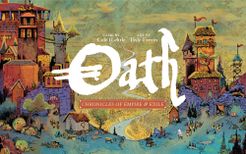
Oath is a political fantasy strategy game in which players contest the kingdom’s ruling objective. Each result is written into a Chronicle that shapes future games; the base box provides an automated-Chancellor option for solo and two-player play.
Oath supports 1–6 players; community best: 4 players; playing time: 45–150 minutes. A WANGO browser trial has not been confirmed.
Background & introduction
Oath: Chronicles of Empire & Exile portrays a fantasy kingdom where political power changes hands. Players become the Chancellor, a Citizen, or an Exile and pursue the current ruling objective through sites, armies, relics, cards, and support. These are changing political positions rather than fixed team labels: players can challenge the ruler, join the Empire, or build enough influence from outside to change how the game ends.
Each game unfolds across a world of sites and cards. Players travel, muster, trade, explore, and fight while spending a limited supply of actions each round. Victory may hinge on who holds the Oathkeeper, an Exile’s Usurper status, or a revealed Vision. There is no general rule that the player with the most accumulated VP wins; players must understand the current Oath and their role before deciding whether to stabilize the Empire or overthrow it.
Oath’s result can shape the next game. The winner follows the Chronicle procedure to preserve or update the map, cards, and next objective, which are used when preparing a later game. The system can also be reset or played with a different group, so it is not a destructive, linear legacy campaign. In the base box, Clockwork Prince can act as Chancellor in solo or two-player play, but this is an automated ruler in a competitive game, not a cooperative team.
Core rules & scoring
Objective, roles, and victory: Players become Chancellor, Citizen, or Exile in a changing kingdom and pursue the current Oath and any available Vision. The Chancellor rules the Empire, Citizens belong to its side, and Exiles may challenge it. The first-printing rules do not use a general “highest VP total wins” ending. Victory depends on Oathkeeper/Usurper status, Vision conditions, stability checks, and the priority rules at the end of round eight.
First and later setups: For a first game, follow the guided setup in the Playbook for sites, cards, resources, and roles. For later games, consult the Chronicle and previous result to preserve or rebuild the map, world deck, Oath, and player positions. Choose a Chancellor; other eligible players begin as Exiles and may later become Citizens. Setup reflects the current Chronicle state, so not every game starts from an identical fixed board.
Player count and automated opponent: The original game supports one to six players. In multiplayer, people take the Chancellor, Citizen, and Exile roles. The base-box Clockwork Prince provides automated-Chancellor rules for solo and two-player play. It follows its own board, reference rules, and action sequence; it is not a full human player and does not create a cooperative team. The base rules do not divide multiplayer players into two teams with a shared win.
Rounds and Wake: The game lasts up to eight rounds. Each round begins with the Chancellor, then players take turns clockwise, completing Wake, Act, and Rest. Wake handles support, Oathkeeper or Usurper status, and immediate victory checks. A player must check the conditions for their current role and Oath before moving on. A player with the largest army or most cards does not automatically win.
Act and Supply: In Act, spend Supply to take major actions and, when allowed, Minor Actions. Search finds a card in the world deck or a local discard pile; Muster adds warbands; Trade gains support or secrets; Recover takes a relic or banner at the current site; Campaign uses dice combat to contest sites and objects; and Travel moves the pawn and explores a site. Supply limits how much a player can do in a round, while site and card abilities can change action costs or results.
Rest and card resources: After acting, Rest recovers resources on cards and refreshes Supply according to the rules. Denizens, Relics, sites, and advisors provide different powers and resources, subject to their location, control, and printed conditions. A card effect is not automatically a permanent global rule; resolve its timing, costs, exhaustion, and refresh using the first-printing Law.
Exile victories: An Exile can win by taking the ruling objective and changing the Oathkeeper state. If an Exile has the Oathkeeper marker on its Usurper side at their Wake, they win immediately. Another path is to reveal a Vision and meet its goal; after at least three Visions have been drawn from the world deck, an eligible Exile may win at Wake. A Vision has its own requirements, so drawing or revealing one alone is not a victory.
Stable regime and succession: At the end of rounds five, six and seven, roll the regime die only if the Chancellor or a Citizen is Oathkeeper. An empire win requires a 6 in round five, a 5–6 in round six, or a 3–6 in round seven. The Chancellor normally wins, but a Citizen meeting the current Oath’s Successor goal wins instead. Depending on the Oath, succession concerns relics and banners, the Darkest Secret, the People’s Favor or the Grand Scepter; Citizens do not all share a team victory.
Eighth-round priority: If no earlier ending occurred, resolve the eighth-round ending in order. First, an Imperial Oathkeeper gives an Empire win, subject to Citizen succession. Otherwise an Exile who is Usurper wins. Otherwise check Exiles with a revealed, fulfilled Vision; simultaneous claims prioritize Conquest, Rebellion, Sanctuary, then Faith. If none applies, the Empire wins, again checking succession. There is no ninth round.
Chronicle and the next game: After a win, follow Writing the Chronicle to set the next Oath, resolve Citizen and Exile status, preserve or update sites and components, and rebuild the world deck. Some cards, map relationships, and goals carry forward, but the system is not an irreversible legacy. The publisher says groups may reset or change players; recording a result is part of the rules, not a requirement to finish a fixed campaign.
Clockwork Prince and expansion boundary: The base-box Clockwork Prince plays the Chancellor in solo and two-player games and uses its own board, cards, and automated action table. Later Queen of Shadows, Servant, New Foundations, and Clockwork Adversaries designs add other solo or cooperative systems and are not the original base rules. A 2019 design diary described an earlier VP-leader ending; this entry follows the first-printing Law’s victory paths and round-eight priority instead.
Rules & gameplay questions
How many players does Oath support? Is solo included?
Leder Games’ launch materials list one to six players. In the base box, the Clockwork Prince acts as Chancellor in solo and two-player games; multiplayer uses human Chancellor, Citizen, and Exile roles. The Prince is an automated ruler in a competitive process, not a cooperative teammate. The 45–150 minute range is a BGG catalog estimate rather than a fixed duration promised by the publisher’s rulebook.
What happens on a player’s turn?
Each round begins with the Chancellor, then players proceed clockwise through Wake, Act, and Rest. Wake resolves support, ruling markers, and victory checks; Act spends Supply on major actions and permitted minor actions; Rest recovers card resources and refreshes Supply. At the end of rounds five through seven, check for Empire stability, and at the end of round eight use the printed priority rules if nobody has already won.
What is Supply used for, and what actions are available?
Supply is the limited resource spent on major actions during Act and refreshed according to the Rest rules. Major actions include Search for cards, Muster warbands, Trade, Recover relics or banners, Campaign through dice combat, and Travel to move and explore. Sites, advisors, and cards can change action costs or effects, so resolve each action using the current board and card text.
How do Chancellor, Citizen, and Exile differ?
The Chancellor is the current ruler; Citizens are on the Empire’s side and may qualify to become the successor victor; Exiles stand outside the Empire and can pursue usurpation or a Vision. Role affects Oathkeeper status, resources, and which victory paths apply, rather than serving as a label alone. Since roles and markers can change during play, check the current role at each Wake instead of relying on starting identity.
How can an Exile win through Usurper or a Vision?
An Exile with the Oathkeeper marker flipped to its Usurper side wins at their Wake. Another route is to reveal a Vision and complete the condition printed on it; once at least three Visions have been drawn from the world deck, an eligible Exile can claim victory at Wake. Merely drawing or revealing a Vision does not win, and every Vision has its own objective.
Does the player with the most VP win?
No. The first-printing Law does not end by ranking accumulated VP. It checks Oathkeeper and Usurper status, Vision conditions, Empire stability at the ends of rounds five to seven, and named priorities at the end of round eight. A 2019 design diary described an earlier VP-leader ending, but the printed first-edition rules replaced it; use the Law rather than an old development diary for the final procedure.
Does the Chronicle make Oath an irreversible legacy game?
No. After a game, the winner follows the Chronicle procedure to preserve or update the map, cards, objectives, and roles for a later game. This lets future sessions inherit the kingdom’s history, but the publisher also says the game can be reset or played with a different group. It is not a destructive campaign that must be played in order with the same players.
Is the base Clockwork Prince the same as later cooperative expansions?
No. The base-box Clockwork Prince is an automated Chancellor for solo or two-player competitive games; players still contest the Empire and Exile victory conditions. Queen of Shadows, Servant, New Foundations, and Clockwork Adversaries are later designs with other solo-player or cooperative systems and their own goals. They should not be presented as default rules for BGG 291572.
Rules & introduction sources
- Edition
- This entry covers Leder Games’ original Oath: Chronicles of Empire & Exile (BGG 291572), using the first-printing The Law of Oath dated 20 October 2020 and its first-printing Playbook and Clockwork Prince files. Leder’s launch announcement confirms 1–6 players; the 45–150 minute range is a BGG catalog estimate. The detailed rule PDF is third-party hosted but matches the designer-uploaded first-printing file description. Clockwork Prince is the base-box Chancellor bot for solo and two-player competitive games, not a cooperative mode. New Foundations, Clockwork Adversaries, and later cooperative rules are outside scope. A 2019 VP-leader ending was an earlier design and is superseded by the printed Law.
- Rule references
- Leder Games — Oath original Kickstarter launch announcement
- BGG — Oath, game ID 291572
- BGG — Oath files, including first-printing Law and Clockwork Prince files
- The Law of Oath, first-printing PDF copy (third-party hosted; matches designer-uploaded file description)
- Leder Games — Oath FAQ
- Leder Games — Designer Diary 16: All About That Bot
- Introduction source
- BoardGameGeek
WANGO editorial
| Parameter | Recorded value |
|---|---|
| BGG overall rank (snapshot) | #337 |
| Complexity Weight | 4.13 / 5 |
| Best player count (community) | 4 |
| Player range | 1–6 |
| Playing time (minutes) | 45–150 |
| Core mechanisms | Action Points · Area Majority / Influence · Area Movement · Dice Rolling · Legacy Game · Modular Board · Negotiation · Scenario / Mission / Campaign Game · Solo / Solitaire Game · Storytelling · Take That · Variable Set-up |
| Chinese publication | Unconfirmed |
| WANGO browser play | No confirmed WANGO trial |
| Year published | 2021 |
| Suggested age | 10+ |
BGG statistics are stored snapshots, not live rankings. Source checked:2026-09-27
Player questions
What is the best player count for Oath, and can I play online?
Oath supports 1–6 players; community best: 4 players; playing time: 45–150 minutes. A WANGO browser trial has not been confirmed. Recorded mechanism tags: Solo / Solitaire Game.
How complex is Oath, and which mechanisms does it use?
Weight: 4.13 / 5. Mechanisms: Action Points · Area Majority / Influence · Area Movement · Dice Rolling · Legacy Game · Modular Board · Negotiation · Scenario / Mission / Campaign Game · Solo / Solitaire Game · Storytelling · Take That · Variable Set-up. Chinese publication: Unconfirmed.
Where can I learn Oath?
No rule guide, strategy article or WANGO trial has been confirmed for this record.