Azul: Summer Pavilion
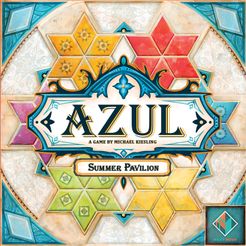
Build star patterns from diamond tiles over six rounds, balancing drafting, placement costs, and a wild color that changes each round.
Azul: Summer Pavilion supports 2–4 players; community best: 2–3 players; playing time: 30–45 minutes. A WANGO browser trial has not been confirmed.
Background & introduction
As artisans decorating a Portuguese summer pavilion, players work on seven stars. Each outer star takes its own color, while the central star needs six different colors. Diamond tiles and numbered placement costs give this installment its own placement and final-scoring rules.
Each round starts with drafting from factories or the center; placement begins only after every tile has been taken. The round's wild color can help pay for other colors, although the tile left on the board must have the correct actual color. Players can also save a limited supply for later rounds.
Connected tiles within a star score immediately, and completing the spaces around pillars, statues, or windows supplies extra tiles. Complete stars and specified number groups earn bonuses after round six, linking small placement choices to a larger plan. Unused materials cost points.
Core rules & scoring
Use the colored-star side. Set out 5, 7, or 9 factories for 2, 3, or 4 players, with 4 random tiles each and 10 tiles in the supply. Start at 5 points. Play six rounds, each with drafting, placement and scoring, then preparation for the next round.
On a drafting turn, take every tile of one non-wild color from one factory or the center, plus exactly one wild tile if any are there. If only wild tiles remain there, take just one. Move a chosen factory's remaining tiles to the center.
The first player to draft from the center takes the start token and loses points equal to the number of tiles taken that turn, stopping at 1 point. That player places first and drafts first next round. Placement starts only when the factories and center are empty.
In the placement phase, take turns placing one tile on an empty diamond space. A space numbered N costs N tiles: place one and discard the rest into the tower. Outer stars require their own colors; all six tiles in the central star must differ.
Current wild tiles can pay part of another color's cost, but at least one tile of the actual required color is necessary and that tile is placed. Wild tiles can also be placed as their actual color. The track determines a new wild color each round.
Each placement scores 1 point plus 1 for each existing tile connected to it within that star. Connections do not cross between stars. Use a point token to keep recording scores beyond 80.
Fill the 4 spaces around a pillar to take 1 supply tile, the 4 around a statue to take 2, or the 2 around a window to take 3. Add rewards to your available materials. Refill the supply before the next player acts, recycling tower tiles if the bag empties.
When you cannot or do not wish to place, pass for the rest of the round. Save up to 4 tiles in your board's corners and discard others for a loss of 1 point each. Next round, return saved tiles to your available materials and refill each factory with 4 tiles.
After six rounds, complete central, red, blue, yellow, orange, green, and purple stars score 12, 14, 15, 16, 17, 18, and 20 points respectively. Covering every space numbered 1, 2, 3, or 4 adds 4, 8, 12, or 16 points respectively.
After the final round, lose 1 point per unused tile still in the corners. The highest total wins, with tied players sharing victory. There is no next-round preparation after round six, and completing a star does not end the game early.
Rules & gameplay questions
Can a wild tile itself occupy a space of another color?
No. It can help pay the cost, but the placed tile must have the required actual color. A wild tile can occupy its own color's star or a central space if that color is not already present.
What do completed decorations award?
The four spaces around a pillar award one tile; the four around a statue award two; the two around a window award three. Choose them from the supply, which is refilled immediately afterward.
Do saved wild tiles stay wild next round?
Only the color shown for the new round is wild. Saved tiles remain usable, but the previous round's wild status does not carry over.
Can I pass and return to placing after other players finish?
No. Passing saves at most four tiles and discards the rest with a penalty. You take no more turns that round, even if you later see a better placement.
When taking two or three reward tiles, am I limited to one wild tile?
No. You may freely choose reward tiles from the supply, including two or three wild tiles if available. The drafting rule about one additional wild tile does not apply to rewards.
Rules & introduction sources
- Edition
- Next Move Games English rules EN-Azul-SP-Rules-2019-12-16; both downloaded foldout pages read in full (printed pages 2-6 and cover), with colored diagrams checked for star bonuses and adjacent decoration spaces. Covers the 2019 base game for 2-4 players on the colored-star side; excludes the monochrome-side variant, Glazed Pavilion expansion, and Mini-specific components.
- Introduction source
- BoardGameGeek
WANGO editorial
| Parameter | Recorded value |
|---|---|
| BGG overall rank (snapshot) | #246 |
| Complexity Weight | 2.08 / 5 |
| Best player count (community) | 2–3 |
| Player range | 2–4 |
| Playing time (minutes) | 30–45 |
| Core mechanisms | End Game Bonuses · Open Drafting · Pattern Building · Set Collection · Tile Placement · Turn Order: Claim Action |
| Chinese publication | Unconfirmed |
| WANGO browser play | No confirmed WANGO trial |
| Year published | 2019 |
| Suggested age | 8+ |
BGG statistics are stored snapshots, not live rankings. Source checked:2026-09-27
Player questions
What is the best player count for Azul: Summer Pavilion, and can I play online?
Azul: Summer Pavilion supports 2–4 players; community best: 2–3 players; playing time: 30–45 minutes. A WANGO browser trial has not been confirmed.
How complex is Azul: Summer Pavilion, and which mechanisms does it use?
Weight: 2.08 / 5. Mechanisms: End Game Bonuses · Open Drafting · Pattern Building · Set Collection · Tile Placement · Turn Order: Claim Action. Chinese publication: Unconfirmed.
Where can I learn Azul: Summer Pavilion?
No rule guide, strategy article or WANGO trial has been confirmed for this record.