Brass: Lancashire
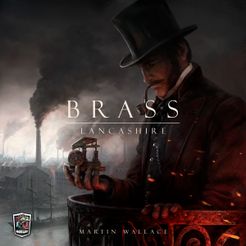
Martin Wallace’s industrial economic game develops cotton mills, coal mines, iron works, ports and shipyards in Lancashire, using canals and railways to turn industries into income and victory points.
Brass: Lancashire supports 2–4 players; community best: 4 players; playing time: 60–120 minutes. A WANGO browser trial has not been confirmed.
Background & introduction
Brass: Lancashire is an economic competition built around cotton mills, coal mines, iron works, ports and shipyards. Players use cards and transport networks to establish industries across the Canal and Rail Eras.
Coal and iron follow different supply rules, while cotton sales depend on ports or the Distant Cotton Market. Other players’ links and resources may help you, and your sales may increase an opponent’s port income. Spending determines next round’s turn order.
Both eras score separately. All links and level 1 industries on the board disappear after the Canal Era, while higher-level industries can score twice. This page specifically uses Roxley’s revised 2018 rules and Full Map, without mixing in the 2007 classic setup, legacy two-player variant, or Birmingham’s beer and Scout action.
Core rules & scoring
Normally take two actions per turn, discarding one card for each action, including passing. The Canal Era’s first round allows only one action. Refill to eight cards at turn end until the draw deck runs out. Actions are Build, Network, Develop, Sell and Loan. Each round, order players from least money spent to most, preserving relative order for ties, then collect income; there is no income collection after the game’s final round.
For Build, a Location card permits construction there without requiring your network; an Industry card requires the matching industry in your network, with a special free choice of location if you have no industries or links on the board. Alternatively spend both actions and any two cards as one Location card. Use your lowest-level tile of that industry, pay money and coal/iron, and obey space icons. In the Canal Era each player may have only one industry per location; the Rail Era removes this restriction.
Your network includes locations containing your industry or adjacent to your link. Resource connectivity can use any player’s links. Take free coal from the closest connected coal mine; only if no connected mine can supply it may you buy from the market, requiring connection to a market trade icon. Iron is free from any player’s iron works, without connectivity or nearest-source restrictions; buy from its market only when no iron works can supply it.
A newly built coal mine connected to a market trade icon, and any newly built iron works regardless of connectivity, must immediately sell as many cubes as possible into empty market spaces, filling the most expensive first and collecting money. Remaining cubes cannot be sold to the market on later turns. Mines and works flip when emptied; mills and participating ports flip through cotton sales; shipyards flip immediately when built. Flipping increases income by the printed number of track spaces, not income levels.
One Sell action may sell several of your unflipped cotton mills, choosing for each a connected unflipped port belonging to any player, or attempting the Distant Cotton Market through a market trade icon. Port sales flip both port and mill. Distant sales first reveal a demand tile and reduce demand; reaching X leaves that mill unflipped and immediately ends the entire Sell action, with no switch to a port. Using a port to reach the distant market does not itself flip it. Sales require no beer.
Network links must adjoin your network. In the Canal Era, build one canal for £3 per action. In the Rail Era, build one rail for £5 or two for £15; each separately consumes one coal and must satisfy connectivity. Develop removes one or two lowest-level industry tiles from your mat, costing one iron per tile. Level 0 shipyards cannot be built and must be developed away; level 1 shipyards are Canal Era only and level 2 are Rail Era only.
For Loan, discard any card, take £10/£20/£30, and reduce income by one/two/three levels, placing the marker on the highest space of its new level. You cannot go below income level −10, and loans are never repaid. Loans are forbidden in the last four Rail Era rounds. Revealing the deck tile signals one remaining round for loans before it is flipped to indicate the ban.
An era ends when the draw deck and all hands are exhausted. Score each link for link-scoring icons at both ends and remove it; score printed VP on flipped industries remaining on the board, with none for unflipped industries. After the Canal Era, remove all level 1 industries from the board, reset the distant market and prepare the new deck. Level 2+ industries remain and can score twice if flipped. After the Rail Era add one VP per £10. Highest VP wins; break ties by income, then cash, sharing victory if still tied.
Rules & gameplay questions
Can I take both coal and iron from anywhere?
No. Coal requires a connected source and prioritises the nearest connected mine. Iron needs no connection and may come from any iron works. Both must use the required board supply before the market; you cannot arbitrarily buy from the market to benefit your own industry.
Does a cotton mill still sell when distant demand reaches X?
No. The mill that causes demand to reach X does not flip, and the entire Sell action immediately ends. You cannot continue by selling to a port. Mills successfully sold earlier in the action remain sold.
Does Lancashire have beer or a Scout action for wild cards?
No. Do not import these from Birmingham. Lancashire instead allows spending both actions of a turn and discarding any two cards as a Location card for construction; this is a different action arrangement.
Can shipyards be developed?
Yes. Level 0 shipyards cannot be built and must be developed away to expose higher levels, consuming one iron per removed tile. Level 1 may be built only in the Canal Era and level 2 only in the Rail Era. They flip immediately upon construction.
Does a two-player game use the smaller map and £25 starting cash?
This page uses the revised 2018 standard rules for two to four players: the Full Map, £30 starting cash, and player-count-specific removal of cards and distant market tiles. The smaller map and £25 belong to the legacy community two-player variant preserved in the appendix; do not mix its setup with the standard game.
Rules & introduction sources
- Edition
- For BGG 28720, Brass / Brass: Lancashire, this page uses the Roxley 2018 reprint English rulebook v2018.11, labelled 2018.11.20 on the publisher’s download page. Covers the standard 2–4-player Full Map game with both eras. Excludes the Classic Rules appendix, legacy community two-player map, Canal-only introductory game and Brass: Birmingham.
- Rule references
- Introduction source
- BoardGameGeek
WANGO editorial
| Parameter | Recorded value |
|---|---|
| BGG overall rank (snapshot) | #22 |
| Complexity Weight | 3.84 / 5 |
| Best player count (community) | 4 |
| Player range | 2–4 |
| Playing time (minutes) | 60–120 |
| Core mechanisms | Chaining · End Game Bonuses · Hand Management · Income · Loans · Market · Multi-Use Cards · Network and Route Building · Ownership · Tags · Tech Trees / Tech Tracks · Tile Placement · Turn Order: Stat-Based · Variable Set-up |
| Chinese publication | Unconfirmed |
| WANGO browser play | No confirmed WANGO trial |
| Year published | 2007 |
| Suggested age | 14+ |
BGG statistics are stored snapshots, not live rankings. Source checked:2026-09-27
Player questions
What is the best player count for Brass: Lancashire, and can I play online?
Brass: Lancashire supports 2–4 players; community best: 4 players; playing time: 60–120 minutes. A WANGO browser trial has not been confirmed.
How complex is Brass: Lancashire, and which mechanisms does it use?
Weight: 3.84 / 5. Mechanisms: Chaining · End Game Bonuses · Hand Management · Income · Loans · Market · Multi-Use Cards · Network and Route Building · Ownership · Tags · Tech Trees / Tech Tracks · Tile Placement · Turn Order: Stat-Based · Variable Set-up. Chinese publication: Unconfirmed.
Where can I learn Brass: Lancashire?
No rule guide, strategy article or WANGO trial has been confirmed for this record.