Tapestry
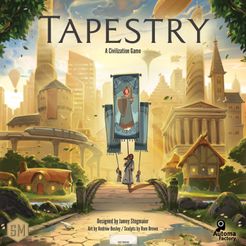
Tapestry is a competitive civilization-building game for 1–5 players who develop asymmetric civilizations across four advancement tracks and five income turns.
Tapestry supports 1–5 players; community best: 3 players; playing time: 90–120 minutes. A WANGO browser trial has not been confirmed.
Background & introduction
Tapestry is a competitive civilization-building game for one to five players. Each player begins with an asymmetric civilization and develops it from humanity’s beginnings toward the future. A civilization’s path need not reproduce real history; its tracks, abilities, and capital-city layout form a distinct story. The goal is to finish with as many victory points as possible and compare the final score with the other players.
Civilization growth is represented by four advancement tracks: military, science, exploration, and technology. Players can specialize or move across several tracks; spaces provide resources, territory, cards, landmarks, or additional actions. Science uses a die to move another track, technology upgrades cards, exploration expands the map, and military places outposts to contest territory. Each track offers a different route, so players choose when to advance based on available resources and the state of the map.
On a normal turn, a player either begins a new era and takes an income turn or pays resources to advance one space on any track. An income turn combines civilization abilities, tapestry cards, technology, the income mat, and the capital city. Track advances gradually reveal buildings and resources on the income mat. The capital is both a tile-placement puzzle and a scoring area; the map and achievements add points, connecting city planning, resource management, and competition with opponents.
Every player takes five income turns, but each chooses when to enter the next era, so players usually finish at different times. A player’s game ends after their fifth income turn; opponents continue until they finish. Once everyone has completed five income turns, the player with the most victory points wins. Current official rules break a tie by comparing each player’s highest landmark in their capital. The theme evokes civilization and historical storytelling, while the mechanisms model development through tracks, income, map control, and city space.
Core rules & scoring
Objective and base-game scope: Each player leads an asymmetric civilization and earns victory points by advancing tracks, taking income turns, building a capital, and controlling territory. Everyone takes five income turns, but each player chooses how many ordinary track advances to take between them. The current base game supports 1–5 players and includes 16 revised civilization mats; no expansion is required for the four base tracks.
Map and civilization setup: Choose the public map size for the player count: the small map for one to three players and the large map for four or five. Each player takes a capital mat, income mat, and civilization mat. Arrange farms, houses, markets, and armories on the four income tracks with the leftmost building uncovered; all four resources begin at zero. Take a starting territory and outposts, place track markers at their starting spaces, and randomly determine first player. Everyone’s first turn is an income turn.
Two choices on a turn: On their turn, a player either begins a new era and takes an income turn, or pays the cost shown for the current level to advance one space on any development track and resolve that space. Optional benefits may require an additional cost. Under the publisher’s current global rule, a player cannot initiate the same track space a second time in one turn. The restriction applies to the specific space, not the entire track. Play then passes clockwise.
Income turns and resource limits: An income turn generally resolves the civilization ability, places a tapestry card in the next era space, optionally upgrades a technology card, and collects the exposed victory points, resources, tiles, and card income on the income mat. A tapestry card occupies its era space and can provide an immediate or ongoing benefit. The base rulebook caps each resource at eight. Income, technology, complete capital rows and columns, and controlled territory contribute to scoring at their listed steps.
Science track: When a player advances to a science space, roll the science die and move forward for free on the other track shown by the die. If the result would move the marker beyond that track’s end, it does not move. Further movement can provide additional spaces and benefits. Science can turn one paid action into progress in another area, but the die determines which track is available; the player cannot choose a different free advance.
Technology track: When gaining a technology card, choose from the face-up cards or the top of the deck and place the card in the bottom row beside the capital. Gaining it normally has no immediate card effect. To upgrade, move a technology card up a row and resolve the circular or square effect associated with its new row. A move to the top row requires the printed prerequisite, such as the player or an adjacent player reaching a specified track level. Technology is developed by upgrading acquired cards, not by simply collecting more cards.
Exploration track and map: Place a territory tile in an unexplored map space adjacent to territory you control, choosing its orientation. Gain one victory point for each matching edge with adjacent terrain, up to six, then take the resources printed on the tile. Reaching level IV of the exploration track allows a player to explore space tiles. Space tiles sit beside the player’s income mat, do not need to connect to one another, and provide their printed benefit. The supplies of territory and space tiles are limited.
Military track and control: A military action places an outpost from the player’s supply on an adjacent territory that has at most one outpost, then rolls two conquest dice and chooses one of their benefits. If an opponent has an outpost there, turn it sideways to show that control is contested; the opponent may discard a trap card to keep control, while the attacker still receives the chosen die benefit. A territory with two outposts cannot be conquered again. A player with all outposts on the map cannot start another conquest.
Capital construction and scoring: When an exposed building on the income mat is available, place it in an open capital space. Completing a region of the 3×3 capital grants a resource of the player’s choice immediately; each complete row and column is worth one victory point during scoring. Landmarks also occupy capital space and affect the tie-break rule. If the capital has no room, the official FAQ still allows the player to gain an income building or landmark and place the model beside the capital mat; a full city does not cancel an earned component.
Tapestry cards, traps, and technology: Play a tapestry card only when beginning an income turn by placing it in an era space. “When played” effects resolve immediately; “this era” effects last until the next income turn begins. Trap cards can respond to an opponent’s military conquest. Technology cards are gained and upgraded through the technology track. Under current official updates, a player’s game ends after their fifth income turn: they cannot play a tapestry or trap card or respond to another player afterward.
End of game, winner, and ties: A player finishes their own game after their fifth income turn; other players continue. Once everyone has completed five income turns, the player with the highest victory-point total wins. If scores are tied, current publisher rules award the win to the player with the highest landmark in their capital. The publisher’s FAQ does not specify a second tie-break if those landmarks are also tied, so do not invent a comparison of remaining resources or other values. This update replaces the older resource tie-break in the 2019 rulebook.
Rules & gameplay questions
Does every turn have to be an income turn?
No. On a turn, a player can begin a new era and take an income turn, or pay to advance on one development track. Each player takes five income turns total, but the number of track advances between them is their choice, so players do not all take the same number of ordinary turns. Income turns resolve abilities, cards, technology, and income; a track advance gives a specific development benefit.
Can I activate the same track space twice in one turn?
No. The publisher’s current rules and FAQ say that the same track space cannot be initiated twice in one turn. The restriction is tied to a specific space, not the entire track. A player may still take multiple advances in one turn if they can pay and meet the requirements, provided each advance initiates a different space. Avoid simplifying the rule to “one action per track per turn.”
Can I choose any track for a free advance from the science die?
No. The science space instructs the player to roll the science die, and the die face determines which other track can advance for free. If the marker would move beyond that track’s end, it does not move. The free advance can resolve the destination space’s benefit when applicable, but the player cannot replace the die result with a different track.
Does a technology card grant its ability as soon as I gain it?
Usually not. A newly gained technology card goes in the bottom row beside the capital and normally has no immediate card effect. The player later upgrades it through the technology track, moving it upward and resolving the effect for the row it enters. A move to the top row may require a condition printed on the card, such as the player or an adjacent player reaching a particular track level. Read the card for its specific ability.
Are territory and space tiles placed in the same way?
No. A territory tile goes in an unexplored map space adjacent to territory the player controls, and the player chooses its orientation. Each matching terrain edge scores one point, up to six, followed by the resources shown on the tile. At exploration level IV, the player may take a space tile; it sits beside their income mat, does not connect to other space tiles, and grants its printed benefit.
Can I still gain a building or landmark if my capital is full?
Yes. The publisher’s FAQ says a player still gains an income building or landmark when the capital has no open space; place the model beside the capital mat. A crowded city does not cancel an earned reward. Capital spaces still matter for completing regions, rows, and columns, and removing a building from the income mat also exposes a different income for later turns.
Can I play a trap card after my fifth income turn?
No. Once the fifth income turn ends, that player’s game is finished. The current official FAQ says they cannot play tapestry or trap cards or respond to another player. If other players have not finished, the completed player may still gain victory points from a passive civilization ability, but cannot gain other things. Final scoring happens after everyone completes their fifth income turn.
How is a tie in victory points broken?
Current official rules compare the highest landmark in each tied player’s capital; the higher landmark wins. The 2019 base rulebook used remaining resources, but Stonemaier later replaced that rule on its Rules & FAQ page, and the update applies without an expansion. The publisher does not list a second tie-break if the highest landmarks also tie, so do not compare resources or invent another test.
Does Tapestry represent a real historical timeline?
No. The publisher frames the theme as civilizations developing from humanity’s beginnings toward the future, but also says players’ paths can differ greatly from real events or people. Each civilization makes its own story. The rules model development through military, science, exploration, and technology tracks, with points from growth, income, the capital, and the map rather than a requirement to recreate a historical civilization.
Does the base game support solo play?
Yes. The publisher’s current base-game page lists a full solo mode with Automa cards. The entry’s main rules summary covers the shared income-turn and advancement-track system; solo players should use the official Automa rules for the automated opponent’s dedicated steps. Automa is not a fifth civilization or an extra advancement track.
Rules & introduction sources
- Edition
- This entry covers the current English base game Tapestry (BGG 286096), including its 16 revised civilization mats marked with a purple icon. It excludes Plans & Ploys, Arts & Architecture, Fantasies & Futures, the Revised Civilization Pack, and variants. Core procedures follow Stonemaier Games’ 2019 four-page base rulebook (printed pages 1–4), with current global updates from the publisher’s Rules & FAQ page applied to all Tapestry games: a track space may not be initiated twice in one turn, a player cannot respond after their final income turn, and ties are broken by the highest landmark in the capital. The rulebook is available through the publisher’s public files directory; edition scope and updates were checked against the publisher’s product and rules pages.
- Rule references
- Introduction source
- BoardGameGeek
WANGO editorial
| Parameter | Recorded value |
|---|---|
| BGG overall rank (snapshot) | #306 |
| Complexity Weight | 2.98 / 5 |
| Best player count (community) | 3 |
| Player range | 1–5 |
| Playing time (minutes) | 90–120 |
| Core mechanisms | Area Majority / Influence · Card Play Conflict Resolution · Contracts · Dice Rolling · Die Icon Resolution · Events · Grid Coverage · Hand Management · Hexagon Grid · Income · Layering · Map Addition · Multiple Maps · Once-Per-Game Abilities · Open Drafting · Push Your Luck · Solo / Solitaire Game · Square Grid · Tags · Take That · Tech Trees / Tech Tracks · Tile Placement · Variable Player Powers · Variable Set-up |
| Chinese publication | Unconfirmed |
| WANGO browser play | No confirmed WANGO trial |
| Year published | 2019 |
| Suggested age | 12+ |
BGG statistics are stored snapshots, not live rankings. Source checked:2026-09-27
Player questions
What is the best player count for Tapestry, and can I play online?
Tapestry supports 1–5 players; community best: 3 players; playing time: 90–120 minutes. A WANGO browser trial has not been confirmed. Recorded mechanism tags: Solo / Solitaire Game.
How complex is Tapestry, and which mechanisms does it use?
Weight: 2.98 / 5. Mechanisms: Area Majority / Influence · Card Play Conflict Resolution · Contracts · Dice Rolling · Die Icon Resolution · Events · Grid Coverage · Hand Management · Hexagon Grid · Income · Layering · Map Addition · Multiple Maps · Once-Per-Game Abilities · Open Drafting · Push Your Luck · Solo / Solitaire Game · Square Grid · Tags · Take That · Tech Trees / Tech Tracks · Tile Placement · Variable Player Powers · Variable Set-up. Chinese publication: Unconfirmed.
Where can I learn Tapestry?
No rule guide, strategy article or WANGO trial has been confirmed for this record.