Ankh: Gods of Egypt
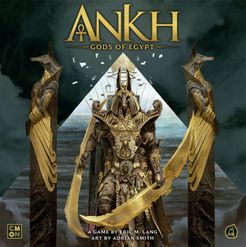
Ankh: Gods of Egypt is a competitive area-control game in which Egyptian gods use actions, monuments, followers, and deterministic battles to seek sole divine rule.
Ankh: Gods of Egypt supports 2–5 players; community best: 2, 4 players; playing time: 90 minutes. A WANGO browser trial has not been confirmed.
Background & introduction
Ankh: Gods of Egypt is a competitive area-control strategy game for two to five players, set in a mythic ancient Egypt moving from polytheism toward monotheism. Each player leads a distinct god, commands warriors, and seeks the devotion of the people before rival deities fade from memory. The story is about the old pantheon struggling to survive a religious transition, while the game turns that conflict into a contest over territory, monuments, and timing.
Players gather followers and spend them to unlock Ankh powers or attract mythical Guardians with special abilities. Position on the Nile map matters because monuments and figures define control of each region. Battles use hidden choice rather than dice: eligible gods select a battle card, reveal it together, and compare strength after card and power effects. Reading an opponent’s remaining options and being in the right region before a conflict are central decisions.
Four action tracks also serve as clocks. Moving an action marker can trigger a monument-control event, a camel caravan that divides a region, or a global conflict that resolves the map in order. In games with at least three players, the two lowest-ranked gods can merge after the third conflict while their players continue taking separate turns. A battle win is only one step toward victory: devotion, the forgetting event, and the final conflict determine whether a god survives as Egypt’s sole deity.
This listing follows the core competitive rules and general core rulings in CMON’s rulebook and FAQ. The rulebook directs players to choose a compatible scenario for exact board placement, so no single map setup applies to every player count. CMON’s detailed booklet is not labelled as a second-edition ruleset; later printing-specific rules are not mixed into this summary.
Core rules & scoring
Setup and objective: Each player chooses an available god and takes its dashboard, god figure, six Warriors, Ankh tokens, Battle cards, and player aid. Place figures, monuments, conflict-order tokens, and other pieces according to a compatible scenario. Each player starts with one Follower; choose Guardian cards and available figures by player count. Set devotion order, the four action markers, and the Event marker as directed. The Scenario Booklet controls the exact map setup, so do not treat one scenario’s starting positions as universal. A god that reaches the top of the Devotion track wins immediately.
Turn and action tracks: Choose Move Figures, Summon Figure, Gain Followers or Unlock Ankh Power, slide its marker one space right and resolve the action fully. Reaching the last space triggers an event: finish the action, advance and resolve the event, reset the action marker and end the turn. If the first action triggers no event, a second action from a lower row is mandatory; move its marker even if its effect cannot be resolved. A single action is used when the first triggers an event, the first is Unlock Ankh Power with no lower row, or the player is Merged. The same action cannot be chosen twice in one turn.
Actions and events are mandatory when possible: CMON’s FAQ says that a player must carry out an action or event when its legal benefit can be taken. If the selected action cannot produce an effect because a required condition is missing, the player may still advance its marker without gaining the benefit. For example, a player who cannot pay the Follower cost to unlock a power gets no power, while a legal benefit cannot be declined simply to avoid the event track. God abilities, Ankh powers, and card text may define specific exceptions.
Move, summon, and gain Followers: The Move action lets the player move each of their figures up to three spaces, ending in an empty non-Water space; passing through pieces and determining adjacency are separate questions. Summon places one Warrior or controlled Guardian from the player’s pool on an empty non-Water space adjacent to one of their figures or a monument they control in the same region. Gain Followers gives one Follower for each neutral or player-controlled monument adjacent to any of their figures. An opponent-controlled monument does not count, and a controlled monument without an adjacent friendly figure does not count.
Unlock powers: Ankh powers have three levels, with costs of one, two, or three Followers. On each unlock, move the currently available Ankh token to a power in that level. The required lower-level powers must be unlocked before advancing to a higher level. Only unlocked powers can be used. Some power symbols grant a Guardian of the matching level if a figure and suitable base remain available. Spent Followers return to the general supply; they are not both spent and retained in the player’s pool.
Events: When an action marker reaches the end of its track, advance the central Event marker and resolve the indicated event. A Control Monument event normally lets the triggering player claim an adjacent neutral monument; only after no neutral monuments remain may they replace an opponent’s control token, and adjacency is still required. A Camel Caravan places a line of up to six camels to split a region; both resulting regions must contain at least six land spaces, with Water excluded. Camels change region boundaries and adjacency, and the event also assigns Conflict Order tokens.
Conflict and monument scoring: A global Conflict resolves regions from the lowest to highest Conflict Order number. Ignore a region with no figures. If figures from only one god are present, that god dominates and receives the applicable devotion reward and monument-majority rewards. A battle occurs only when at least two gods each have a figure in the region. Obelisks, Temples, and Pyramids are checked as separate monument types. The majority holder must also have a figure in the region; the official FAQ says that a second-place god does not inherit the reward if the actual majority holder is absent. A tied count creates no majority reward.
Battle: Each eligible god secretly selects an available Battle card and reveals it simultaneously. Resolve the card and conflict steps, including Build Monument and Plague of Locusts when applicable, then monument majorities and total strength. Each figure has one base strength; powers, god abilities, Guardians, and Battle cards may change it. The highest strength wins devotion and removes opposing Warriors and Guardians, never God figures. At a tie, the player who triggered the Conflict may use the tiebreaker token to win one tied battle during that Conflict. A god with no figure in a region has zero strength and cannot win from a card bonus alone. If no tie is broken, Warriors and Guardians subject to elimination are removed, with God figures and applicable protection effects respected; nobody wins the battle.
Merge, forgetting, and victory: In games with at least three players, after the third Conflict the two gods lowest on the Devotion track merge. The higher-ranked of those two remains the shared god; both players keep their original seat order and each takes one action on their own turn, sharing specified figures and resources. A merge does not create consecutive turns or make one Ankh power resolve twice. After the fourth Conflict, gods still in the red area are forgotten and removed: one remaining god wins, while all gods forgotten means nobody wins. If the game has not ended earlier, resolve the final event and the highest Devotion wins.
Rules & gameplay questions
Can a player skip an action or event that would benefit them?
No. CMON’s FAQ says actions and events must be resolved when their legal benefit is available. If an action cannot produce an effect because the player lacks a required piece, cost, or condition, its marker can still advance without a benefit. The distinction is between an action that is impossible and a legal result the player dislikes. Check the god, power, and card text for specific exceptions before applying the general rule.
Does every monument controlled by a player generate Followers?
No. Gain Followers counts neutral or friendly monuments adjacent to at least one of that player’s figures. A controlled monument with no friendly figure next to it produces no Follower for this action, while a monument controlled by an opponent never counts even when it is nearby. Adjacency also requires the same region; a river or camel line can separate spaces that look close on the map.
Can the second-place monument holder score when the majority holder is absent?
No. Each monument type is checked separately, and the god with the actual majority must have a figure in that region to gain its devotion. CMON’s FAQ explicitly says that the second-place player does not take the reward if the majority holder has no figure there. If counts are tied, there is no majority reward at all. This region-presence condition is separate from the battle for control.
Who may use the battle tiebreaker token?
Only the player who triggered the current global Conflict receives the token. They may use it to win one tied battle during that Conflict, and it is then unavailable for the rest of the event. If all figures in a region are gone, the token cannot award a battle to a player with no figure. A player without a figure has zero battle strength, so card bonuses alone cannot make that player a winner.
Can the God figure be killed like a Warrior?
No. The rulebook explicitly exempts God figures from effects that kill figures. A battle may eliminate enemy Warriors and Guardians, but does not remove a God from the board. That distinction matters for later positioning and area-control conditions: the God remains present even after losing its Warriors. Scenario or card text can create a specific exception only when its wording clearly says so.
Does a merge change seating order or give one player two actions in a row?
No. The rulebook and CMON FAQ both say the turn order stays the same. The two merging players each continue taking one action on their own turn while sharing the specified figures and resources of the merged god. The merge does not combine both turns into one player’s turn, and a shared Ankh power is not resolved twice simply because two players control the merged deity.
When does Ankh end, and does the forgetting event always eliminate the lowest god?
A god wins immediately when its Devotion marker reaches the top of the track. If play reaches the forgetting event, gods remaining in the red area after the fourth Conflict are removed; one survivor wins and if all are forgotten nobody wins. Otherwise play continues to the final event, where the highest devotion decides the winner. Scenarios may change board setup, but their exceptions should not be mistaken for the general forgetting rule.
Rules & introduction sources
- Edition
- Core competitive game described in CMON’s 32-page core rulebook and FAQ 1.0. Excludes expansions such as Pharaoh and Pantheon. The CMON booklet is not claimed to match a later second-edition printing; board setup follows a compatible scenario.
- Rule references
- Introduction source
- BoardGameGeek
WANGO editorial
| Parameter | Recorded value |
|---|---|
| BGG overall rank (snapshot) | #258 |
| Complexity Weight | 3.13 / 5 |
| Best player count (community) | 2, 4 |
| Player range | 2–5 |
| Playing time (minutes) | 90 |
| Core mechanisms | Action Retrieval · Alliances · Area Majority / Influence · Auction: Sealed Bid · Card Play Conflict Resolution · Grid Movement · Hexagon Grid · Kill Steal · Player Elimination · Race · Tech Trees / Tech Tracks · Variable Player Powers |
| Chinese publication | Unconfirmed |
| WANGO browser play | No confirmed WANGO trial |
| Year published | 2021 |
| Suggested age | 14+ |
BGG statistics are stored snapshots, not live rankings. Source checked:2026-09-27
Player questions
What is the best player count for Ankh: Gods of Egypt, and can I play online?
Ankh: Gods of Egypt supports 2–5 players; community best: 2, 4 players; playing time: 90 minutes. A WANGO browser trial has not been confirmed.
How complex is Ankh: Gods of Egypt, and which mechanisms does it use?
Weight: 3.13 / 5. Mechanisms: Action Retrieval · Alliances · Area Majority / Influence · Auction: Sealed Bid · Card Play Conflict Resolution · Grid Movement · Hexagon Grid · Kill Steal · Player Elimination · Race · Tech Trees / Tech Tracks · Variable Player Powers. Chinese publication: Unconfirmed.
Where can I learn Ankh: Gods of Egypt?
No rule guide, strategy article or WANGO trial has been confirmed for this record.