Marvel Champions: The Card Game
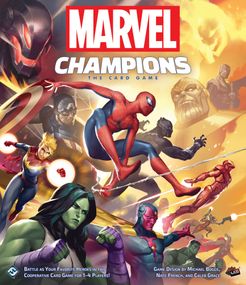
Marvel Champions: The Card Game is a cooperative card game for 1–4 players. Switch between hero and alter-ego, use your personal deck to defeat the villain, and stop the main scheme from reaching its final threshold.
Marvel Champions: The Card Game supports 1–4 players; community best: 1–2 players; playing time: 45–90 minutes. A WANGO browser trial has not been confirmed.
Background & introduction
The original core set contains five heroes and three scenarios: Rhino, Klaw, and Ultron. Each player controls a double-sided identity, combining its identity-specific cards with one aspect and basic cards. The team wins or loses together; individual finishing blows do not determine a winner.
Cards in hand are both options to play and resources to spend. Allies, supports, and upgrades can remain in play, while events generally resolve and enter the discard pile. Hero and alter-ego restrictions, action windows, interrupts, and responses matter as much as the printed resource cost.
Your form changes the pressure you face: enemies normally attack heroes and scheme against alter-egos. Recovering and building an engine can therefore give the main scheme room to advance. Success requires managing threat, enemy hit points, and the survival of the whole team.
Core rules & scoring
A standard player deck has 40–50 cards, excluding the identity. Include all required identity-specific cards, then cards from one aspect and basic cards. Normally include at most three copies of a non-unique title and no matching unique cards; follow identity-specific deckbuilding requirements.
Each round has a player phase followed by a villain phase. Players each take one turn in order, playing cards, triggering abilities, and using basic powers. You may normally change form voluntarily once during your turn each round. Basic powers exhaust the identity; being exhausted does not stop abilities that do not require exhausting.
After everyone finishes their turn, players may discard cards, must discard down to their current hand size, draw up to that size, and ready their cards. Discarding hand cards generates resources to pay costs; excess resources cannot be saved for another payment.
The villain phase adds the specified threat to the main scheme, then activates the villain and engaged minions against each player: attacks against heroes, schemes against alter-egos. Deal and reveal encounter cards as instructed, then pass the first-player token clockwise.
Defeating a villain stage advances to the next specified stage; defeating the final stage wins. Completing the final main scheme or eliminating every player loses. Excess damage does not carry from one villain stage to the next.
Core standard mode uses villain stages I and II and the Standard encounter set. Expert mode uses II and III and adds the Expert set alongside Standard. Build the encounter deck from the scenario list and chosen modular set.
A villain attack or scheme normally gets one encounter card as a boost. Add boost icons to that activation; a star instructs you to resolve the boost ability, adds no point itself, and does not resolve ordinary When Revealed text. Core minions normally receive no boost cards.
Stunned replaces the next attack; confused replaces the next thwart or scheme. Players still pay the costs of a replaced attack or thwart, including required exhaustion. Tough prevents the next damage instance and is discarded; if defense already reduces damage to zero, tough remains.
Rules & gameplay questions
Does changing to alter-ego ready my identity or heal damage?
No. Changing form retains exhaustion, damage, attached cards, and statuses. An alter-ego may exhaust to use its recovery power, but flipping alone does not heal.
Do I lose when my player deck runs out?
No. Shuffle your discard pile into a new deck and immediately deal yourself one facedown encounter card. If you were drawing cards, continue to the required number. Resolve that encounter card at the appropriate encounter-reveal step.
Can the others continue after one player is defeated?
Yes. The remaining players continue, and eliminated players share the eventual team result. Values marked per player still use the number who started the scenario, so elimination does not reduce those thresholds or hit points.
Must a solo player control two heroes?
No. You can control one hero and use one player for all per-player values. Multiplayer assigns one hero to each player and resolves enemy activations in player order. One person may also simulate multiple seats, using that seat count for setup.
Rules & introduction sources
- Edition
- Original 2019 core set, 1–4-player standard mode, with core expert-mode differences. Checked the current official Learn to Play (24 pages) and relevant revisions, FAQ, and core errata in the 2026 Rules Reference v1.8 (71 pages). The reference was checked selectively rather than read in full. No separate official Revised Core Set rules were identified; rules from other LCG core sets are excluded. Expansions, campaigns, and Standard II/III are outside scope.
- Rule references
- Introduction source
- BoardGameGeek
WANGO editorial
| Parameter | Recorded value |
|---|---|
| BGG overall rank (snapshot) | #50 |
| Complexity Weight | 2.96 / 5 |
| Best player count (community) | 1–2 |
| Player range | 1–4 |
| Playing time (minutes) | 45–90 |
| Core mechanisms | Card Play Conflict Resolution · Cooperative Game · Deck Construction · Events · Hand Management · Interrupts · Scenario / Mission / Campaign Game · Solo / Solitaire Game · Turn Order: Progressive · Variable Player Powers · Variable Set-up |
| Chinese publication | Unconfirmed |
| WANGO browser play | No confirmed WANGO trial |
| Year published | 2019 |
| Suggested age | 14+ |
BGG statistics are stored snapshots, not live rankings. Source checked:2026-09-27
Player questions
What is the best player count for Marvel Champions: The Card Game, and can I play online?
Marvel Champions: The Card Game supports 1–4 players; community best: 1–2 players; playing time: 45–90 minutes. A WANGO browser trial has not been confirmed. Recorded mechanism tags: Solo / Solitaire Game.
How complex is Marvel Champions: The Card Game, and which mechanisms does it use?
Weight: 2.96 / 5. Mechanisms: Card Play Conflict Resolution · Cooperative Game · Deck Construction · Events · Hand Management · Interrupts · Scenario / Mission / Campaign Game · Solo / Solitaire Game · Turn Order: Progressive · Variable Player Powers · Variable Set-up. Chinese publication: Unconfirmed.
Where can I learn Marvel Champions: The Card Game?
No rule guide, strategy article or WANGO trial has been confirmed for this record.