Dune
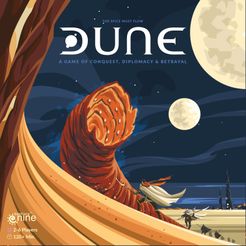
An asymmetric struggle for spice and strongholds on Arrakis. Auctions, transport, secret battle plans and public alliances intertwine, while faction powers change the value of information and military threats.
Dune supports 2–6 players; community best: 6 players; playing time: 120–180 minutes. A WANGO browser trial has not been confirmed.
Background & introduction
Each player leads one of six factions with distinct economic, informational or military advantages. Spice pays for cards and deployment, but wealth alone is not the usual victory condition: forces must be positioned to take and hold the places that matter.
Battles use secret commitments rather than dice. Forces, leaders, weapons, defences and traitors can overturn apparent numerical superiority. Even the winner normally sacrifices the forces committed, making a successful attack a possible opening for another opponent.
Sandworm-triggered Nexus opportunities let players form or break alliances and combine faction strengths. Basic and Advanced are distinct rules layers. Advanced spice support and additional powers alter how much risk an army can afford.
Core rules & scoring
This entry covers GF9’s 2019 Dune for 2–6. Follow faction sheets for starting forces, spice and privileges. Deal four traitor cards from factions in play and normally keep one secretly; faction exceptions take precedence.
Play at most ten turns, each ordered as Storm, Spice Blow/Nexus, CHOAM Charity, Bidding, Revival, Shipment/Movement, Battle, Spice Collection and Mentat Pause. Capturing a stronghold does not itself trigger an immediate victory check.
Storms can destroy forces and spice in sand sectors and restrict shipping, movement and battle, subject to protected terrain and faction exceptions. Ignore sandworms drawn on turn one. Later sandworms resolve their effects and create a Nexus for public alliance changes.
Players with zero or one spice may claim charity up to two. The normal Treachery hand limit is four; a full hand cannot bid. Bids must be payable, including permitted allied assistance and faction exceptions.
Normally revive at most three forces total per turn, including your faction’s free allowance; additional permitted forces cost two spice each and return to reserves. Normally, after all five leaders are in the tanks, revive one per turn for its fighting value. Advanced captured leaders affect availability; cards and factions provide exceptions.
Normally make one shipment to a single territory, then move one group. Shipping costs one spice per force into a stronghold or two elsewhere. Movement is normally one adjacent territory, or up to three if you have forces in Arrakeen or Carthag when movement starts. Storm and two-other-faction stronghold occupancy restrict entry.
Enemy factions sharing a territory must battle, except where storm separation or the Polar Sink prevents it. Secretly choose strength, an available leader or Cheap Hero, and up to one weapon and one defence. Compare dial plus surviving leader strength; the aggressor wins ties. The loser loses all local forces; the winner normally loses the committed forces, subject to traitors and other effects.
Basic combat does not charge spice to support forces. In Advanced combat each used force needs one spice for full strength; unsupported forces count at half strength. The Fremen Advanced privilege waives this cost. Advanced also adds double spice blows, specified stronghold income and advanced faction/Karama effects.
The default public alliance has at most two members and normally changes only at a Nexus. It needs four strongholds held between its members, in separate occupations. Allies normally cannot enter each other’s occupied territories except the Polar Sink. They may assist permitted bidding/shipping costs and share the alliance powers on their sheets.
Normally check during Mentat Pause: one faction wins with at least one force in each of three strongholds. Two-player games require four; default alliances require four combined. Bene Gesserit prediction and Fremen/Guild special victories also apply. Resolve final-turn outcomes using the factions in play; most spice is not the default tiebreak or victory rule.
Rules & gameplay questions
Can I buy three more forces after free revival?
Normally no. Three is the standard combined total of free and paid force revivals, not a separate paid allowance. Explicit extra revival from factions, allies or cards follows its own rules.
Must I support forces with spice in Basic combat?
No. One spice per supported force and half strength for unsupported forces belong to Advanced combat. The Fremen Advanced privilege is a further exception.
Does an alliance win by holding three strongholds together?
Not under the default rules. A two-player alliance needs four combined, checked at Mentat Pause. Other alliance settings printed at the back of the manual are optional variants.
Can one leader fight in several territories that turn?
Normally no. A surviving leader can fight repeatedly in the same territory during a Battle Phase, but cannot serve in multiple territories. Explicit exceptions such as revival cards follow their own rules.
In Advanced play, must a captured leader die before I can revive my others?
A captured leader does not remain available to you. The rulebook’s built-in Q&A permits revival when you have none of your own leaders available for battle, subject to payment and other revival restrictions.
Rules & introduction sources
- Edition
- Gale Force Nine’s 2019 Dune base box only. Basic procedures are the baseline, with Advanced differences labelled. Uses the 2019 official rulebook and its built-in Q&A, actually read through an accessible publisher-text mirror because the official host restricted access. The separate November 2020 FAQ could not be read in full this session; no new rulings from it or comprehensive later-errata audit are claimed. Excludes expansions, 2021 A Game of Conquest and Diplomacy, Imperium, the 2026 second edition and tournament house rules.
- Rule references
- Introduction source
- BoardGameGeek
WANGO editorial
| Parameter | Recorded value |
|---|---|
| BGG overall rank (snapshot) | #214 |
| Complexity Weight | 3.98 / 5 |
| Best player count (community) | 6 |
| Player range | 2–6 |
| Playing time (minutes) | 120–180 |
| Core mechanisms | Alliances · Area Majority / Influence · Area Movement · Auction / Bidding · Bribery · Card Play Conflict Resolution · Force Commitment · Map Deformation · Negotiation · Predictive Bid · Roles with Asymmetric Information · Take That · Variable Player Powers |
| Chinese publication | Unconfirmed |
| WANGO browser play | No confirmed WANGO trial |
| Year published | 2019 |
| Suggested age | 14+ |
BGG statistics are stored snapshots, not live rankings. Source checked:2026-09-27
Player questions
What is the best player count for Dune, and can I play online?
Dune supports 2–6 players; community best: 6 players; playing time: 120–180 minutes. A WANGO browser trial has not been confirmed.
How complex is Dune, and which mechanisms does it use?
Weight: 3.98 / 5. Mechanisms: Alliances · Area Majority / Influence · Area Movement · Auction / Bidding · Bribery · Card Play Conflict Resolution · Force Commitment · Map Deformation · Negotiation · Predictive Bid · Roles with Asymmetric Information · Take That · Variable Player Powers. Chinese publication: Unconfirmed.
Where can I learn Dune?
No rule guide, strategy article or WANGO trial has been confirmed for this record.