Calico
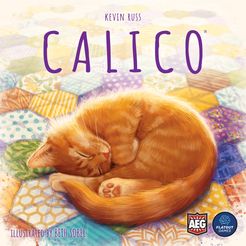
Calico is a hex-tile quilting game in which you place one of two hand tiles before drafting from a three-tile market, balancing design goals, pattern groups for cats and color groups for buttons.
Calico supports 1–4 players; community best: 2 players; playing time: 30–45 minutes. A WANGO browser trial has not been confirmed.
Background & introduction
Kevin Russ's Calico asks players to build a comfortable quilt while balancing three scoring systems. Each patch has both a color and a pattern. Cats require connected pattern areas, buttons require connected color areas, and three design goals examine the six patches immediately surrounding them. The objective is the highest combined score, so collecting the most cats alone does not necessarily win.
The turn is short: place one of the two tiles in your hand, then draft one of three face-up market tiles. The difficult choices come from limited space. A tile that completes a color group may spoil a design goal's pattern distribution; expanding a cat area may prevent another local combination. Printed patches around the board's border participate in cat and button groups, making edge spaces useful parts of the puzzle.
Standard setup selects three cats and assigns each two preferred patterns, while each player chooses three of four revealed design goals. Beginner setup fixes the cats and goals to make scoring easier to learn. Family and solo modes make separate adjustments. Once everyone has filled 22 patch spaces, design goals, cat tokens and button tokens determine the final score. Competing demands for each space make the simple drafting sequence a sustained planning challenge.
Core rules & scoring
Scope and objective: These rules use AEG's official retail Calico rulebook, bearing a 2020 copyright, for 1–4 players. Multiplayer is competitive; solo adjustments are identified separately. Do not import early print-and-play rules or the digital game's campaign features. Each quilt has three design goals and 22 patch spaces to fill, with points from goals, cats and buttons.
Shared standard setup: Group cat scoring boards by their corner dots, randomly choose one from each group and randomly select a side. Alternatively, agree on three cats. Randomly assign two of the six black-and-white pattern tiles to each cat. Put out the matching cat tokens, button scoring board and buttons. Shuffle the colored patches into a bag or face-down stacks and reveal a three-tile market. All players use the same selected cat conditions and preferences.
Personal setup: Take a quilt board and its matching set of six design goals. Shuffle the goals, reveal four and choose three, assigning them to the board's three designated goal spaces. Return unused goals to the box. Draw two random patches for your hand. The player who most recently petted a cat starts; continue clockwise. Goals are not chosen afresh each round or replaced after placement. Leave the printed border unchanged.
Beginner setup: Use Millie, Tibbit and Coconut, with two randomly assigned pattern preferences each. Each player uses the all-different, AA-BB-CC and AAA-BBB goals in the positions shown in the rulebook's beginner example. Goals still score normally; this setup does not remove them. Once familiar with the game, use standard cat selection and individual goal choices.
Turn sequence: First place one of your two hand tiles in any empty patch space, then check for newly earned cat and/or button tokens. Next choose one of the three face-up market tiles for your hand and refill the market from the supply. You cannot draw directly from the bag into your hand, draft before placing, or wait to see the replacement before deciding which market tile to take. Your other hand tile remains for a later turn.
Placement and shared uses: Standard placement need not touch the tile played last turn or match neighboring colors or patterns. A placed patch remains part of the quilt rather than being freely relocated. Its color can help a button group, its pattern a cat group, and its location a design goal. These are different scoring systems, so earning one reward does not consume the patch or prevent another kind of reward.
Design goals: At game end, evaluate the six adjacent patches using colors as a complete test and patterns as a separate complete test. Completing either test scores the lower blue value; completing both scores only the higher yellow value, not both numbers added. You cannot mix color pairs and pattern pairs to satisfy one test. An incomplete goal scores zero without an additional penalty.
Goal notation: All-different means six different colors or six different patterns. AAA-BBB means two different triples; AAAA-BB a four-of-a-kind and a different pair; AA-BB-CC three different pairs; AAA-BB-C a triple, a pair and a distinct single; AA-BB-C-D two different pairs and two distinct singles. Letters describe multiplicities within one attribute. Matching members need not be adjacent to one another around the goal.
Cats: A cat accepts either of its two assigned patterns, but any one qualifying area must use a single pattern. Build the connected group size or illustrated shape required by the cat; required shapes may rotate. Take its token when achieved and place it on a patch in that area. Each token scores the cat board's printed value. Beginner cats Millie, Tibbit and Coconut need at least three, four and five connected matching-pattern tiles and score three, five and seven points respectively.
Separate scoring areas: One connected pattern area attracts one corresponding cat. Enlarging it does not award another token whenever it reaches another multiple of the size threshold. Another cat of that type requires a new, separate pattern area that does not touch the scored area. The same area principle applies to buttons. A shape-based cat requires its illustrated shape, not just an equal number of tiles in any arrangement.
Buttons and border patches: A connected group of at least three tiles of one color, in any shape, earns one matching button worth three points. Expanding the area to six or more does not earn another. Collecting at least one button of each color earns one rainbow button, also worth three points. Both partial and whole patches printed around the border may contribute to cat and button areas. Tokens record achievements and do not occupy additional patch spaces.
End and ties: Finish after all players fill their 22 patch spaces. Add all design-goal scores, cat-token points and button points, including the rainbow button. Most points wins. A tie is broken first by number of cat tokens, then number of button tokens; a further tie is shared. Compare token counts rather than the points those tokens contributed. Unplaced hand tiles are not additional patches on the quilt.
Solo: Use beginner or standard setup and follow the normal placement-and-drafting order. After taking a market tile, also discard the tile farthest from the supply stack or bag. Slide the single remaining tile away from the supply and refill the two nearer positions one at a time, conveyor-belt style. Do not replace all three or omit the extra discard. Fill your quilt and score normally; the rulebook's scenarios can provide specific objectives.
Optional variants: Family play turns the three design goals face down as obstacles, removing their scoring while retaining cats and buttons. The two-player lower-variance variant removes one set of 36 patches, one of every color-pattern combination, before setup; solo may also use it. Scenarios and achievement restrictions use their specified cats, goals and extra conditions. They are optional formats, not automatic restrictions on standard placement or scoring.
Rules & gameplay questions
Do I draft a market tile before placing a hand tile?
No. Place one of your existing two hand tiles first, check rewards, then choose from the three face-up market tiles and refill the market. You cannot turn the placement into a choice among three by drafting first, or take an unseen replacement instead. Your unplayed hand tile remains available on later turns, but you still must place a tile on the current turn.
Can a design goal combine color pairs with pattern pairs?
No. Test all six neighboring patches by color, then independently by pattern. For AA-BB-CC, either three different color pairs or three different pattern pairs qualifies. Two color pairs plus a pattern pair does not. Complete one attribute for the blue score or both for only the yellow score. Members of a pair need not sit next to each other around the goal.
Can I mix a cat's two preferred patterns in one group?
No. Either preference is acceptable, but a qualifying area must be entirely one pattern. You may build separate qualifying areas using the two preferences; you cannot combine three of one pattern and two of the other into five matching tiles. A shape-based cat also requires its depicted shape. Colors within a cat area may differ and can contribute independently to buttons and goals.
Does a six-tile color area earn two buttons, or a large pattern area several cats?
No. A connected color area earns one button after reaching at least three tiles, even if expanded to six or nine. A qualifying connected pattern area similarly attracts one corresponding cat. Another reward requires a separate qualifying area that does not touch the scored one. Tokens record the result; they do not let you arbitrarily divide one continuous area into repeated scoring groups.
Do border patches count, and can one patch help both a cat and a button?
Printed partial and whole border patches count toward cat and button groups. A patch can simultaneously contribute its pattern to a cat area and its color to a button area, and may also neighbor a design goal. It is not spent when a reward is earned. A goal still examines its own six adjacent patches; you cannot add unrelated distant border patches to its test.
How does the solo market differ from the multiplayer market?
After drafting, discard the market tile farthest from the supply, slide the sole remaining tile away from the supply and refill the two nearer spaces. This conveyor movement prevents unwanted tiles from remaining indefinitely. Normal placement, cat rewards, buttons and goal scoring still apply, and either beginner or standard setup works. Optional scenarios add their stated setup and objectives; they do not replace the basic solo market rule.
When does the game end, and do tied players compare cat points or cat counts?
Finish when all players have filled their 22 patch spaces, then total goals, cats and buttons. Tied totals first compare the number of cat tokens, not their point values, then the number of button tokens. If still tied, share victory. Solo uses the same scoring without an invented opponent. Family scoring is an optional format chosen in advance, not a rule you switch to at the end because a goal failed.
Rules & introduction sources
- Edition
- Calico physical retail base game, 1–4 players. Based on AEG's currently hosted 16-page English rulebook, copyright 2020, at a 2025/02 URL. Standard, beginner, solo and optional formats are identified separately. Excludes early PnP rules, digital-game campaign features and promotional-cat-specific rules.
- Rule references
- Introduction source
- BoardGameGeek
WANGO editorial
| Parameter | Recorded value |
|---|---|
| BGG overall rank (snapshot) | #275 |
| Complexity Weight | 2.20 / 5 |
| Best player count (community) | 2 |
| Player range | 1–4 |
| Playing time (minutes) | 30–45 |
| Core mechanisms | Enclosure · End Game Bonuses · Grid Coverage · Hexagon Grid · Open Drafting · Pattern Building · Set Collection · Solo / Solitaire Game · Tile Placement |
| Chinese publication | Unconfirmed |
| WANGO browser play | No confirmed WANGO trial |
| Year published | 2020 |
| Suggested age | 10+ |
BGG statistics are stored snapshots, not live rankings. Source checked:2026-09-27
Player questions
What is the best player count for Calico, and can I play online?
Calico supports 1–4 players; community best: 2 players; playing time: 30–45 minutes. A WANGO browser trial has not been confirmed. Recorded mechanism tags: Solo / Solitaire Game.
How complex is Calico, and which mechanisms does it use?
Weight: 2.20 / 5. Mechanisms: Enclosure · End Game Bonuses · Grid Coverage · Hexagon Grid · Open Drafting · Pattern Building · Set Collection · Solo / Solitaire Game · Tile Placement. Chinese publication: Unconfirmed.
Where can I learn Calico?
No rule guide, strategy article or WANGO trial has been confirmed for this record.