Steam
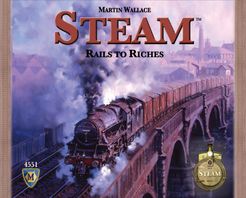
Steam is a railway and economic strategy game. Build connected track, deliver colored goods, and choose whether each delivery becomes income or victory points as you compete for the strongest network and finances.
Steam supports 3–6 players; community best: 4 players; playing time: 90 minutes. A WANGO browser trial has not been confirmed.
Background & introduction
Steam turns railway operations into a contest over connections, freight, and cash flow. Players lay track across the Northeast United States and Canada or the Ruhr, linking cities and towns into routes that can carry goods to destinations of matching color. Every connection may create delivery points or become part of another player’s route, so where a line is built, who moves goods first, and whether a route remains connected all shape the value of a network.
Each round begins with an action tile, followed by track building, two rounds of moving goods or upgrading locomotives, income and expense accounting, and a change in turn order. Action tiles can grant first building or delivery, extra track, urbanization, city growth, locomotive upgrades, or a better position next round. A locomotive’s level determines how many links goods can travel. When a shipment uses completed track owned by multiple players, each player whose links are used earns points according to their contribution.
For every delivery, each scoring player must place all of that delivery’s points either on Income or on Victory Points; the amount cannot be split between the two tracks. The rulebook offers Base Game for a simpler or shorter game and Standard Game with auctions, share issues, and locomotive maintenance. At the end, income converts to points or penalties, and completed owned links add points. The player with the highest total wins; the 2009 rules do not include official solo or cooperative play.
Core rules & scoring
Objective and modes: Build connected track between cities, deliver goods to cities of matching color, and allocate each delivery entirely to income or victory points. The rulebook includes Base Game and Standard Game; Base is simpler, while Standard adds auctions, shares, and locomotive maintenance. The highest final score wins. The 2009 rules do not list official solo or cooperative play.
Maps and players: The included Northeast US/Canada map is for 3–4 players, while the Ruhr map is for 4–5. Six-player rules are described, but require an additional compatible map. BGG lists 3–6 players, about 90 minutes, and age 10+; time and age are catalogue data. Set up goods in cities according to their spaces and place each player’s income and victory-point markers and level-1 locomotive.
Six phases per round: Select an action tile, build track, take two rounds of moving goods or upgrading locomotives, resolve income and expenses, use the chosen action to set next round’s order, then advance the round. Tiles can give first track-building or delivery, extra track, city growth, urbanization, a locomotive upgrade, or a turn-order advantage. Each player chooses one tile, whose effect can shape both the current round and the next.
Building track: Extend a continuous route from a city or your existing track. Normally, build up to three track spaces per round; the Engineer action allows four. Pay the costs for track, town spaces, and river or hill terrain. Urbanization converts a town into a new city. Keep routes connected and plan unfinished sections carefully; a line that is not extended in the next round may lose its ownership.
Delivering goods: A locomotive’s level determines how many links a good may travel. Goods must reach a city of the same color, and the route must use at least as many of your completed links as any other player’s links. Once delivered, the good leaves the board. A route may use completed track owned by several players, so one shipment can reward every player whose links are actually used.
Income or victory points: After a delivery, each player whose completed links were used earns points according to the number of their links on the route. Each scoring player must allocate all points from that delivery to either the Income track or the Victory Point track; a shipment cannot be split. Income affects ongoing finances and endgame conversion, while victory points count directly, so weigh future costs, final conversion, and the race for the current shipment.
Action tiles and locomotives: Each round, select one exclusive action tile. It may give the first track-building or delivery position, an Engineer’s extra track space, city growth, urbanization, a locomotive upgrade, or a better turn order next round. Upgrading a locomotive increases delivery distance; order advantages can determine whether a key route or good is used by an opponent first. Resolve each tile as printed.
Round count and final scoring: The rulebook uses ten rounds for three players, eight for four, and seven for five or six. After income and expenses in the final round, score positive income at one VP per two income, and penalize negative income by two VP per point below zero. Add one VP for each completed link you own; incomplete links score nothing. The highest final total wins.
Standard Game differences: Standard adds share purchase or issuance at the start of each round, an auction to determine turn order, and locomotive maintenance. Shares may be issued only at the start of a round, not as emergency money during another phase. The basic goals of connecting track and delivering goods remain, and the same round counts and final scoring apply. Do not use Base Game action-tile cost rules in the Standard auction sequence.
Ties and boundaries: A victory-point tie is broken by higher final income; if still tied, compare the lowest-numbered action tile taken in the last round. The rulebook distinguishes player counts for included maps from six-player use with an additional map; it also separates Base and Standard finances and turn order. The Mayfair Official Steam FAQ archive could not be fully accessed in this review, so unverified FAQ summaries are not presented as errata.
Rules & gameplay questions
What is the goal of Steam, and how do goods move?
Connect cities and towns with your own continuous track, then deliver goods to a city of the matching color. Locomotive level limits how many links a good may travel, and the route must meet the required count of your completed links. Deliveries may benefit every player whose finished track is actually used, so route planning affects both your score and the opponents who helped build the network.
What is the difference between Base Game and Standard Game?
The rulebook provides a simpler Base Game and a more advanced Standard Game. Both share the track-building and freight-delivery core. Standard adds share issuance or purchase at the start of a round, an auction to determine turn order, and locomotive maintenance. Base Game is recommended for learning or shorter play; in Standard, follow its own auction and finance rules rather than copying the Base Game action-tile cost procedure.
What are the phases of a round?
Each round has six phases: choose an action tile, build track, take two rounds of moving goods or upgrading a locomotive, resolve income and expenses, set next round’s order using the selected tile, and advance the round. Tiles can grant first building or delivery, extra track, urbanization, city growth, or a locomotive upgrade. Read the tile carefully because it can affect both current actions and the next round’s order.
What benefits can an action tile provide?
Tiles can let you build track or deliver goods earlier, add track spaces for the round, urbanize a town, grow a city’s goods, upgrade a locomotive, or influence next round’s turn order. You select only one tile per round, so the effect should match your current route plan. Some tiles change the order of actions; others provide extra building or upgrade opportunities.
What limits apply when building track?
Normally, build up to three spaces from a city or your existing connected track; the Engineer action increases this to four. Pay the costs shown for track spaces, towns, rivers, and hills. Urbanization turns a town into a new city. Keep the route connected, and plan unfinished sections carefully because a line that is not extended later may lose its ownership under the rules.
Should a delivery be scored as Income or Victory Points?
After a delivery, each player whose completed links were used earns points based on their contribution. Every scoring player must put all points from that shipment on either the Income track or the Victory Point track; the reward cannot be split. Income affects cash flow and endgame conversion, while victory points count directly, so consider future building costs, remaining rounds, and whether the delivery changes the race.
How many players can use each map?
The rulebook identifies the Northeast US/Canada map for three or four players and the Ruhr map for four or five. It also gives rules for five- and six-player round counts, and BGG lists the overall game as 3–6 players, but six players require a compatible additional map. Do not assume both maps included in the base box support six players.
How many rounds are played, and how is the final score calculated?
The rulebook gives ten rounds for three players, eight for four, and seven for five or six. After the final round’s income and expenses, positive income converts at one VP for every two income, while each negative point below zero costs two VP. Add one VP for each completed link you own; incomplete links do not score. Compare the total Victory Points to find the winner.
Can Steam be played solo or cooperatively? Is it the same as Age of Steam?
The Mayfair 2009 rulebook does not list official solo or cooperative rules; players compete for routes and delivery rewards. BGG describes Steam as a reimplementation related to Age of Steam, but they do not share one interchangeable rulebook. Steam itself has Base and Standard modes. Do not transfer Age of Steam’s auction or action details into Steam unless the Steam rules explicitly say so.
Rules & introduction sources
- Edition
- This entry covers BGG 27833, Steam, using the 2009 Mayfair Games base-box rules designed by Martin Wallace. The rulebook includes Base Game (simpler/shorter) and Standard Game (with auctions, shares, and locomotive maintenance); the main flow here follows Base Game and calls out Standard differences. The included Northeast US/Canada map is for 3–4 players and the Ruhr map for 4–5; six players require a suitable additional map. BGG lists 3–6 players, 90 minutes, and age 10+, with age and time as catalogue data. No official solo or cooperative mode is listed, and Age of Steam rules are not interchangeable.
- Rule references
- Introduction source
- BoardGameGeek
WANGO editorial
| Parameter | Recorded value |
|---|---|
| BGG overall rank (snapshot) | #351 |
| Complexity Weight | 3.45 / 5 |
| Best player count (community) | 4 |
| Player range | 3–6 |
| Playing time (minutes) | 90 |
| Core mechanisms | Auction / Bidding · Loans · Network and Route Building · Ownership · Pick-up and Deliver · Tile Placement |
| Chinese publication | Unconfirmed |
| WANGO browser play | No confirmed WANGO trial |
| Year published | 2009 |
| Suggested age | 10+ |
BGG statistics are stored snapshots, not live rankings. Source checked:2026-09-27
Player questions
What is the best player count for Steam, and can I play online?
Steam supports 3–6 players; community best: 4 players; playing time: 90 minutes. A WANGO browser trial has not been confirmed.
How complex is Steam, and which mechanisms does it use?
Weight: 3.45 / 5. Mechanisms: Auction / Bidding · Loans · Network and Route Building · Ownership · Pick-up and Deliver · Tile Placement. Chinese publication: Unconfirmed.
Where can I learn Steam?
No rule guide, strategy article or WANGO trial has been confirmed for this record.