1960: The Making of the President
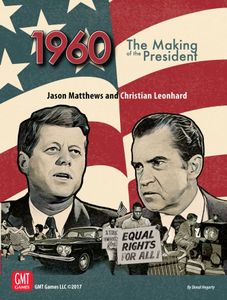
1960: The Making of the President is a two-player campaign game. Play as Kennedy or Nixon, contest state support, issues, media, and debates, then compete for electoral votes.
1960: The Making of the President supports 2 players; community best: 2 players; playing time: 90–120 minutes. A WANGO browser trial has not been confirmed.
Background & introduction
1960: The Making of the President turns a United States presidential election into a political contest between two players. Each player represents John F. Kennedy or Richard Nixon and competes for support across the electoral map while managing issue positions, media presence, and campaign momentum. State value is measured in electoral votes, so the contest is not simply about adding support everywhere. Players must decide which regions deserve investment, when to move a candidate, and how to resist an opponent’s counter-campaign.
The game is card-driven. In each round, campaign cards can trigger their Events or be spent for Campaign Points used to add state support in a candidate’s region, place media advertising, or adjust issue positions and support. Political Capital drawn from the bag determines Initiative, while the Momentum phase rewards performance in media and issues with Momentum and endorsements. The first five rounds also require each player to reserve a card for the sixth-round debate; later, players must save cards for Election Day, balancing immediate gains against decisive future turns.
The campaign lasts nine rounds, with the debate in round six and Election Day in round nine. Winning the debate can add state support by issue, while the final round resolves media, issues, Momentum, endorsements, undecided voters, and state cubes. Usually a candidate needs at least 269 electoral votes, although an Unpledged Electors Event can change the outcome. This entry follows GMT’s updated Support Check, Momentum sequence, and Election Day tiebreaks.
Core rules & scoring
Objective and victory: The two players represent Kennedy and Nixon in the 1960 presidential election. Use campaign cards to contest states, issues, and media, build support, and win electoral votes. Normally, the winner needs at least 269 of the 537 electoral votes. If electoral votes are tied, GMT’s rules compare the number of states won, then the total number of state support cubes.
Edition and components: This entry uses GMT’s 2017 Final Rules for BGG 27708. GMT’s third-printing note says it matches the second printing except that known errata are corrected; the GMT rules also list changes from previous editions. Each side uses candidate cards, campaign cards, Momentum markers, and support cubes, with Political Capital cubes drawn from the bag to determine Initiative.
Setup: Choose candidates and place them in their home states: Kennedy begins in Massachusetts and Nixon in California. Place the issue, phase, and round markers, prepare each player’s support resources and the Political Capital Bag, and shuffle campaign and endorsement cards. Set the Debate Board aside until round six. GMT’s game lasts nine rounds, each representing a week of the campaign.
Normal round sequence: Each side receives six cards in rounds 1–5; round 6 is the debate. Afterward each receives seven cards in rounds 7 and 8; round 9 is Election Day. A normal round proceeds through Initiative, five Activity phases, Momentum and Campaign Strategy. The player with Initiative chooses who acts first in the Activity phases; each player plays a campaign or candidate card in each phase.
Campaign cards and points: Play a campaign card for its Event or spend its Campaign Points on one category, without splitting points across categories. Choices are campaigning in the candidate’s region (which can also move the candidate), media advertising, or issue positioning. When a card is used for points, the opponent may spend one Momentum to trigger its Event; before the action, the active player can spend two Momentum to prevent this. A candidate card substitutes for a hand card for five points, then is exhausted until a specific Event restores it.
State support and checks: Only one side can have support cubes in a state. When gaining support, remove opposing cubes first and place your own only after those are gone. One cube gives the lead; four or more means carrying the state. Campaigning to add support in a state carried or occupied by the opposing candidate requires a Support Check, unless the campaigning player has media support in that region. GMT also requires checks for certain Events adding state support as specified in its rules. The state leader receives its electoral votes at the tally.
Momentum phase: Each player first discards half of their Momentum markers, rounding down. The player with more media support may swap adjacent issues on the issue track; a media tie allows no swap. Then award Momentum and Endorsement cards according to issue positions and resolve issue-support decay. GMT’s current rules specify that the media leader moves issues before Momentum and endorsements are awarded; do not use the earlier edition’s sequence.
Campaign Strategy and debate: Each player secretly saves one card in each of the first five rounds. In round six, both select and reveal one card at a time, placing each by its issue and candidate icons. When two cards lie on one side of an issue, compare both sides’ Campaign Points; Initiative wins a tie. Issues award 2, 3 and 4 state support cubes in the order actually won, placed immediately without checks. If issues resolve together or remain unresolved after all cards are played, resolve the lowest original issue first.
Election Day: Save two cards in each of rounds seven and eight. In round nine, each player adds supply cubes to the Political Capital Bag equal to their media cubes, then adds all their media and issue cubes and two supply cubes per remaining Momentum. After Initiative, both reveal their four saved cards; each provides three Support Checks in its printed state, with the Initiative player resolving first. Resolve Election Day Events, endorsements and undecided states before the final tally; there are no ordinary Activity phases.
Final tally and scope: Normally a player needs at least 269 of 537 electoral votes. The Unpledged Electors Event can remove votes from certain states Kennedy leads but does not carry, changing that usual threshold or producing a tie. If electoral votes are tied, GMT compares states won and then total state support cubes. The GMT Final Rules include revisions to earlier Z-Man rules; the official rules provide no solo or cooperative procedure.
Rules & gameplay questions
Who do the two players represent?
The game is a head-to-head contest between John F. Kennedy and Richard Nixon. Each player manages one candidate’s campaign and competes on the state map, issue track, and media area, then tries to win the state electoral votes at the final tally. GMT lists two players. It is not a cooperative team game, and the box rules do not ask one person to operate both candidates as an official solo mode.
How do you win, and is 269 electoral votes always required?
Normally a player needs at least 269 of the 537 electoral votes. Election Day determines states using support, endorsements and undecided voters, then counts electoral votes. The Unpledged Electors Event can remove votes from specified states Kennedy leads but does not carry, so a player can win with fewer than 269 or the vote can tie. GMT breaks ties by states won and then state support cubes.
What happens in a normal round?
GMT’s game has nine rounds. A normal round determines Initiative, then runs five Activity phases in which both players play cards in Initiative order, followed by Momentum and Campaign Strategy. Round six is the debate instead of a normal sequence, and round nine uses the special Election Day sequence. Check the round marker before proceeding; the normal five Activity phases do not apply to those two special rounds.
Can I choose a card Event or spend its Campaign Points?
Yes. Play a campaign card for its Event or use its Campaign Points on one action category: campaigning, media advertising or issue positioning. Points cannot be split between categories. When points are used, the opponent may spend one Momentum to trigger the card’s Event; the active player can spend two beforehand to prevent it. A candidate card can substitute for a hand card for five points, then becomes exhausted.
How much support makes a state lead or carry?
Only one side can have cubes in a state: new support removes opposing cubes first, then places your own. One cube gives the lead and four or more means carrying. Campaigning to add support in a state carried or occupied by the opposing candidate requires a Support Check, except when the campaigning player has media support in that region. Certain Events also require checks under GMT’s revised rules.
How does the round-six debate work?
Each player saves one card per round for the first five rounds. In round six both select and reveal one card at a time and place them by issue and candidate icons. When an issue has two cards on one side, compare each side’s points; Initiative breaks ties. The first, second and third issues resolved award 2, 3 and 4 state cubes respectively, placed without Support Checks. Remaining issues resolve after the cards run out, lowest original position first.
What does media support do during Momentum?
First, each player discards half of their Momentum markers, rounding down. Then compare media support. The player with more media may exchange adjacent issues on the issue track; if media is tied, no exchange occurs. After that, award Momentum and Endorsement cards according to the issue positions and apply issue-support decay. GMT’s updated sequence has the media leader move issues before those rewards are issued.
Does Election Day use the normal five Activity phases?
No. Round nine uses the Election Day sequence. Each player adds all media and issue cubes to the bag, plus supply cubes equal to their media count and two per remaining Momentum. After Initiative, each reveals the four cards saved across rounds seven and eight; each card grants three Support Checks in its printed state, with Initiative resolving first. Then resolve Election Day Events, endorsements, undecided states and the final tally.
How does GMT’s version relate to the earlier Z-Man edition, and is there solo play?
BGG 27708 identifies the same base game, but GMT’s Final Rules include explicit changes to Support Checks, the Momentum sequence, Election Day cubes, and electoral-vote tiebreaks. This entry follows the current GMT rules rather than blending in the early Z-Man procedures. GMT lists two players, and its rules do not provide solo or cooperative play; a fan-made variant should not be described as an official box mode.
Rules & introduction sources
- Edition
- This entry covers the base game 1960: The Making of the President (BGG 27708), using GMT’s 2017 Final Rules. GMT’s third-printing product page says known errata are corrected; the rules separately list changes from earlier editions. The procedures below follow that GMT rules document rather than mixing in earlier Z-Man procedures. The official game is a two-player Kennedy-versus-Nixon contest, with no official solo or cooperative rules.
- Rule references
- Introduction source
- BoardGameGeek
WANGO editorial
| Parameter | Recorded value |
|---|---|
| BGG overall rank (snapshot) | #345 |
| Complexity Weight | 3.20 / 5 |
| Best player count (community) | 2 |
| Player range | 2 |
| Playing time (minutes) | 90–120 |
| Core mechanisms | Action / Event · Area Majority / Influence · Campaign / Battle Card Driven · Hand Management · Simulation |
| Chinese publication | Unconfirmed |
| WANGO browser play | No confirmed WANGO trial |
| Year published | 2007 |
| Suggested age | 12+ |
BGG statistics are stored snapshots, not live rankings. Source checked:2026-09-27
Player questions
What is the best player count for 1960: The Making of the President, and can I play online?
1960: The Making of the President supports 2 players; community best: 2 players; playing time: 90–120 minutes. A WANGO browser trial has not been confirmed.
How complex is 1960: The Making of the President, and which mechanisms does it use?
Weight: 3.20 / 5. Mechanisms: Action / Event · Area Majority / Influence · Campaign / Battle Card Driven · Hand Management · Simulation. Chinese publication: Unconfirmed.
Where can I learn 1960: The Making of the President?
No rule guide, strategy article or WANGO trial has been confirmed for this record.