Maracaibo
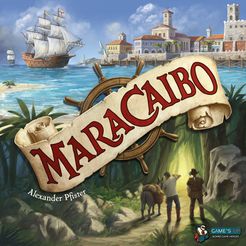
Sail around the Caribbean, balancing deliveries, project cards, exploration and national influence to build an engine and earn victory points over four rounds.
Maracaibo supports 1–4 players; community best: 3 players; playing time: 30–120 minutes. A WANGO browser trial has not been confirmed.
Background & introduction
Maracaibo, designed by Alexander Pfister, combines a sailing circuit with economic development. Departing from Havana, players stop at cities and villages along a one-way route, developing their capabilities through multipurpose project cards, ship upgrades and a network of assistants.
A card can supply a delivery good, provide an object needed for a quest, or be purchased for lasting benefits. Longer moves can provide more village actions but pass over opportunities. When a player reaches the homeward endpoint, everyone enters scoring, making sailing pace part of the competition.
National influence and the distribution of national markers jointly determine part of the final score, while exploration and quests offer other rewards. The base box supports standalone games, an ongoing story campaign and solo play against Jean. This overview reveals no story-card events or later map changes.
Core rules & scoring
The base game supports 1–4 players; multiplayer lasts four rounds. Set up cities, project cards, quests and national markers for the player count, and give each player a ship board, career objectives and starting resources. Select the prescribed campaign or non-campaign setup before play rather than freely mixing story cards.
Each turn consists of sailing, a main action and refilling your hand, in that order. Normally move forward 1–7 locations following arrows, never backward. Ships do not block one another. Mandatory-stop symbols end your movement; the destination determines your available main action.
At a city, you may first discard one hand card showing the requested good to an empty market space, moving one disc there from your ship board, then perform the city action. Delivery is not required to use the city action. Removing both discs from a ship section immediately grants its upgrade, subject to printed prerequisites.
At a village you normally take one village action; spending 4–6 movement points that turn gives two, and spending 7 gives three, unless an upgrade changes these thresholds. Each action can take one doubloon, discard your entire hand for two doubloons if at least one card is discarded, or buy one project card from your hand or planning area. Options may be repeated.
Quest, assistant, city and village actions are alternative main-action choices; having several options at one location does not allow all of them. Pay a quest’s requirements to claim its tile. Only your own assistants can be used. Each of your assistants skipped or left unused normally earns two points, including assistants bypassed when ships return at round end.
Combat serves one chosen nation: reveal a combat token, resolve that nation’s costs or rewards and spend combat value to gain influence or place/displace national markers. Spend ship-board combat points or return your figures to increase combat value; each individual combat action is usable at most once in that combat. Exploration instead follows a separate track, skipping spaces occupied by other explorers and taking the destination reward plus applicable barrier rewards.
During the main-action phase, free actions may place hand cards in the three-space planning area or complete eligible career goals. Planned cards do not count toward your hand limit, but cannot be used as goods or objects and have no effect until purchased. Refill to four cards, or six with the upgrade: blind draws are free, while face-up cards normally cost one doubloon each. Replenish the display only after finishing the refill.
In rounds I–III, reaching 21a triggers common scoring: each player buys one card/invests in one prestige building or takes two points, then income, markets, display, buildings and story are resolved and all ships return to Havana. The next player clockwise starts the new round. In round IV, travel via 21b to 22 triggers final scoring; other players do not receive another sailing turn.
Final scoring again begins with each player buying one card/investing or taking two points. Add victory-point income, points shown for doubloon-income position, purchased projects and prestige investments, national influence leadership bonuses, and noble ranks multiplied by national multipliers. Those multipliers depend on emptied national supply spaces and map majorities. Unpurchased hand/planning cards score nothing. Most points wins; tied players share victory.
Rules & gameplay questions
Can I use a city action without making a delivery?
Yes. Both parts are optional; if you do both, deliver first. The special homeward-bound cities do not accept deliveries.
Does putting a card in planning activate it?
No. Planning reserves a card for later purchase. It is not a free purchase, and the card can no longer be discarded as a good or object.
May everyone else sail to the endpoint after a player ends the round?
No. The first three rounds proceed to common scoring and return all ships; the fourth proceeds to final scoring. Each player’s scoring-time purchase/two-point choice is not another sailing turn.
Is the campaign compulsory, and does solo require an expansion?
The campaign is optional; use the designated story card for a non-campaign setup. Jean and her Automa cards are in the base box. Solo uses two-player setup with specific changes, not two ordinary players controlled by one person.
What should owners of the first English printing check?
The publisher supplies corrections for the Adventure career, both Martyr projects and a missing refill passage. This overview follows the revised second-edition rules; first-print owners should also consult that correction file.
Rules & introduction sources
- Edition
- Original Maracaibo base box, using the revised second-edition English rules. Covers multiplayer’s four-round structure and the scope of solo and optional campaign play, without exhaustive card, Automa or story instructions. Excludes The Uprising and La Armada; not the standalone Pirates of Maracaibo.
- Rule references
- Introduction source
- BoardGameGeek
WANGO editorial
| Parameter | Recorded value |
|---|---|
| BGG overall rank (snapshot) | #91 |
| Complexity Weight | 3.92 / 5 |
| Best player count (community) | 3 |
| Player range | 1–4 |
| Playing time (minutes) | 30–120 |
| Core mechanisms | Contracts · End Game Bonuses · Events · Hand Management · Income · Movement Points · Multi-Use Cards · Narrative Choice / Paragraph · Point to Point Movement · Scenario / Mission / Campaign Game · Set Collection · Solo / Solitaire Game · Stock Holding · Tech Trees / Tech Tracks · Track Movement · Variable Set-up |
| Chinese publication | Unconfirmed |
| WANGO browser play | No confirmed WANGO trial |
| Year published | 2019 |
| Suggested age | 12+ |
BGG statistics are stored snapshots, not live rankings. Source checked:2026-09-27
Player questions
What is the best player count for Maracaibo, and can I play online?
Maracaibo supports 1–4 players; community best: 3 players; playing time: 30–120 minutes. A WANGO browser trial has not been confirmed. Recorded mechanism tags: Solo / Solitaire Game.
How complex is Maracaibo, and which mechanisms does it use?
Weight: 3.92 / 5. Mechanisms: Contracts · End Game Bonuses · Events · Hand Management · Income · Movement Points · Multi-Use Cards · Narrative Choice / Paragraph · Point to Point Movement · Scenario / Mission / Campaign Game · Set Collection · Solo / Solitaire Game · Stock Holding · Tech Trees / Tech Tracks · Track Movement · Variable Set-up. Chinese publication: Unconfirmed.
Where can I learn Maracaibo?
No rule guide, strategy article or WANGO trial has been confirmed for this record.