Dwellings of Eldervale
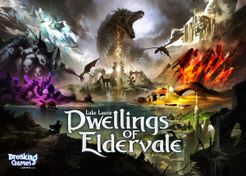
Expand through an elemental world, build Dwellings, and develop a card engine while workers, warriors, wizards, and dragons compete for power.
Dwellings of Eldervale supports 1–5 players; community best: 3 players; playing time: 60–150 minutes. A WANGO browser trial has not been confirmed.
Background & introduction
Luke Laurie’s Dwellings of Eldervale combines worker placement, territorial battles, and tableau building. Asymmetric factions enter an expanding map where elemental realms offer treasure and ruins provide summoning, Adventure cards, and construction.
Each turn chooses between placing a unit and regrouping. Units act in a realm when placed, then can activate cards when recalled. Returning early may surrender opportunities, while waiting exposes units to opponents and roaming monsters.
Dwellings permanently turn workers into settlements, award adjacency points, support battles, and determine how many Adventure cards can score. Elemental tracks value cards, Dwellings, and their own markers, connecting expansion and engine development to a common plan.
Core rules & scoring
Setup: use each player faction’s element plus two additional elements for realms, monsters, and Adventure decks; build the starting map with the prescribed ruins for the player count. Each player starts with three active workers, five Magic cards, one of each basic resource, and a Starter card; other units await summoning.
Turns: either place one ready unit or Regroup, adding Free Actions at their permitted times. With no units in Eldervale, normally place in any realm without units or monsters. Otherwise place adjacent to one of your units, never in a realm already containing your own unit. Advanced units and card abilities provide exceptions.
Realm actions: placement requires and performs the realm’s action. Elemental realms provide one Treasure token, or a printed resource from an empty stack. Ruins exchange resources, summon units, build Dwellings, or grant cards. A Dungeon first adds a realm adjacent to at least two existing realms, then buys one Adventure card, buys a second or burns a faceup card, and replenishes the display.
Regroup: retrieve map units one at a time to an eligible tableau action, resolving it immediately, or directly to readiness. Each card action accepts one unit. Then retrieve Underworld units directly, without card activations, and finally return units from the tableau. All active units must be retrieved.
Dwellings and power: the Mill or Starter Dwell action converts a worker still in an elemental realm without a Dwelling, paying the realm cost. It remains permanently and is no longer a unit. Score two points per adjacent ruin or any player’s Dwelling and advance for the realm’s elemental symbols. Gaining Adventure cards also advances the matching track; maintain at most four elemental tracks.
Battles: until everyone has Regrouped once, the game is peaceful and monsters dormant. Later, contested placement or a monster rushing in can trigger battle, after the realm action. Adjacent units may join in order. Units, Dwellings, and spent Swords supply dice, up to six per player. Compare highest dice successively; an exact tie defeats everyone. Losing units go to the Underworld, gaining one Sword each.
Resources and Magic: Gold substitutes for other resources; ordinary resource types each cap at five and Magic hands cap at seven at turn end. Cash in Treasure tokens or slot them into cards; replacing a slotted token gives no resources. Spells follow their timing, quests score immediately, and prophecies score at the end. Orbs claim public rewards or empower cards, among other uses.
Ending and scoring: a sixth Dwelling or the last drawn realm triggers one more turn for everyone, including the triggering player. Add elemental values for the Starter and eligible Adventure cards, track markers and Dwellings, plus Vaults, prophecies, and one point per unused Orb. Each Dwelling supports up to three Adventure cards for elemental card scoring; the Starter is exempt. Highest score wins; break ties by resources including Magic cards, then share victory.
Rules & gameplay questions
Can a recalled worker become a Dwelling on its former realm?
No. Dwell requires a worker still in the chosen elemental realm. Regroup order matters: another retrieved unit can activate Dwell before that worker is recalled.
Can defeated units activate tableau actions during Regroup?
No. Underworld units return directly in step two and cannot perform step-one tableau actions. Each of your units sent to the Underworld earns one Sword.
Can every Adventure card score without building Dwellings?
No. Each Dwelling supports at most three Adventure cards for elemental card scoring. The Starter always scores outside that limit. Vaults and other separate card effects follow their text; this limit does not disable every effect.
Are Gold, Magic cards, and other resources all wild?
No. Gold substitutes for other resources. Magic cards are resources and can pay a treasure-chest cost requiring any resource, but are not wild. A cost specifically demanding Gold requires actual Gold.
Can I use the Dungeon after the realm stack is empty?
Yes. The official appendix FAQ allows skipping discovery when no realms remain and resolving the other Dungeon steps. You must still be able to obtain at least one Adventure card.
Rules & introduction sources
- Edition
- Dwellings of Eldervale, current Breaking Games-linked DoERulebook2024 and DoEAppendix2024, standard multiplayer rules with default Peaceful Beginning. Excludes Oracle, Mercenaries, Mother of Dragons, Frost Giant, Legendary monsters, Tactics tokens, 2v2, and other optional variants. Ghosts of Eldervale solo rules are a separate booklet and are not summarized here.
- Rule references
- Introduction source
- BoardGameGeek
WANGO editorial
| Parameter | Recorded value |
|---|---|
| BGG overall rank (snapshot) | #131 |
| Complexity Weight | 3.24 / 5 |
| Best player count (community) | 3 |
| Player range | 1–5 |
| Playing time (minutes) | 60–150 |
| Core mechanisms | Action Retrieval · Area Majority / Influence · Chaining · Contracts · Dice Rolling · End Game Bonuses · Force Commitment · Hand Management · Investment · Map Addition · Modular Board · Multi-Use Cards · Open Drafting · Solo / Solitaire Game · Tech Trees / Tech Tracks · Variable Player Powers · Variable Set-up · Worker Placement, Different Worker Types · Zone of Control |
| Chinese publication | Unconfirmed |
| WANGO browser play | No confirmed WANGO trial |
| Year published | 2020 |
| Suggested age | 14+ |
BGG statistics are stored snapshots, not live rankings. Source checked:2026-09-27
Player questions
What is the best player count for Dwellings of Eldervale, and can I play online?
Dwellings of Eldervale supports 1–5 players; community best: 3 players; playing time: 60–150 minutes. A WANGO browser trial has not been confirmed. Recorded mechanism tags: Solo / Solitaire Game.
How complex is Dwellings of Eldervale, and which mechanisms does it use?
Weight: 3.24 / 5. Mechanisms: Action Retrieval · Area Majority / Influence · Chaining · Contracts · Dice Rolling · End Game Bonuses · Force Commitment · Hand Management · Investment · Map Addition · Modular Board · Multi-Use Cards · Open Drafting · Solo / Solitaire Game · Tech Trees / Tech Tracks · Variable Player Powers · Variable Set-up · Worker Placement, Different Worker Types · Zone of Control. Chinese publication: Unconfirmed.
Where can I learn Dwellings of Eldervale?
No rule guide, strategy article or WANGO trial has been confirmed for this record.