Aeon's End: The New Age
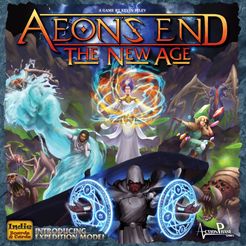
Aeon’s End: The New Age is a cooperative deck-building game for 1–4 players who defend Gravehold as mages and defeat a Nemesis together.
Aeon's End: The New Age supports 1–4 players; community best: 2 players; playing time: 60 minutes. A WANGO browser trial has not been confirmed.
Background & introduction
Aeon’s End: The New Age is a cooperative deck-building battle game for one to four players. Each player takes the role of a mage, and the team protects Gravehold from a Nemesis and its minions. Players must defeat the Nemesis or meet another printed victory condition before the city is destroyed. The team shares the same crisis; the game does not ask players to compete for individual points.
Spells connect two steps: a mage prepares a spell on one of their breaches and later casts it at the right time. Breaches have open, closed, and focused states that affect the cost and timing of those actions. Gems produce Aether for the current turn, relics provide effects, and market cards join a player’s deck. Mage decks are never shuffled, so players plan the order of draws and discards in a way that differs from many deck-builders.
The New Age includes standard battles and an Expedition mode. An Expedition links several encounters: players use its deck and guide to reveal the current battle, manage the Barracks, and apply rewards after a victory before facing a stronger Nemesis. The campaign’s cards and instructions change as it progresses. A public overview can explain this structure without exposing envelopes, story cards, or the order of campaign content.
The publisher describes the box as playable on its own and compatible with other Aeon’s End boxes. During a battle, players balance their mage’s economy and breaches against threats to both the mages and Gravehold. The whole team wins or loses together; there is no personal scoring or tie-break procedure. Expedition mode links the battles, while each encounter still uses shared victory and failure conditions.
Core rules & scoring
Objective and battle scope: The team selects a Nemesis and manages each mage’s life, Gravehold’s life, and the Nemesis area. The team wins when the Nemesis reaches zero life; the rules also list a victory condition for an empty Nemesis deck with no minions or power cards in play at the end of a turn. Players must defend the city as well as develop their own mage.
First battle and later setup: For the first battle, follow the included First Game Setup Sheet, which may specify teaching components and starting quantities. Later battles use the standard Nemesis setup on rules pages 7–9. Choose the Nemesis cards and basic cards for the player count, then build a three-tier Nemesis deck: tier 1 on top, tier 2 in the middle, and tier 3 on the bottom. Do not shuffle the assembled Nemesis deck.
Order of player and Nemesis turns: Shuffle the player turn cards together with two Nemesis turn cards. Draw one card at a time to determine who acts next. In a two-player game, each player uses two player turn cards; in a three-player game, each player uses one and the Wild card is assigned by its marker; in a four-player game, use the paired player-number cards. When the turn deck runs out, shuffle its discard pile to form a new deck; this is separate from the mage-deck rule.
Three phases of a player turn: A player turn has a Casting Phase, Main Phase, and Draw Phase, in that order. During Casting, the player may cast spells prepared on open breaches, while spells on closed breaches must be cast. In the Main Phase, the player plays cards and takes actions. In the Draw Phase, the player arranges the gems and relics played that turn, then draws back up to five cards.
Main Phase actions: A player may perform permitted Main Phase actions in any order and repeat them, including playing gems or relics, gaining a market card, gaining a charge, focusing or opening a breach, preparing a spell, using a “while preparing” effect, and paying a “TO DISCARD” effect. There is no fixed action sequence, but players must check their resources and breach states. A spell cannot be cast at an arbitrary point in the Main Phase; casting belongs to the Casting Phase.
Breaches and spells: Each mage has their own breaches. To focus a closed breach, pay the printed focus cost and rotate its marker; the mage may then prepare a spell there this turn. Opening a breach costs its printed amount and an opened breach does not close again. Spells are normally prepared only on their owner’s breaches, and each breach can hold no more than one prepared spell. When casting, first put the spell on top of the discard pile, then resolve its effect.
Aether, the market, and charges: Gems produce Aether, which the active player spends in their Main Phase to gain market cards, pay breach costs, or gain charges. Aether lasts only for that player’s current turn; unused Aether disappears at the end of the turn and cannot be saved or transferred to a teammate. A gained gem, relic, or spell normally goes on top of that player’s discard pile. Paying two Aether gains one charge, and a mage cannot hold more charges than the ability spaces on their board.
Drawing and the no-shuffle deck: During the Draw Phase, place the gems and relics played this turn on top of the discard pile in any order; cards still in hand stay there. Draw until the player has five cards. If the deck runs out, draw the remaining cards, flip the discard pile over to form a new deck, and continue. A mage’s deck is never shuffled; this rule does not apply to the turn deck or Nemesis deck, which have their own shuffle rules.
Nemesis phase: Resolve continuing effects and power counters on powers already in play; when a power’s counters reach zero, resolve its delayed effect and discard it. Then draw a Nemesis card. An attack resolves immediately and is discarded; a minion or power card resolves any “immediately” text and stays in play for later effects. If the Nemesis deck is empty when a card must be drawn, resolve Unleash three times instead of treating the empty deck alone as a win.
Exhaustion, solo play, and failure: A mage whose life reaches zero becomes exhausted but does not immediately leave a multiplayer game. Follow the exhaustion procedure: destroy one breach, discard its prepared spell, and remove charges. An exhausted mage cannot regain life; later damage to that mage is dealt to Gravehold at double value. The team loses in a multiplayer game if all mages are exhausted. In true solo play, mage exhaustion alone does not end the game; the game ends in defeat if Gravehold reaches zero life.
Victory and Expedition: The team wins if the Nemesis reaches zero life, or at the end of a turn when its deck is empty and there are no minions or powers in play. The team loses if Gravehold reaches zero, every mage is exhausted in multiplayer, or the Nemesis’s special defeat condition is met. After an Expedition victory, use its deck and guide to apply treasures, update the Barracks, and open the next encounter. Rewards belong to the campaign; they are not personal points, and the rules do not rank players or break ties.
Rules & gameplay questions
Do players shuffle their mage decks?
No. A mage’s personal deck is never shuffled during a battle. When the player needs to draw and the deck is empty, flip the discard pile over to create a new deck and continue drawing. Players may choose the order in which the gems and relics they played go on top of the discard pile, but they cannot discard their entire hand at will. The turn deck is different: it is reshuffled when its discard pile is used to make a new turn deck.
Can I leave a spell prepared on a closed breach?
No. During the Casting Phase, a spell prepared on an open breach may be cast or kept, but a spell on a closed breach must be cast. To use a spell later, consider focusing or opening the breach first. Focusing costs the amount printed on that breach and allows a spell to be prepared there that turn; opening costs its printed amount and the breach stays open afterward.
Can I save Aether for next turn or give it to a teammate?
No. Aether is temporary and may be spent only by the player who generated it during their own Main Phase. Any unused Aether disappears when that turn ends; it cannot be transferred to another mage. Players must budget it among market cards, breach costs, and charges. Since Main Phase actions can be taken in any order and repeated, the player can inspect their hand and costs before deciding how to spend the available Aether.
Where does a market card go when I gain it?
A gained market card normally goes on top of the player’s discard pile rather than into their hand or the middle of their deck. It enters the draw cycle after the current deck runs out and the discard pile is flipped over. Because a mage deck is not shuffled, players can use purchases and discard-pile order to plan when a new gem, relic, or spell is likely to appear.
Do minions and power cards resolve completely when drawn?
No. An attack resolves immediately and is discarded. A minion or power card usually resolves only text marked “immediately” when it is drawn, then stays in play. Powers can have ongoing effects and power counters that are handled in later Nemesis phases; when the counters reach zero, resolve the delayed effect and discard that power. Read whether the text is immediate, ongoing, or delayed instead of treating every Nemesis card as a one-time attack.
Does an exhausted mage leave the game?
Usually not. In a multiplayer game, a mage with zero life becomes exhausted but remains in play. The player follows the exhaustion procedure, including destroying a breach, discarding its prepared spell, and removing charges. The mage cannot regain life, and later damage to them is dealt to Gravehold at double value. The team loses if every mage is exhausted. True solo play is different: exhaustion alone does not end the game.
Does an empty Nemesis deck mean the team has won?
Not by itself. If the empty deck must supply another card, resolve Unleash three times. The empty deck is a victory condition only when a turn ends with no minions or power cards in play. If an enemy card remains in play, the team must still resolve the threat. Defeating the Nemesis by reducing its life to zero is a separate, direct victory condition.
How is turn order decided in a two-player game?
Shuffle two player turn cards for each player together with two Nemesis turn cards. Draw one card at a time to determine the next actor, so the sequence is not fixed and a particular mage is not guaranteed to act first. When the turn deck runs out, shuffle its discard pile into a new turn deck. This shuffle rule applies to turn cards, not to the players’ mage decks, which are never shuffled.
What changes in Expedition mode?
Expedition mode links several battles into a cooperative progression. Before and after each encounter, use the Expedition deck and guide to handle the battle’s cards, Barracks, and rewards. A victory can grant treasures or new cards for later fights, and the Nemeses grow stronger as the team advances. Expedition rewards are campaign resources rather than personal scores; a public guide should describe the structure without revealing envelope order or story-card content.
Rules & introduction sources
- Edition
- This entry covers the English standalone base box Aeon’s End: The New Age (BGG 270633, SKU IBCAENA01; 2019). The publisher confirms Expedition mode, post-battle treasures, and progressively stronger Nemeses. Rules follow the English rules text marked ©2019 Lone Oak Games, pages 7–19, hosted on Scribd; Indie Boards & Cards’ current product page does not host the same English PDF, and the book shows no revision number. Use the included First Game Setup Sheet for the first battle. Other Aeon’s End boxes, expansion-specific rules, and Expedition story or envelope order are excluded.
- Rule references
- Introduction source
- BoardGameGeek
WANGO editorial
| Parameter | Recorded value |
|---|---|
| BGG overall rank (snapshot) | #304 |
| Complexity Weight | 2.96 / 5 |
| Best player count (community) | 2 |
| Player range | 1–4 |
| Playing time (minutes) | 60 |
| Core mechanisms | Cooperative Game · Deck, Bag, and Pool Building · Hand Management · Open Drafting · Scenario / Mission / Campaign Game · Variable Phase Order · Variable Player Powers |
| Chinese publication | Unconfirmed |
| WANGO browser play | No confirmed WANGO trial |
| Year published | 2019 |
| Suggested age | 14+ |
BGG statistics are stored snapshots, not live rankings. Source checked:2026-09-27
Player questions
What is the best player count for Aeon's End: The New Age, and can I play online?
Aeon's End: The New Age supports 1–4 players; community best: 2 players; playing time: 60 minutes. A WANGO browser trial has not been confirmed.
How complex is Aeon's End: The New Age, and which mechanisms does it use?
Weight: 2.96 / 5. Mechanisms: Cooperative Game · Deck, Bag, and Pool Building · Hand Management · Open Drafting · Scenario / Mission / Campaign Game · Variable Phase Order · Variable Player Powers. Chinese publication: Unconfirmed.
Where can I learn Aeon's End: The New Age?
No rule guide, strategy article or WANGO trial has been confirmed for this record.