The Taverns of Tiefenthal
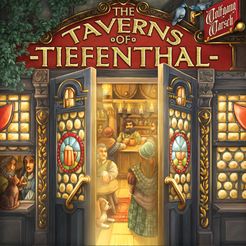
Draft dice, serve guests, and improve a tavern across eight evenings, shaping a personal deck of staff, equipment, and nobles for efficient production and final points.
The Taverns of Tiefenthal supports 2–4 players; community best: 2–3 players; playing time: 60 minutes. A WANGO browser trial has not been confirmed.
Background & introduction
You run a tavern in Tiefenthal, beginning with regular customers, a few helpers, and basic furnishings. Guests revealed from your deck occupy tables, while workers and extra tables change what you can do that evening. Revealing stops when every table is full, so each added card reshapes later visits.
White dice circulate on coasters: choose one, pass left, and repeat. Combine the drafted dice with private dice supplied by servers to plan your work. Suitable values earn money from guests, produce beer, or advance along the monastery track. Money buys tavern cards and permanent improvements; beer attracts guests and nobles.
Improvements often bring both stronger production and a noble card. Newly acquired cards go on top of your deck, ready to arrive soon. Nobles share one table, although that table can be served only once. After the eighth evening, every card's victory points count, connecting current income, deck composition, and final scoring.
Core rules & scoring
Use base Module 1 and play eight evenings. Start with 7 regulars, 1 server, 1 table, and 1 brewer in your deck, with money, beer, and monastery markers at 0. Advance the moon and award that evening's track bonus.
During arrivals, reveal cards into their areas until every table is occupied. Guests use tables; drawn tables add seating. The first noble takes a table and later nobles stack there. When your deck empties, shuffle the discard pile and continue.
Each arriving server supplies one private die, including an existing permanent server, with at most three private dice total. Roll four white dice on each coaster. In clockwise order from the start player, choose one, then pass coasters left. Repeat until everyone has four white dice.
Assign dice to action spaces: match specified values, use any value at question marks, place only one die on a green 1x space, and any number on an ellipsis space. Each dishwasher raises one die's effective value by one; effects can combine but cannot turn 6 into 1. A noble stack accepts only one die.
In start-player order, each player resolves all their actions by removing dice. Guests pay their printed money; the cashbox gives 1 coin and the house-brew barrel 1 beer, increasing to 3 coins and 2 beers when upgraded. Mix production, purchases, and upgrades freely, but never reuse a resolved 1x space.
The brewer accepts values 1 and 6. Each die produces 1 beer plus 1 per arriving brewer card; the permanent upgrade raises the base to 2. Each barback gives exactly 1 beer, without multiplying by dice. A value-5 monk die advances one monastery space, or two when upgraded; collect bonuses passed or reached.
Buy tavern cards for their upper-left money cost, with at most one of each type per evening. Put every purchased or awarded card facedown on top of your deck. They do not go to the discard pile. The cards acquired during service do not join the current evening's already completed arrivals.
Pay an area's cost and flip its tile to upgrade permanently. Return corresponding cards that arrived in that area this evening for the printed discount, never reducing the price below zero. An upgrade normally awards one noble on top of your deck; the eighth-evening free track upgrade does not.
Spend beer to recruit a displayed guest, at most one per evening, immediately refilling its space. A central instant bonus is awarded only when recruiting that guest. Separately, pay 9, 14, or 18 beer for 1, 2, or 3 nobles without using the ordinary-guest limit. Put acquired cards on your deck.
At closing, normally save up to 2 coins and 2 beers, or 5 each with the corresponding storage upgrade; lose any excess. Discard all cards played that evening and pass first player clockwise. After evening eight, count upper-right victory points on all cards in your draw and discard piles. Most points wins; ties favor the greatest stored coin-plus-beer total, then shared victory.
Rules & gameplay questions
Do played staff and table cards stay in the tavern permanently?
No. They are discarded at closing and may be drawn again later. Permanent staff or tables come from paid upgrades that flip equipment tiles, not ordinary arriving cards.
Does upgrading a server, dishwasher, or table immediately provide its benefit?
Normally those three upgrades begin next evening. Brewer, cashbox, barrel, storage, and monk upgrades can work immediately. The eighth-evening free track upgrade explicitly works that evening, but awards no noble.
Can I put separate dice on several nobles sharing a table?
No. The stack occupies one table and only its top card can receive one die to be served. The noble cards still each count their victory points at game end.
Can I return staff from my deck to discount a permanent upgrade?
No. Only corresponding tavern cards revealed during this evening's arrival phase and placed in the upgraded area qualify. Each returned card reduces the cost by that area's small coin value, down to zero.
How do counter guests work?
Receive one in evenings one, four, and six. Spend each once, then return it to the box: after filling your tables, discard all this arrival's cards and restart arrivals, or advance one monastery space during service. You may use several in one phase.
Rules & introduction sources
- Edition
- The 2019 original-box base game, Module 1, for 2-4 players. Checked against Schmidt Spiele's official 88255_Taverns_Rules_UK.pdf, all PDF/printed pages 1-12 including Frequently Forgotten Rules; page 1 of the module supplement was read to verify cumulative module boundaries. Download metadata dates creation to 2019 and modification to 2021; this does not establish a core-rule revision. Excludes original-box Modules 2-5, Open Doors! expansion, and online-platform-specific changes.
- Rule references
- Introduction source
- BoardGameGeek
WANGO editorial
| Parameter | Recorded value |
|---|---|
| BGG overall rank (snapshot) | #251 |
| Complexity Weight | 2.69 / 5 |
| Best player count (community) | 2–3 |
| Player range | 2–4 |
| Playing time (minutes) | 60 |
| Core mechanisms | Deck, Bag, and Pool Building · Dice Rolling · Open Drafting · Turn Order: Progressive · Worker Placement · Worker Placement with Dice Workers |
| Chinese publication | Unconfirmed |
| WANGO browser play | No confirmed WANGO trial |
| Year published | 2019 |
| Suggested age | 12+ |
BGG statistics are stored snapshots, not live rankings. Source checked:2026-09-27
Player questions
What is the best player count for The Taverns of Tiefenthal, and can I play online?
The Taverns of Tiefenthal supports 2–4 players; community best: 2–3 players; playing time: 60 minutes. A WANGO browser trial has not been confirmed.
How complex is The Taverns of Tiefenthal, and which mechanisms does it use?
Weight: 2.69 / 5. Mechanisms: Deck, Bag, and Pool Building · Dice Rolling · Open Drafting · Turn Order: Progressive · Worker Placement · Worker Placement with Dice Workers. Chinese publication: Unconfirmed.
Where can I learn The Taverns of Tiefenthal?
No rule guide, strategy article or WANGO trial has been confirmed for this record.