Paladins of the West Kingdom
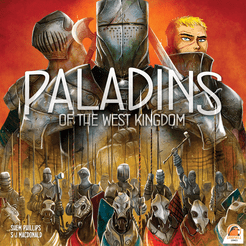
Choose paladins and allocate workers over seven rounds to develop a town, fortify its defences, commission monks and confront outsiders for victory points.
Paladins of the West Kingdom supports 1–4 players; community best: 2 players; playing time: 90–120 minutes. A WANGO browser trial has not been confirmed.
Background & introduction
Set in West Francia around AD 900, the game asks players to balance town development and defence against threats at the borders. Each round’s chosen paladin supplies two workers, temporary attribute boosts and a special ability, giving the same actions a different emphasis.
Faith, Strength and Influence determine access to actions and contribute to final scoring. Commissioning monks requires Faith but can increase Influence; fortification requires Influence and increases Strength. Actions can therefore build an expanding cycle of capabilities.
Most work happens on personal boards, while public King’s Favours offer contested action spaces. Purple criminals can substitute for any worker colour, but acquiring them adds Suspicion. Emptying the Tax supply triggers an Inquisition that can give Debts to the most suspicious players, linking short-term labour to end-game penalties.
Core rules & scoring
Play seven rounds. Draw three paladins, choose one for this round, return one to the top of your deck and one to the bottom. In turn order, reveal your paladin for its two workers and choose an available Tavern card for four more. Paladin attribute boosts and abilities last only this round.
Take one action per turn clockwise, placing the required workers and paying costs. Transparent spaces accept any colour, coloured spaces require matching workers, and purple criminals are wild. Passing clears your personal board and lets you keep at most three unused workers for next round; you cannot act again this round.
Develop costs two workers of any type and 4 Silver: move your leftmost Workshop onto a worker space of a right-side action, reducing its future worker requirement. Each action allows at most two Workshops. Pray costs one black Cleric and 2 Silver to clear one action area on your own board for reuse.
Hunt provides Provisions and Trade provides Silver. One worker gives one resource; two workers, with the second matching the required colour, give three. You cannot add the second worker on a later turn. With Recruit, one worker discards a Townsfolk card for an immediate reward; two workers including a red Fighter recruit it for an ongoing ability. Pay the displayed cost; the two leftmost cards permit taking a Debt instead of paying Silver.
Commission, Fortify, Garrison, Absolve and Convert can each be completed at most seven times, following the printed left-to-right progression. Attack has no such limit; Silver can cover a Strength shortfall at 1 Silver per two Strength. Convert requires the necessary Faith and grants the outsider’s end-game scoring ability.
Each criminal gained gives one Suspicion, resolved individually with its printed Tax reward. Taking the last Tax coin immediately triggers an Inquisition: resolve Townsfolk abilities first, then players tied for most Suspicion each gain a Debt and discard half their Suspicion rounded down, newest first. With no Suspicion, no Debts are issued; refill Tax afterward. Unpaid Debts score −3 each, paid Debts +1 each; destroyed Debts are removed.
After everyone passes in round seven, score King’s Orders, attribute tracks, development and major-action progress, Walls, Converts and Debts. Each combined set of three remaining Silver/Provisions scores 1 point. Highest total wins; ties favour more King’s Order points, then less Suspicion, then shared victory.
Solo uses the AI board and Scheme cards, with the human acting first each round. The AI starts with the round number plus three workers, ignores worker colours and Silver/Provision costs, but still obeys attribute requirements. Income advances its Resource Track, increasing its lowest attribute on each wraparound. It takes no paladin or Tavern workers and carries no workers between rounds. Follow the solo chapter for targeting, fallback actions and priorities.
Rules & gameplay questions
Can Pray clear a King’s Favour so I can use it again?
No. Pray clears one action area on your own board. Each public King’s Favour can be used only once per round and cannot be reopened with Pray.
Do paladin attribute bonuses remain for final scoring?
No. These boosts apply only during their round. Permanent rewards move your attribute markers; temporary paladin values do not.
Can an Inquisition affect me after I have passed?
Yes. Passing prevents further actions, but you can still gain Debts or lose Suspicion, and some recruited Townsfolk abilities can still trigger.
Can I swap the costs and rewards of Attack and Convert?
No. Attack uses Strength, allows Silver to reach a higher requirement, grants top-right immediate rewards and keeps the card facedown. Convert must meet the Faith requirement and pay the next Silver cost on your board; it grants the lower Strength reward and end-game scoring, keeping the card faceup.
Is solo just the normal game with fewer players?
No. The base box contains a complete AI system with difficulty settings, a dedicated board, Scheme cards, a Resource Track and different refresh discards. Each AI Convert scores at least 1 point. City of Crowns adds diplomacy, allies and revised solo rules; these expansion rules are outside this entry.
Rules & introduction sources
- Edition
- 2019 Garphill base game for 1–4 players. The official 36-page English rulebook covers multiplayer setup and play on pages 5–25, solo on pages 26–34 and Townsfolk/Outsider explanations on page 35, with a rewards quick reference on page 36. The solo overview does not replace the full AI priorities. Excludes City of Crowns diplomacy and allies, The West Kingdom Tomesaga and promotional cards.
- Rule references
- Introduction source
- BoardGameGeek
WANGO editorial
| Parameter | Recorded value |
|---|---|
| BGG overall rank (snapshot) | #82 |
| Complexity Weight | 3.70 / 5 |
| Best player count (community) | 2 |
| Player range | 1–4 |
| Playing time (minutes) | 90–120 |
| Core mechanisms | End Game Bonuses · Market · Open Drafting · Solo / Solitaire Game · Worker Placement · Worker Placement, Different Worker Types |
| Chinese publication | Unconfirmed |
| WANGO browser play | No confirmed WANGO trial |
| Year published | 2019 |
| Suggested age | 12+ |
BGG statistics are stored snapshots, not live rankings. Source checked:2026-09-27
Player questions
What is the best player count for Paladins of the West Kingdom, and can I play online?
Paladins of the West Kingdom supports 1–4 players; community best: 2 players; playing time: 90–120 minutes. A WANGO browser trial has not been confirmed. Recorded mechanism tags: Solo / Solitaire Game.
How complex is Paladins of the West Kingdom, and which mechanisms does it use?
Weight: 3.70 / 5. Mechanisms: End Game Bonuses · Market · Open Drafting · Solo / Solitaire Game · Worker Placement · Worker Placement, Different Worker Types. Chinese publication: Unconfirmed.
Where can I learn Paladins of the West Kingdom?
No rule guide, strategy article or WANGO trial has been confirmed for this record.